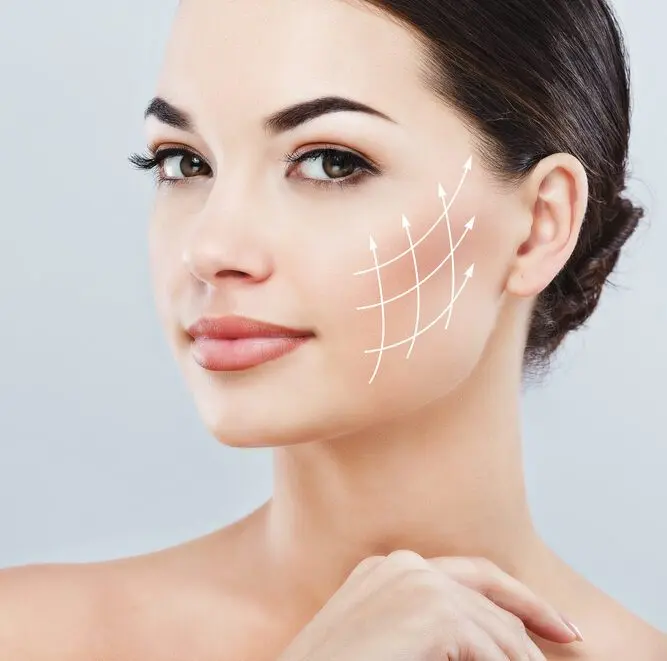
It Usually Shows Up on a Video Call First
You noticed it recently — on a video call, or catching your reflection at a restaurant. The jawline looks softer than it did a couple of years ago. The skin around your mouth sits differently. The face has not aged so much as it has begun to descend, quietly, in a way sleep does not fix and skincare does not reach.
A PDO thread lift is a minimally invasive procedure used to address mild-to-moderate skin laxity in the face and neck — without surgery and without weeks of recovery. This page covers what a thread lift in Scottsdale involves at Desert Bloom: candidacy, procedure, recovery, cost, and what threads will not do. For the science of the suture material itself, our polydioxanone overview covers that separately. PDO thread lifting is one of several thread-based treatments at Desert Bloom, alongside neck thread lift, thread brow lift, and PDO nose threading. The broader PDO threads category indexes the rest.
At a Glance
- What it is
- Dissolvable polydioxanone sutures placed beneath the skin to lift descending tissue and stimulate collagen
- Procedure time
- 30–60 minutes under local anesthetic; same-day discharge
- Downtime
- Most patients back to desk work in 24–48 hours; plan 7–14 days before a visible event
- Results timeline
- Immediate mechanical lift; collagen-driven refinement over 1–3 months
- Duration
- Threads dissolve in 4–6 months; visible effect typically lasts 12–18 months
- Starting price
- Varies by treatment zone; see the full price list below
- Reviewer
- Dr. Natalya Borakowski, NMD — 17 years in Scottsdale aesthetic medicine, IMCAS Paris 2025 presenter on thread technique
What Is a PDO Thread Lift?
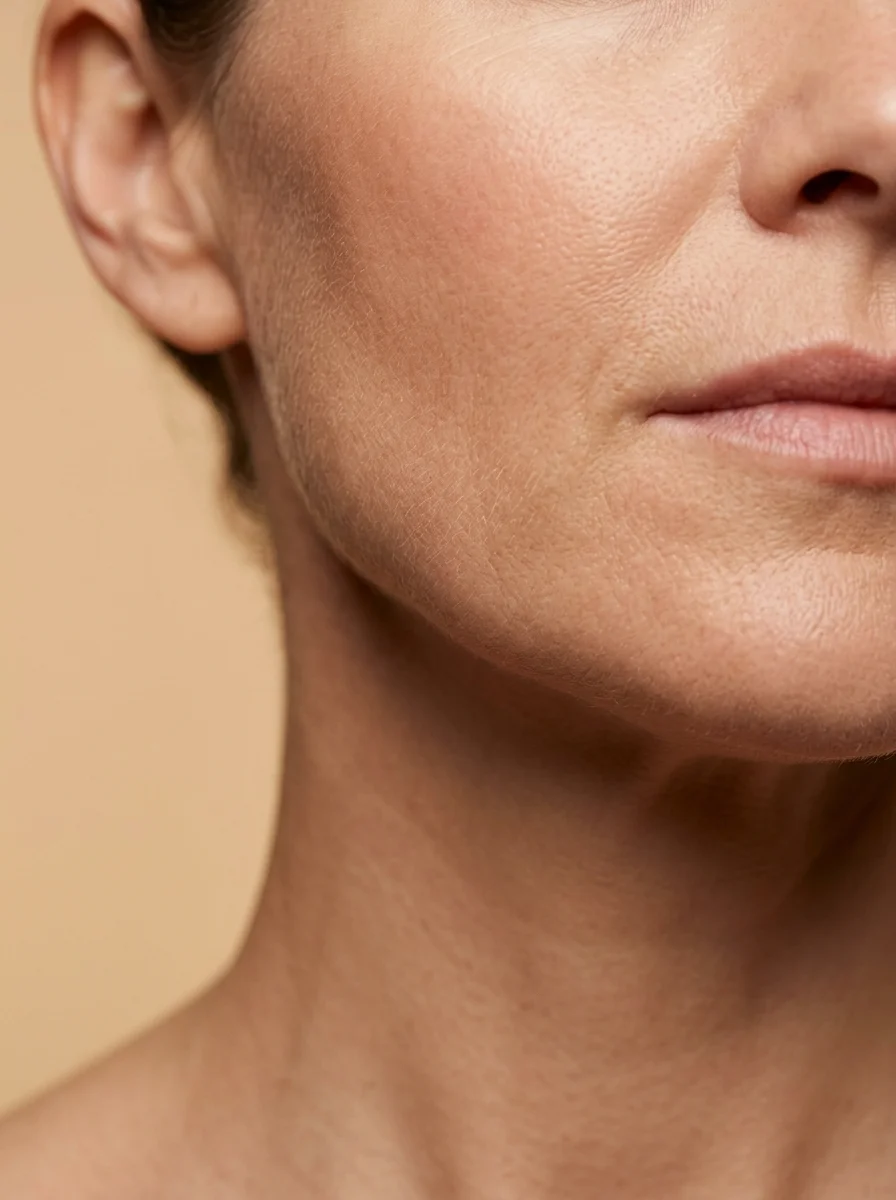
A PDO thread lift is a non-surgical procedure that uses dissolvable sutures to lift and support tissue that has started to descend. It helps when the face begins to soften — the contour is less crisp, early jowls form, the skin no longer holds itself the way it used to — but you are not ready for surgery and may not need it yet.
The threads are placed beneath the skin under local anesthetic using a fine needle or cannula. Once in position, they create an immediate mechanical lift and trigger a slower collagen response as the body heals around them. The lift is what patients notice on day one; the collagen is what helps the skin feel firmer as the months pass.
Threads do not work by mechanical pull alone. They dissolve over about six months through hydrolysis, but while present they stimulate a healing response that encourages new collagen formation around them. That collagen does not vanish when the thread dissolves, though density declines over 12–18 months as part of normal remodeling. Results often continue to improve through the first few months. The degree of collagen response varies from person to person, and published data remains stronger in observational studies than in large controlled trials.
Types of PDO Threads — Smooth, Screw, and Barbed
Mono / Smooth
Texture & Collagen
Fine smooth threads inserted in a mesh pattern to stimulate collagen and refine skin texture. Used primarily in the neck and finer skin zones where mechanical lift is not the goal.
Screw / Tornado
Volume Support
Twisted or coiled threads that add subtle volumization to areas with mild deflation — nasolabial folds, marionette zones — without the bulk of filler.
Cog / Barbed
Mechanical Lift
Barbed threads anchor in tissue to reposition descending soft tissue along the jawline, midface, and brow. These are the workhorse of mechanical lifting and the technique-sensitive type.
PDO Thread Lift vs. Surgical Facelift
Threads are not a facelift, and a facelift is not a thread lift. They address different stages of aging — choosing between them is about candidacy, not preference.
| Property | PDO Thread Lift | Surgical Facelift |
|---|---|---|
| What it does | Repositions soft tissue with dissolvable sutures | Removes excess skin and repositions deep tissue (SMAS) |
| Best for | Mild to moderate laxity, early descent, intact skin elasticity | Significant laxity, heavy jowling, deeper neck change |
| Anesthesia | Local + topical numbing | General anesthesia or deep sedation |
| Downtime | 24–48 hours to desk work; 7–14 days for visible event | 2–4 weeks; restricted activity for longer |
| Duration | 12–18 months | 10+ years |
| Reversibility | Dissolves naturally over 4–6 months | Permanent surgical change |
| Starting investment | From $1,180 (single zone); $2,500 multi-zone | Typically $20,000+ in Phoenix metro |
PDO Thread Lift
- What it does
- Repositions soft tissue with dissolvable sutures
- Best for
- Mild to moderate laxity, early descent, intact skin elasticity
- Anesthesia
- Local + topical numbing
- Downtime
- 24–48 hours to desk work; 7–14 days for visible event
- Duration
- 12–18 months
- Reversibility
- Dissolves naturally over 4–6 months
- Starting investment
- From $1,180 (single zone); $2,500 multi-zone
Surgical Facelift
- What it does
- Removes excess skin and repositions deep tissue (SMAS)
- Best for
- Significant laxity, heavy jowling, deeper neck change
- Anesthesia
- General anesthesia or deep sedation
- Downtime
- 2–4 weeks; restricted activity for longer
- Duration
- 10+ years
- Reversibility
- Permanent surgical change
- Starting investment
- Typically $20,000+ in Phoenix metro
The PDO Thread Lift Procedure at Desert Bloom
Every treatment at Desert Bloom starts with assessment. Not everyone who asks for threads should get them — the consultation determines candidacy before any quote is given.
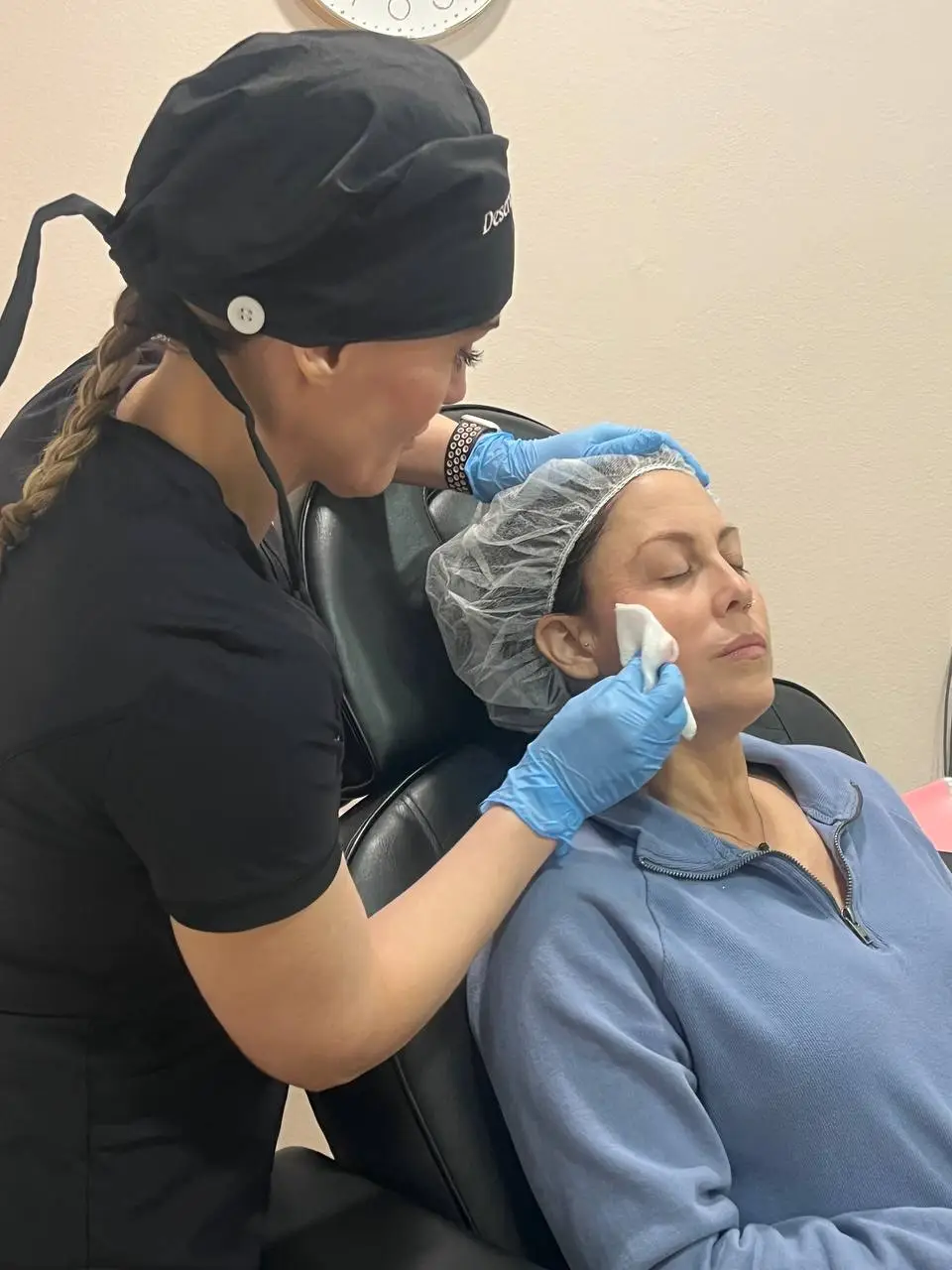
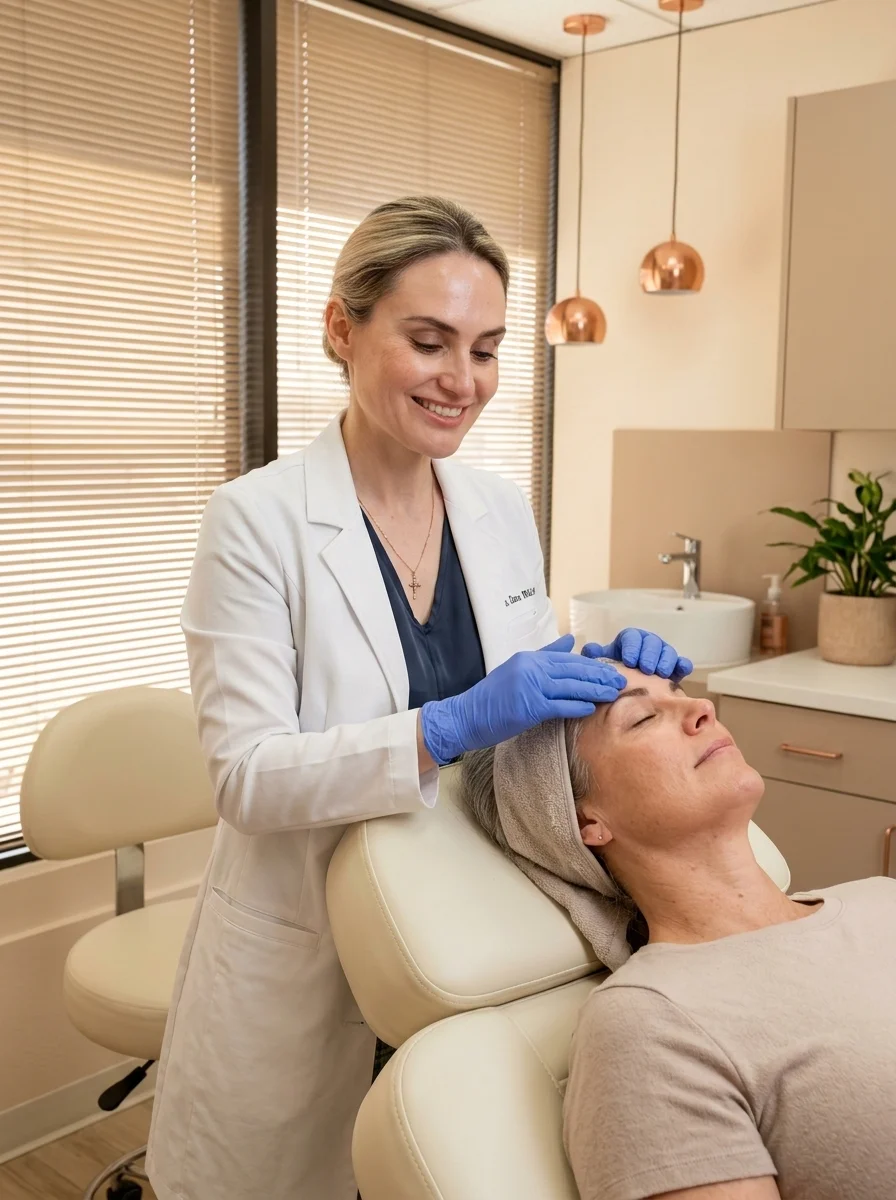
Most procedures take 30 to 60 minutes, and you go home the same day. No general anesthesia, no overnight stay. The clinical sequence is straightforward: assessment and marking, topical numbing plus local anesthetic at entry points, thread insertion through a cannula or fine needle, controlled tension and trimming, and immediate symmetry review before you leave.
How the Session Runs
- 1
Assessment and marking
Dr. Borakowski reviews your skin elasticity, descent pattern, and goals. Vectors and entry points are marked on your face — the plan exists before the first thread is opened.
- 2
Topical numbing plus local anesthetic
Extra-strength topical numbing cream is applied 45 minutes before the procedure. Local anesthetic at each entry point completes comfort. Most patients describe pressure or tugging rather than pain.
- 3
Sterile field and disposable cannulas
Single-use disposable cannulas are used for every session in a sterile field — non-negotiable, every patient.
- 4
Thread insertion at correct depth
Threads are placed through a fine cannula or needle into the deep subcutaneous / supra-SMAS plane. Controlled tension repositions tissue along the planned vectors; trimming hides the thread tails below the skin surface.
- 5
Symmetry review and discharge
Side-by-side review before you leave the room. Aftercare and follow-up are scheduled. Every patient receives a mandatory 14-day follow-up appointment, and you can reach Dr. Borakowski directly at any time during or after that window.
Placement Depth: Why It Matters
Most thread-related complications trace back to one technical question — at what depth was the thread placed? The target plane for many facial lifting threads is the deep subcutaneous / supra-SMAS plane: superficial to the SMAS and deep enough to avoid the dermis. In practical terms, the thread should not sit so superficially that it can be seen or felt from the surface, and not so deep that it misses the tissue plane it is meant to support.
When threads are placed too superficially — closer to the dermis — the patient feels them, sees them, and can develop the dimpling and asymmetry that brings people in for second opinions. When threads are placed too deep, they fail to lift because they pass through the very tissue plane they were meant to reposition. Placement depth is not a marketing detail; it is the entire procedure.
Treatment Areas for PDO Threads
Face
Jowls, Nasolabial Folds, Marionette Lines
Barbed threads along the jawline address early jowl formation. Screw threads around nasolabial folds and marionette lines add collagen stimulation and subtle volumization where appropriate.
Brow
Subtle Eye-Area Opening
A carefully positioned thread brow lift can subtly open the eye area in the right patient. The margin between natural elevation and over-correction is narrow — candidacy is selective.
Neck
Texture and Mild Laxity
A PDO neck thread lift uses smooth threads to improve skin texture and mild laxity. The neck responds well to collagen stimulation before more involved treatments become necessary.
Nose
Asymmetry & Tip Drooping
PDO nose threads can address mild asymmetry or a drooping tip without surgery, though candidacy is more selective than for facial threads.
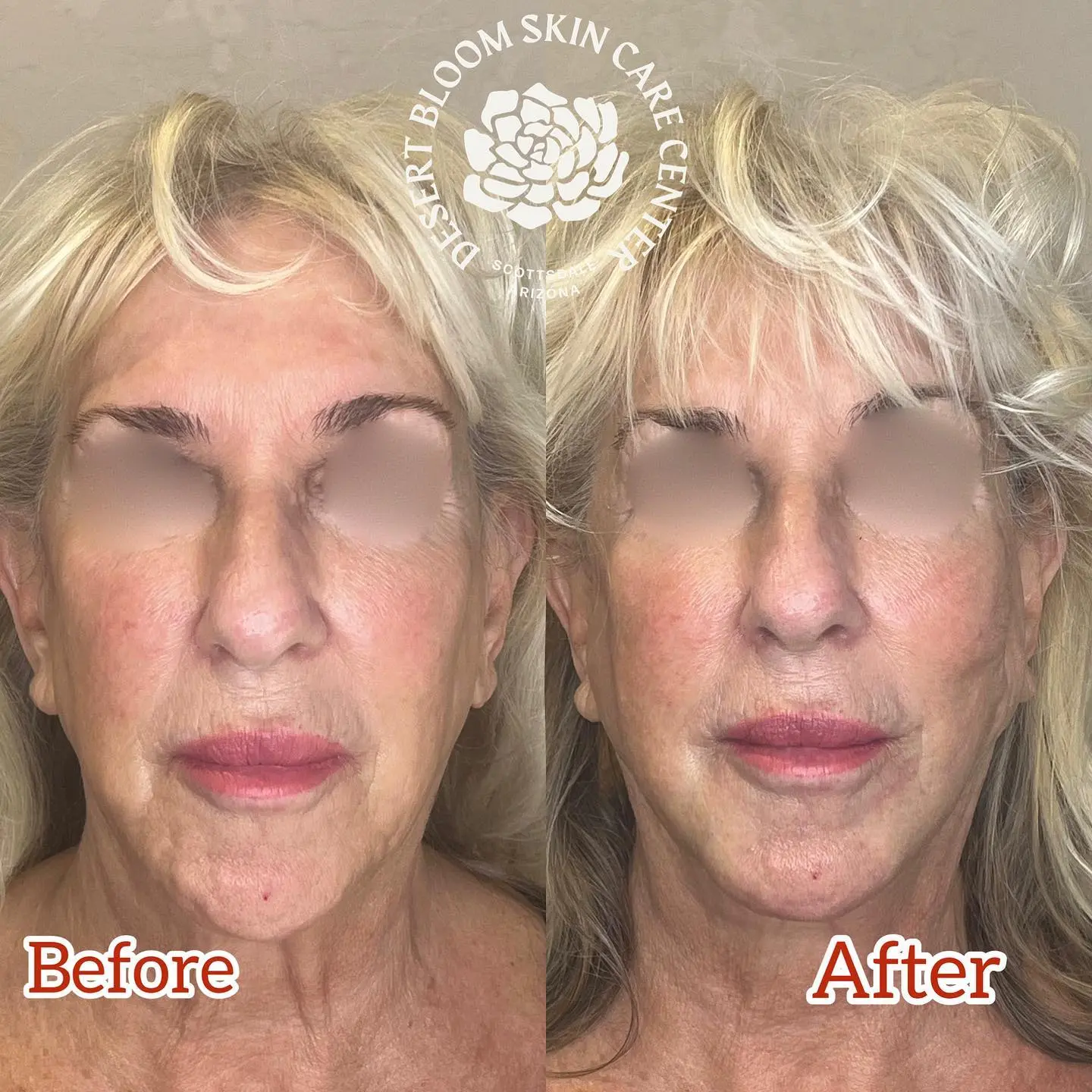
Before & After Gallery
Mid-face, jowl, and lower-face results from PDO and barbed thread lifts at Desert Bloom Scottsdale.
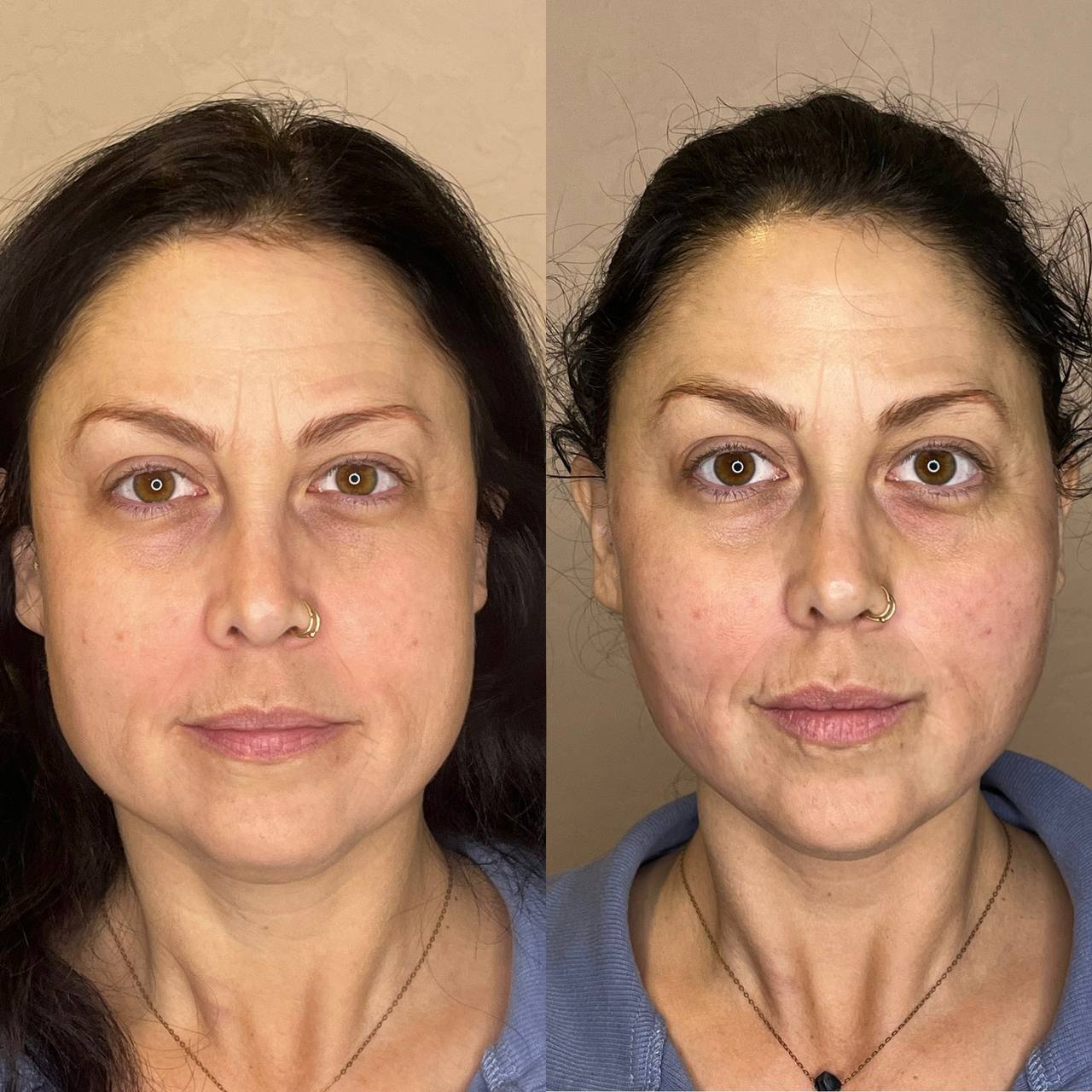 BeforeAfter
 BeforeAfter
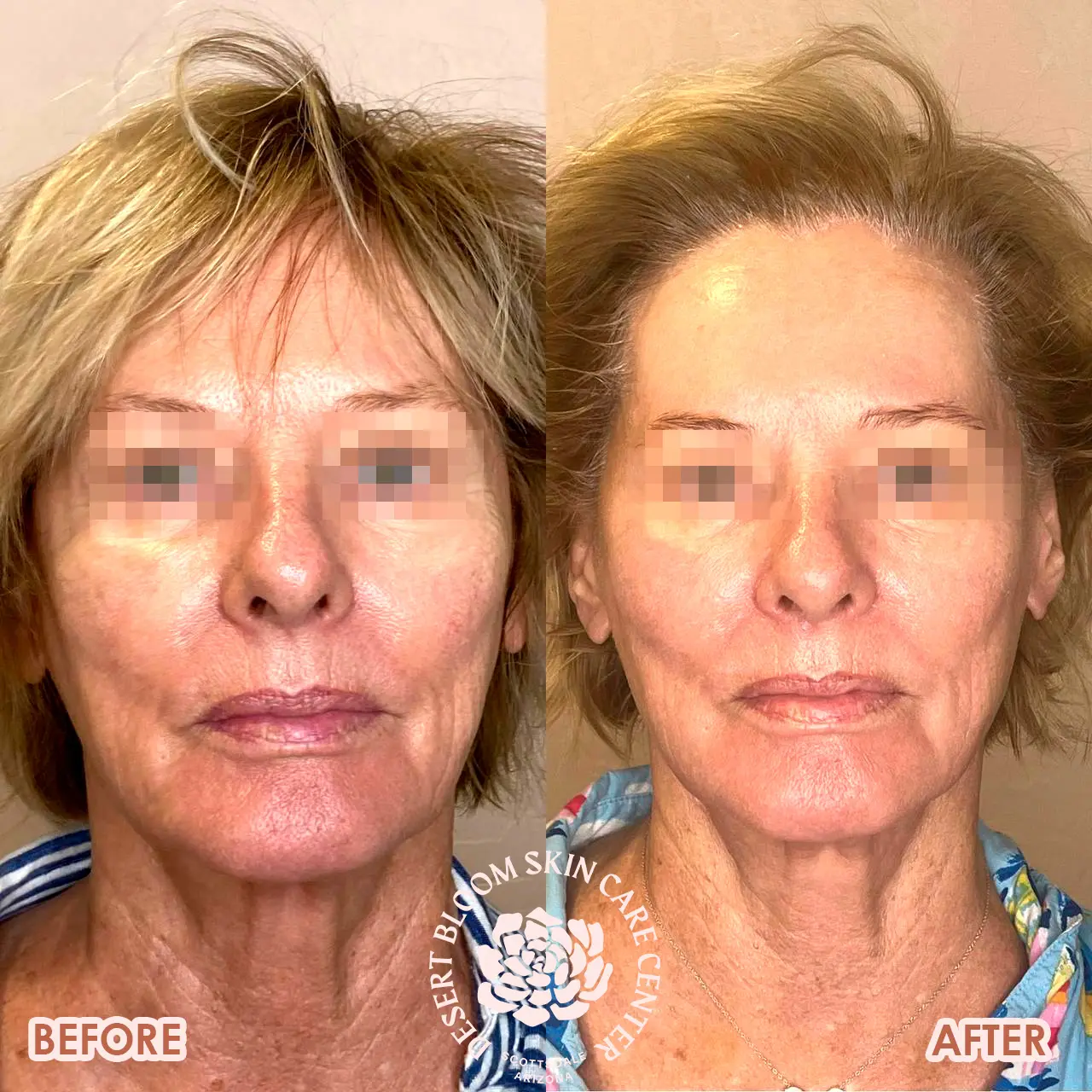 BeforeAfter
 BeforeAfter
Recovery, Downtime, and Aftercare
Days 1–3
Early Swelling and Tenderness
Early swelling, bruising, and tenderness are common. You may feel a pulling sensation. Sleep on your back with head slightly elevated. Avoid excessive facial movement; do not massage the treated area.
Days 4–7
Most Swelling Resolves
Visible swelling subsides. Some patients notice subtle asymmetry or temporary dimpling — typically resolves as threads settle.
Weeks 2–4
Back to Social and Professional Life
Most patients feel comfortable in social and professional settings. Avoid strenuous exercise for at least seven days. No dental work for two weeks. Avoid sleeping face-down for three to four weeks.
Month 1–3
Collagen-Driven Refinement
As the collagen response matures around the threads, the lift refines. Subtle continued improvement is normal through the first three months. Your mandatory 14-day check assesses healing; longer-term review is at your discretion.
How Much Does a PDO Thread Lift Cost in Scottsdale?
At Desert Bloom, PDO thread lifting begins at $1,180 for the foundational face thread lift. Every patient receives a written quote at consultation, based on anatomy and the protocol Dr. Borakowski recommends — not a generic SKU.
The cost depends on more than a price list. The same patient can be quoted very different numbers at different clinics depending on how the plan is built. Six variables determine the cost of any PDO threading session: severity of descent (mild jowl softening needs fewer threads than moderate descent); number of zones treated (jawline-only vs. full lower-face plus neck plus brow); number of threads per zone (anatomy varies — two people with the same concern can require different counts); thread material (PDO is the most common; PLLA and PCL cost more per unit because the collagen response is more sustained); anesthesia approach (local at entry points is standard and included); and follow-up included (complimentary post-procedure check is standard).
Pricing
- Crows Feet$550
- Dark Circles And Eye Bags$600 – $900
- Chest Wrinkles$450 – $800
- Forehead Severe To Moderate Wrinkles$450
- Glabellar (Between Brows) Lines$160
- Hand Rejuvenation$500
- Lip Enhancement$160 – $400
- Malar Crease Correction$590 – $1180
- Marionette Lines$480
- Nasolabial Folds$455 – $800
- Smoker Lines$195
- Sunken Temples$700
- Neck mesh for crepey skin$500 – $750
What the Price Includes
- The consultation itself (complimentary; no obligation to book)
- The procedure and all materials
- Local anesthetic at entry points
- A mandatory 14-day post-procedure check to assess healing and symmetry
- Direct access to Dr. Borakowski for questions at any point after treatment
- No facility fees or hidden add-ons
What the Price Does Not Include
- An optional touch-up session at the 12-month mark
- Combination treatments such as dermal fillers or RF microneedling, priced separately
- Travel, lodging, or time off work for out-of-town patients
Honest Cost Framing
A PDO thread lift in Scottsdale is meaningful money but not facelift money. A surgical facelift in the Phoenix metro area is typically a five-figure investment — frequently $20,000 or more depending on technique, anesthesia, facility, surgeon credentialing, and whether neck work is included. Recovery runs several weeks; results last roughly ten years. Annual dermal filler maintenance runs $1,500–$3,000 in our market depending on syringes and product — filler restores volume but does not lift. Doing nothing has no cost, no risk, and no result; for some patients early in the timeline, this is a clinically reasonable answer.
If your concern is soft-tissue descent at the early-to-moderate stage and you want subtle results with minimal downtime, the thread lift price is in line with the value. If your concern is significant laxity, threads will feel expensive for the outcome they produce.
Financing. Affirm, Cherry, and Care Credit are accepted at Desert Bloom. Ask about no-interest term options at your consultation. Most patients use financing for combination plans or larger multi-zone treatments rather than single-zone work.
Combination Treatments
Sequencing
Threads, Then Fillers — Never the Same Day
If both are planned, threads go first; filler follows at a separate appointment. Putting filler on top of a fresh thread risks displacement and complicates reversal if it is ever needed.
Surface tightening
Threads + RF Microneedling
Threads reposition; RF microneedling tightens the surface and refines texture. Typically several weeks between sessions to let each settle.
Dynamic wrinkles
Threads + Neurotoxin
Botox or Dysport addresses dynamic wrinkles that threads do not touch. These can run alongside thread treatment with appropriate spacing.
Existing filler
Working Around Prior Filler
Existing temporary filler is generally manageable. Dr. Borakowski evaluates current filler type, placement, and history at consultation to plan the safe sequence.
How to Choose a Provider for PDO Thread Lift
The single biggest factor in the outcome of any thread lift is the person holding the needle. Devices and threads are commodities; judgment and technique are not.
What anatomical plane do you place the threads in? The expected answer should reference the deep subcutaneous / supra-SMAS plane — superficial to the SMAS and deep enough to avoid the dermis. A provider who answers in marketing language is a signal to look further.
How do you select thread type for my anatomy? The right answer is patient-specific. A provider who applies the same protocol to every patient is dispensing, not selecting.
What is your candidacy assessment process? Look for an actual clinical assessment — skin elasticity, descent pattern, tissue quality, expectations — before any quote.
What happens if I am not a good candidate? The right answer is “We tell you, and we discuss alternatives.”
What is your protocol for complications? A provider without a clear complication-management answer has not encountered enough cases to develop one.
Why Training Matters Here
PDO thread lifting is a technique-dependent procedure. The same threads in different hands produce different results. Dr. Borakowski trained with Dr. Murat Tsintsadze, an internationally recognized expert in advanced thread-lifting technique, through an intensive hands-on program in Tbilisi, and completed cadaver-based facial anatomy training. She presented PDO thread techniques at the IMCAS World Congress in Paris in January 2025.
The training matters because the supra-SMAS plane is roughly a centimeter wide; the difference between a clean result and a visible thread is a millimeter of depth and a correct vector of pull. For full provider background, see Dr. Natalya Borakowski, NMD.
“Threads are a stage-of-aging tool. They suit the patient who has begun to descend but has not yet lost the elasticity that makes a non-surgical answer reasonable. When I tell someone they are not a candidate, that is not a missed sale — it is the part of the consultation that matters most.”
Frequently Asked Questions About PDO Thread Lift
Will I have visible scars or marks?
Can the threads be removed if I do not like the result?
What is the difference between PDO and PLLA threads?
Do you do thread lifts on darker skin types?
Is 'lifting with threads' the same as a PDO thread lift?

Medically reviewed by
Founder, Desert Bloom Skincare · 17 Years Experience · IMCAS Paris 2025
References
- 1.
Niu Z, Zhang K, Yao W, et al.. Complications of Thread Lift About Face: A Systematic Review and Meta-Analysis. Aesthetic Plastic Surgery; 2021;45(5):2148-2158.
DOI: 10.1007/s00266-021-02256-w
Pooled complication-rate data referenced in the Recovery section; PMID 33821308.
- 2.
Funt DK, Pavicic T.. Dermal fillers in aesthetics: an overview of adverse events and treatment approaches. Clinical, Cosmetic and Investigational Dermatology; 2013;6:295-316.
DOI: 10.2147/CCID.S50546
Anchor reference for soft-tissue injection adverse-event framework that applies to thread-lift consenting conversations.
- 3.
Sundaram H, Cassuto D.. Biophysical Characteristics of Hyaluronic Acid Soft-Tissue Fillers and Their Relevance to Aesthetic Applications. Plastic and Reconstructive Surgery; 2013;132(4 Suppl 2):5S-21S.
DOI: 10.1097/PRS.0b013e31829d1d40
Foundational on rheology of injectables; informs combination-treatment sequencing with fillers.
- 4.
Beleznay K, Carruthers JDA, Humphrey S, Jones D.. Avoiding and Treating Blindness From Fillers: A Review of the World Literature. Dermatologic Surgery; 2015;41(10):1097-1117.
DOI: 10.1097/DSS.0000000000000486
Vascular-safety review informing facial-injection screening protocols that carry over to thread placement near vascular structures.
PDO sutures are FDA-cleared for use in soft tissue approximation. Their application in aesthetic thread lifting is an off-label clinical use. Individual results may vary. A consultation is required to determine suitability for any procedure. All before-and-after images feature actual patients who have provided written consent. All procedures performed or supervised by licensed medical professionals. Content reviewed by Dr. Natalya Borakowski, NMD, Founder, Desert Bloom Skincare, Scottsdale AZ. Last updated: June 2026.

Case studies
Before & after: real patient results
Every face is different, and so is every result. The most meaningful comparison is at the two-week mark, when the full effect has developed. Photos shown with written patient consent.
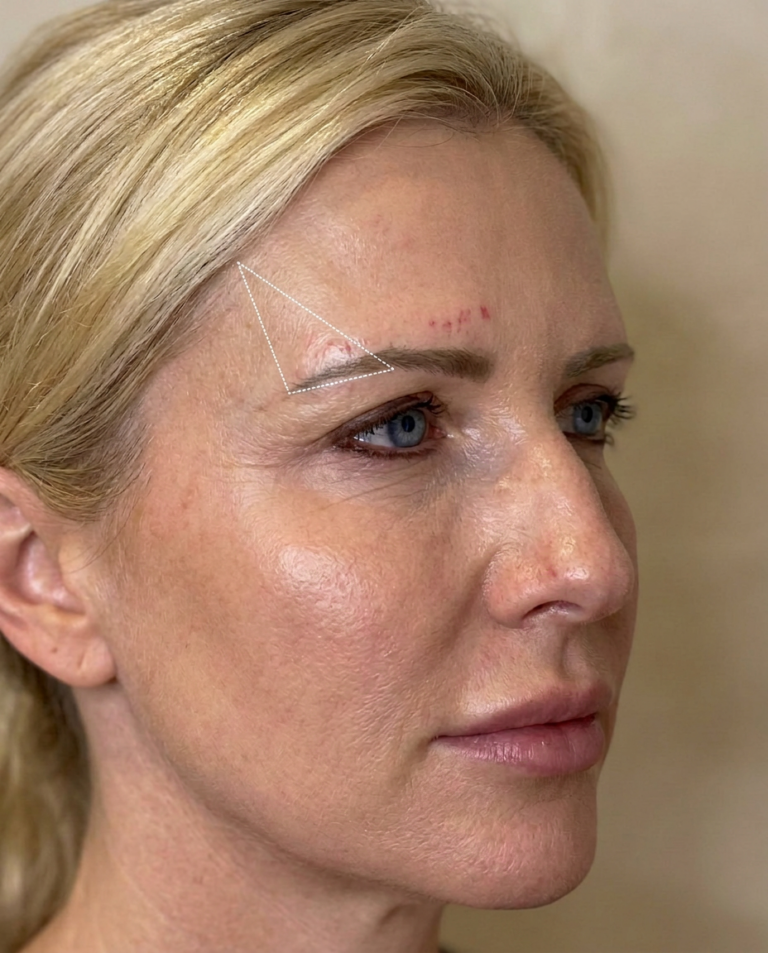
Brow Case Study
A patient in her late 40s presented with lateral brow descent that…
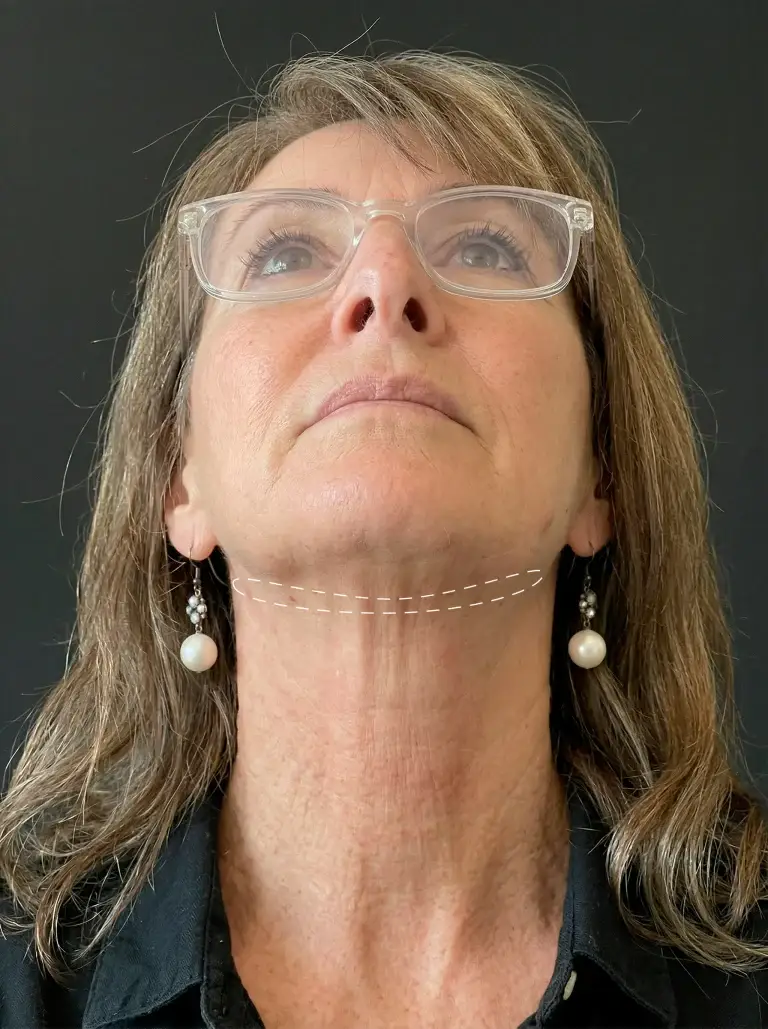
Structural Lower Face Lift: A Case Study in Professional Neck Rejuvenation
Can a non-surgical lower face lift preserve your professional authority? Explore this…
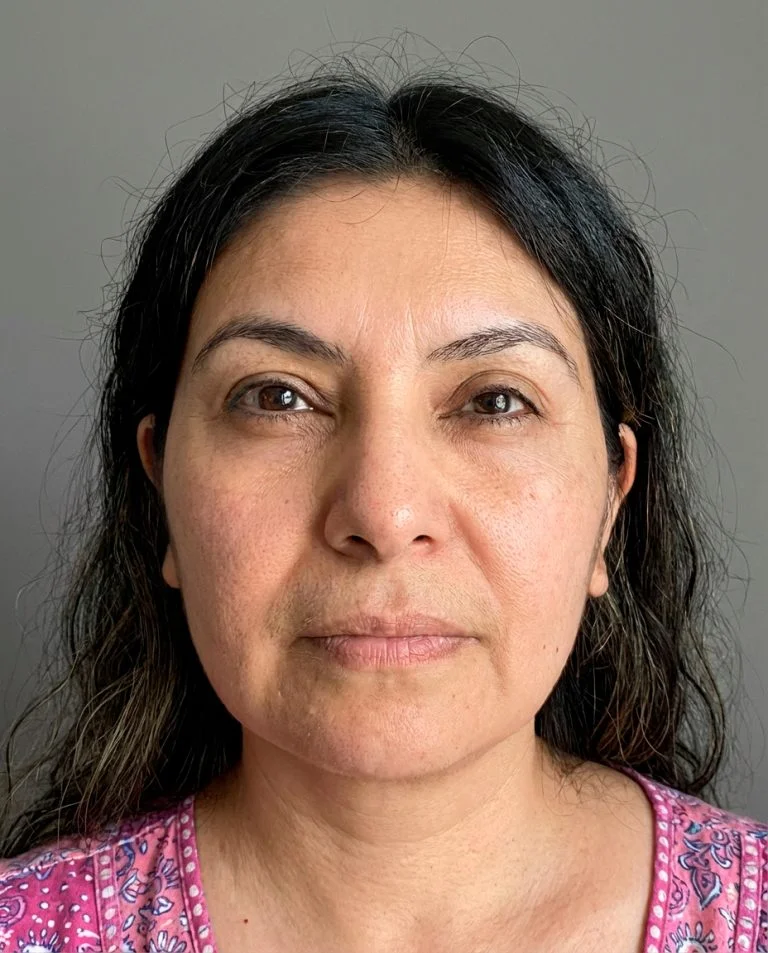
Case Study: Non Surgical Jawline Contouring with Thread Lifting in a 43-Year-Old Woman
This case study explores non-surgical jawline contouring with thread lifting in a…
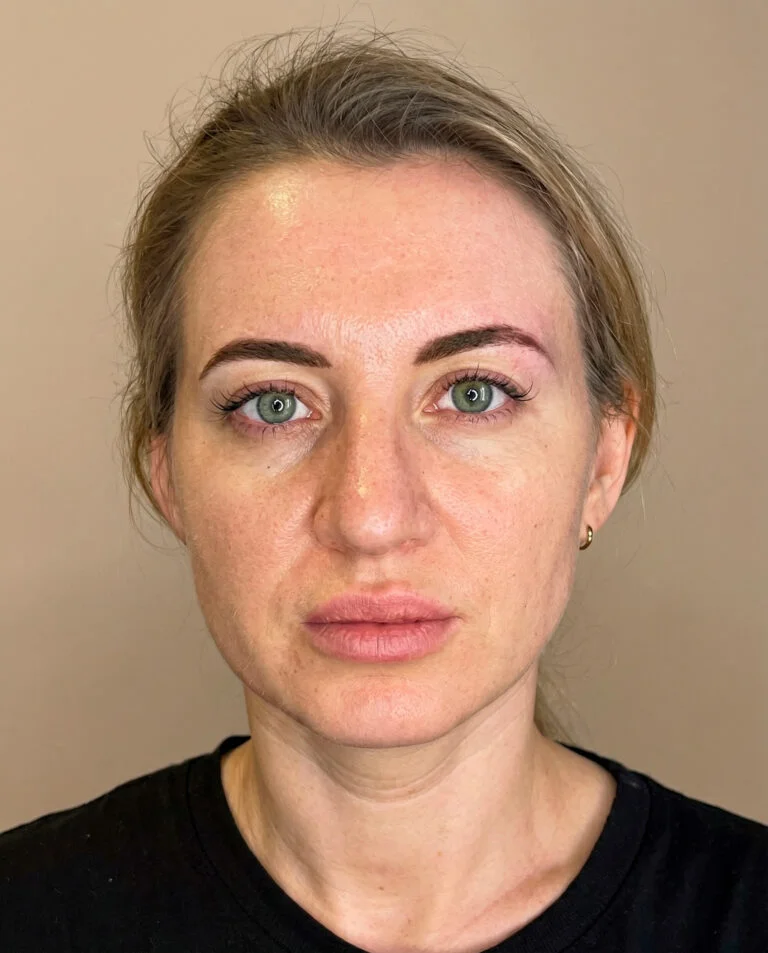
Facial Fatigue
A 37-year-old woman traveled to Scottsdale seeking a non-surgical solution for facial…
Reviews
What our patients say
“Looking for someone who cares, who is incredibly knowledgeable and will also make you look and feel like your best self…. Dr. Natalya is a master at her craft and it shows with her results. I had a non-surgical facelift and astounded by what you can accomplish without going under the knife. Her skill with reshaping the lips has been the most dramatic and yet subtle enhancement and the facial threads are probably the most noticeable and intriguing procedures because you see the results evolve over time. I also appreciated and loved that she informed me of things I didn’t know better on with my skin care routine , so I could have better home care practices. I am incredibly happy with the results, the entire process of the care I received and the knowledge and wisdom she shared to help me achieve this glow up. Picture on the left was right after treatment and picture on right is a couple of months after treatment!”
“Dr. Natalya is amazing, a true professional. I was not familiar at all with the threading procedure when I first called. I was curious about the non-surgical rhinoplasty I read about after deciding full surgery was not what I wanted right now. It seemed to good to be true!! Brian took a good amount of time explaining things to me over the phone when I first called, sent me photos and encouraged me to go to their website and instagram page to learn more. Dr. Natalya then spent another 30+ minutes with me as well during my consultation. I felt so at ease and well informed. A week later, I had the procedure done and the results are incredible! I highly recommend Desert Bloom! (Before and after photos were taken the day of the procedure… I was mid-blink in the one, not sad…haha)”
“OMG!!! If I can give this doctor a million stars I would! Dr. Natalia Borakowski is amazing! She is very kind and friendly also very knowledgeable and professional. I liked how everything was so prepared, organised, sterilise and sanitised with every procedure and that was very important to me. I did PDO threads and PRP Treatment under eye... results were unbelievable! She also does B12 shots which is awesome. Her prices are very reasonable! I would recommend Dr. Borakowski to anyone. I know I found my injector! 😁”
Similar treatments
You may also be considering

Neck Thread Lift
PDO neck thread lift at Desert Bloom Scottsdale — see real before & after photos, cost breakdown, and…
See treatment
Thread Brow Lift
Non-surgical PDO thread brow lift at Desert Bloom Skincare in Scottsdale. Subtle lift, minimal downtime. See if you…
See treatment
Under-Eye PDO
Thinner Skin, Finer Wrinkles, a Subtle Hollow Forming The under-eye area is one of the first places skin…
See treatment
Jawline Filler
Definition Where It Used to Be It usually starts with a photo. Not a dramatic change — just…
See treatmentScottsdale, Arizona
Start with a conversation, not a treatment plan
A consultation with Dr. Borakowski is a screening first. If the treatment you came in asking about isn't the right tool, she'll tell you — and point you toward what is.
Book a consultationContact us
Do you have any questions?
Visit our Scottsdale aesthetic center
Address
10752 N 89th Place,
Ste 122B · Scottsdale, AZ 85260
Phone: (480) 567-8180
E-mail: info@desertbloomskincare.com
Get directionsLocation & directions
Conveniently located in the Shea Corridor of North Scottsdale, within Edwards Professional Park I — minutes from HonorHealth Scottsdale Shea and the Mayo Clinic Scottsdale Campus.
From the North / South: Take Loop 101 and exit at E Shea Blvd, just East of the freeway.
Parking: Ample free parking directly in front of Suite 122B.
Areas we serve
Scottsdale
North Scottsdale · McCormick Ranch · Gainey Ranch
Paradise Valley
Cave Creek & Carefree