Square Jaw
A square jaw is a facial feature where the jawline appears broad, angular, and well-defined. While some people consider a square jaw to be a desirable characteristic, others may find it to be too prominent or masculine for their preferences. An aesthetic medicine clinic offers various cosmetic procedures to soften or reshape the jawline. A specialist can evaluate the face and recommend the best course of action to help achieve the desired look.
See all treatments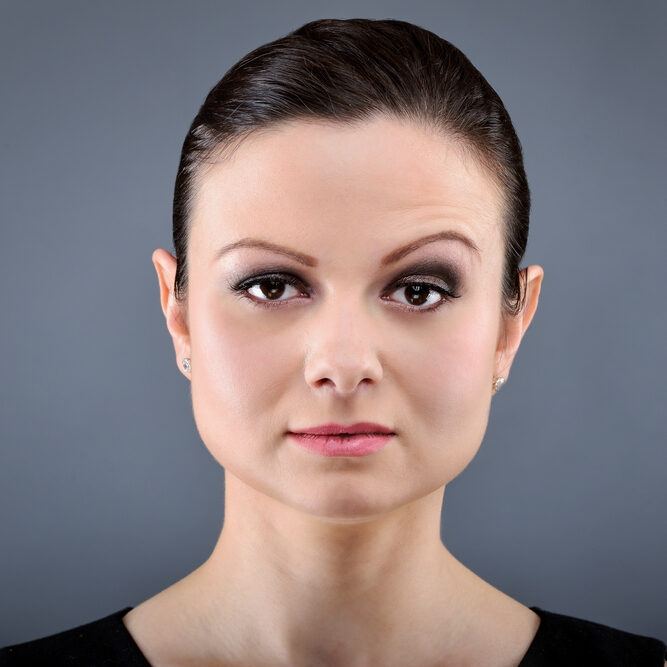
Non-surgical jaw slimming and masseter reduction — physician-led in Scottsdale.
Find Your Treatment
When Your Jawline Feels Too Strong
A wider-than-you-want lower face is one of the most common reasons people come in for a jaw consult. In most cases the width comes from the masseter — the chewing muscle at the angle of the jaw — not from bone. That distinction matters more than anything else in planning what to do about it.
Dr. Natalya Borakowski, NMD works from one principle: her first question at every jaw consultation is structural. Is this muscle, bone, or a combination? The answer changes everything. Muscle-driven squareness is reliably corrected non-surgically. True bony width is a different conversation, and one she will have honestly with you.
Related concerns: Jowling, Weak Chin, Facial Asymmetry.
At a Glance
Scope. Masseter Botox (first-line), Dysport masseter (alternative neuromodulator), Aesthetic Facial Balancing (when chin or cheek context matters). Surgical mandibular reduction is out of scope — we refer to oral/maxillofacial surgery when bone is the sole driver.
Provider & candidacy. All Fitzpatrick types. Best candidates feel jaw tightness in the morning, clench during the day, or have a bruxism diagnosis. Bony-angle-dominant presentations without muscle involvement are honest refer-outs, not cosmetic cases.
Downtime & how to start. Botox-only — zero downtime. Results build over 4–6 weeks; peak narrowing at 6–8 weeks. The consult is the starting point — not a procedure booking.
What Causes a Square Jaw?
A square jawline most commonly results from masseteric hypertrophy — enlargement of the masseter, the primary chewing muscle sitting at the angle of the jaw. Like any muscle, it responds to overuse by getting bigger. Chronic teeth grinding (bruxism), constant clenching, heavy chewing gum habits, and unconsciously tensing the jaw through stress all drive masseter hypertrophy over time, thickening the lower face. This is a muscular issue, not a skeletal one — which is what makes it highly treatable without surgery.
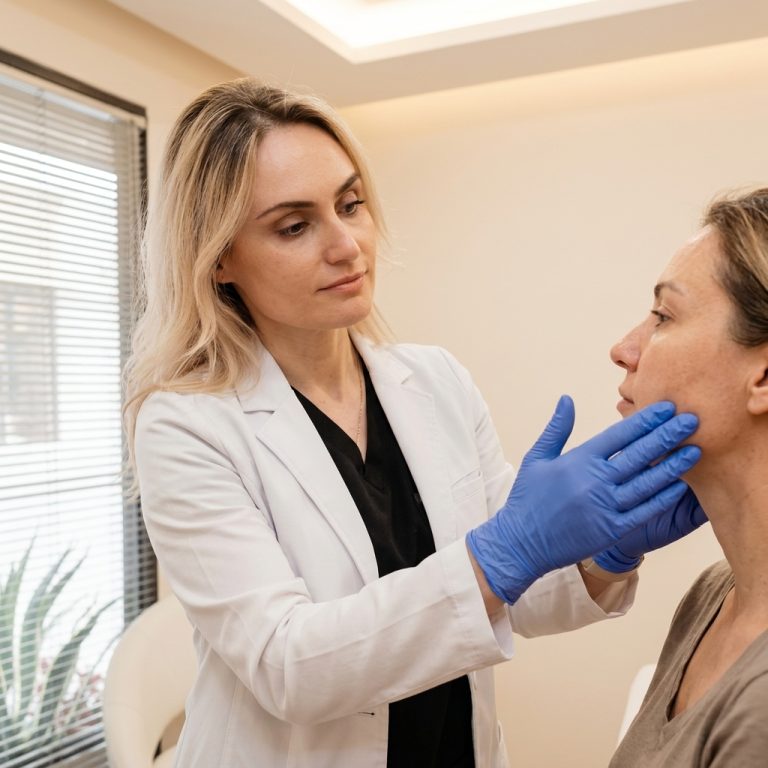
Bone also contributes for some people. A naturally wider mandible creates a square shape regardless of muscle size. In practice, most people presenting with a square jaw show a combination of both factors, and treatment planning accounts for each one separately. On palpation, a hypertrophic masseter balls up visibly when you clench — that simple test usually tells us which component is leading.
Presentation differs by sex. In women, a square jaw is almost always muscle-driven and often accompanied by jaw tension, morning soreness, or a diagnosed teeth grinding habit. In men, bony width is more common as a naturally masculine feature — and not something we alter unless someone is specifically pursuing facial feminization or feels their facial structure feels too strong. One anatomical note: a heavy lower face isn’t always the chewing muscle. Enlarged salivary glands and submental fat can mimic the look, so Dr. Borakowski rules those out before recommending any jaw-slimming treatment.

Most square jaws have more than one driver — but the dominant one determines first-line treatment. Here is how Dr. Borakowski reads the jaw during consultation.
Masseter Hypertrophy (Muscle Bulk)
Most common driver in women. The masseter enlarges from clenching, bruxism, heavy chewing gum use, or chronic jaw tension. Balls up visibly when you clench — palpation on clench is the key diagnostic test. This is a muscular issue, not skeletal, which is what makes it correctable without surgery.
Treatment direction: Botox or Dysport masseter injection — standard of care, first lineBony Mandibular Angle (Skeletal)
A naturally wider mandible creates jaw squareness regardless of muscle size. In men, this is often a structural norm, not a problem. True bony width without significant masseter involvement has limited response to neuromodulators — honest candidacy assessment is required, with surgical referral if bone is the sole driver.
Treatment direction: Surgical consultation (oral/maxillofacial). Non-surgical: realistic-expectations framing onlyClenching & Bruxism (Functional)
Chronic grinding enlarges the masseter over time and continues to do so between treatments. Many patients have a dentist diagnosis. Masseter Botox serves double duty: cosmetic (slimming) and functional (jaw tension, morning soreness, grinding-related headache relief). Dental follow-up for occlusal management is separate.
Treatment direction: Botox masseter — cosmetic + functional co-benefit; dental co-management as neededDesired Structure — Not Everyone Wants to Change
Not every square jaw is a problem. Some people want to understand their anatomy without altering it — or want functional bruxism relief without cosmetic change. Others actively like their jaw’s strength and are here for a different reason entirely. We frame every jaw consultation around your goals, not assumptions about what you should want.
Treatment direction: Education-first; cosmetic treatment only when the patient desires itHow We Treat a Square Jaw at Desert Bloom
Three modalities cover the vast majority of cases. Which leads depends on whether the driver is muscle, a combination, or requires broader facial balancing context. Sequencing matters — we shrink first, then add shape if it is still needed once the muscle has settled.
Patients who clench and also want more jaw definition may be suited for masseter Botox followed — after 6 weeks, once the muscle has settled — by Jawline Filler: one removes bulk, the other adds shape. Those with early jowling alongside jaw width may add a PDO Thread Lift as an escalation layer for tissue laxity.
Muscle Softening vs. Bony Angle — Understanding the Difference
These two pathways look similar from the outside but behave completely differently under treatment. Knowing which you are dealing with determines whether non-surgical care is the right conversation.
Muscle-Driven — Correctable Non-Surgically
Masseter enlargement from overuse — the most common presentation.
Bony Angle — A Different Conversation
Structural mandibular width — honest scope boundaries apply.
Compare All Treatment Options
| Feature | Botox Masseter | Dysport Masseter | Aesthetic Facial Balancing |
|---|---|---|---|
| Primary use-case | Muscle-driven jaw width, bruxism | Muscle-driven jaw width — Dysport preference | Multi-factor: jaw + chin/cheek/lower-face imbalance |
| Mechanism | Neuromodulator atrophies masseter muscle | Neuromodulator — broader diffusion within muscle | Coordinated neurotoxin + filler session |
| Onset / Longevity | 4–6 weeks onset; 4–6 months | Slightly faster onset; 3–4 months | Varies by modalities; 12–18 months with maintenance |
| Sessions | 1; maintenance every 4–6 months | 1; maintenance cycles | 1 (refined over 2–3 visits year 1) |
| Best candidate | Palpable muscle bulk on clench, jaw tension, bruxism | Prior Dysport preference or new patient choosing Dysport | Cannot isolate masseter alone; lower-face proportion imbalance |
When Non-Surgical Treatment Has Limits
Surgical referral triggers: If squareness is present at rest but does not change when you clench — or if Dr. Borakowski confirms on palpation that bony mandibular angle is the primary driver — non-surgical treatment will not meaningfully narrow the jaw. Mandibular reduction surgery is handled by an oral and maxillofacial surgeon, not at Desert Bloom.
Bruxism and dental implications: Active bruxism beyond cosmetic concern — significant tooth wear, TMJ symptoms, or sleep disruption — warrants evaluation by your dentist or a TMJ specialist alongside any cosmetic treatment. Masseter Botox addresses the muscle; it does not treat dental occlusion.
Botox / Dysport contraindications: Pregnancy or breastfeeding, neuromuscular disorders (myasthenia gravis, ALS, Lambert-Eaton syndrome), allergy to botulinum toxin components, or active infection at the injection site. Discuss all medications — especially aminoglycosides — at consultation.
Frequently asked questions
Dr. Borakowski sees jaw-width cases at every stage — from first-time curiosity to patients who have tried masseter Botox elsewhere and want more precise results. The consultation covers a full palpation assessment (muscle vs. bone), bruxism screening, overall lower-face proportion review, and a clear treatment plan before anything is booked.
If the honest answer is that your jaw’s structure is better suited to surgical consultation, she will tell you that directly — and refer you to the right specialist — rather than offer a treatment that won’t deliver what you came in for.

“Most square-jaw consultations end the same way — a few cycles of masseter Botox, a year of follow-up, and we revisit whether definition or lift is still missing. Almost always, narrowing the muscle is enough on its own. The cases where I refer out — true bony angle without significant masseter — I would rather tell you early than let you spend money on something that won’t move the needle.”
Book Your Square Jaw Consultation in Scottsdale
Dr. Borakowski sees jaw-width cases across all presentations — muscle-driven, combined, and uncertain. The consult covers palpation assessment, bruxism screening, and a clear plan before anything is booked.
Complimentary. No obligation. Honest referral if surgical scope applies.
References
- “Efficacy and Safety of PrabotulinumtoxinA in Subjects With Benign Masseteric Hypertrophy: A Double-Blind, Randomized, Placebo-Controlled, Multicenter, Phase 3 Trial and Open-Label Extension Study.” Dermatol Surg. 2024. DOI(Phase-3 RCT: botulinum toxin A efficacy in benign masseteric hypertrophy; supports jaw-narrowing onset, peak, and 4–6 month duration claims.)
- “Literature review of the adverse events associated with botulinum toxin injection for the masseter muscle hypertrophy.” J Cosmet Dermatol. 2018. DOI(Safety profile and dosing-range context for masseter Botox; anchors 25–30 U per side titrated-by-muscle-size language.)
- “Bruxism treatment outcomes: A systematic review and meta-analysis.” Medicine (Baltimore). 2025. DOI(Botulinum toxin injection as established bruxism treatment with documented reduction in jaw tension and morning soreness; anchors cosmetic + functional co-benefit framing.)
- “What Happened to Masticatory Muscles after Botulinum-Toxin-Type A Injection into Masseter: A Systematic Review.” Aesthetic Plast Surg. 2026. DOI(Systematic review of masticatory muscle outcomes after botulinum toxin A injection into masseter; supports efficacy and safety framing for jaw-slimming treatment.)
Treatments
- Botox$10.50/unit15 min
- Daxxify Injections Near Me | Cost & Units | Scottsdale AZ$6/unit15 min
- Dysport$3.5/Unit15 minutes
- Non-Surgical Facelift$250060 and up
Consultation in skin care clinic
Desert Bloom Skincare Center offers personalized skincare consultation to help you achieve a flawless and radiant complexion. Book your appointment today and let our expert team of skincare professionals address your specific concerns and help you reach your skincare goals.
Visit Our Scottsdale Aesthetic Center
Address
10752 N 89th Place, Suite 122B,Scottsdale, AZ 85260.
Phone:(480) 567-8180
E-mail:info@desertbloomskincare.com
Get Directions →Location & Directions
Desert Bloom Skincare is conveniently located in the Shea Corridor of North Scottsdale, within Edwards Professional Park I — minutes from HonorHealth Scottsdale Shea Medical Center and the Mayo Clinic Scottsdale Campus.
Areas We Serve
We proudly provide expert non-surgical rhinoplasty and PDO thread lifts to patients across the Southwest:
- ScottsdaleNorth Scottsdale · McCormick Ranch · Gainey Ranch
- Paradise Valley
- PhoenixArcadia · Biltmore · North Phoenix
- Fountain Hills
- Cave Creek & Carefree