No Incisions, No Anesthesia, Same-Day Result
You have wanted to address it for a while now — a bump along the bridge, a tip that droops, a slight crookedness that catches your eye every time you look in the mirror. You have thought about changing it, but going under the knife feels like too much.
Liquid rhinoplasty at Desert Bloom Skincare in Scottsdale offers a non-surgical path. Using hyaluronic acid dermal filler, Dr. Natalya Borakowski, NMD can reshape and refine your nasal profile in a single office visit — no incisions, no general anesthesia, and a visible change you can see before you leave.
At a Glance
- What it is
- Hyaluronic acid filler placed along the nasal bridge, tip, or radix to smooth bumps, lift the tip, or correct mild asymmetry — without surgery
- Procedure time
- 15–30 minutes; topical numbing applied before injection
- Anesthesia
- Topical numbing cream plus lidocaine in the filler
- Technique
- Needle technique with aspiration; HA fillers only (never Radiesse or permanent fillers in the nose)
- Downtime
- Minimal — most patients return to normal activities the same day
- Results
- Immediate; final settling over 1–2 weeks; lasts 12–18 months
- Reversible
- Yes — HA filler can be dissolved with hyaluronidase if needed
- Cost
- Starts at $800 per session; see treatment pricing below
What Is Liquid Rhinoplasty?
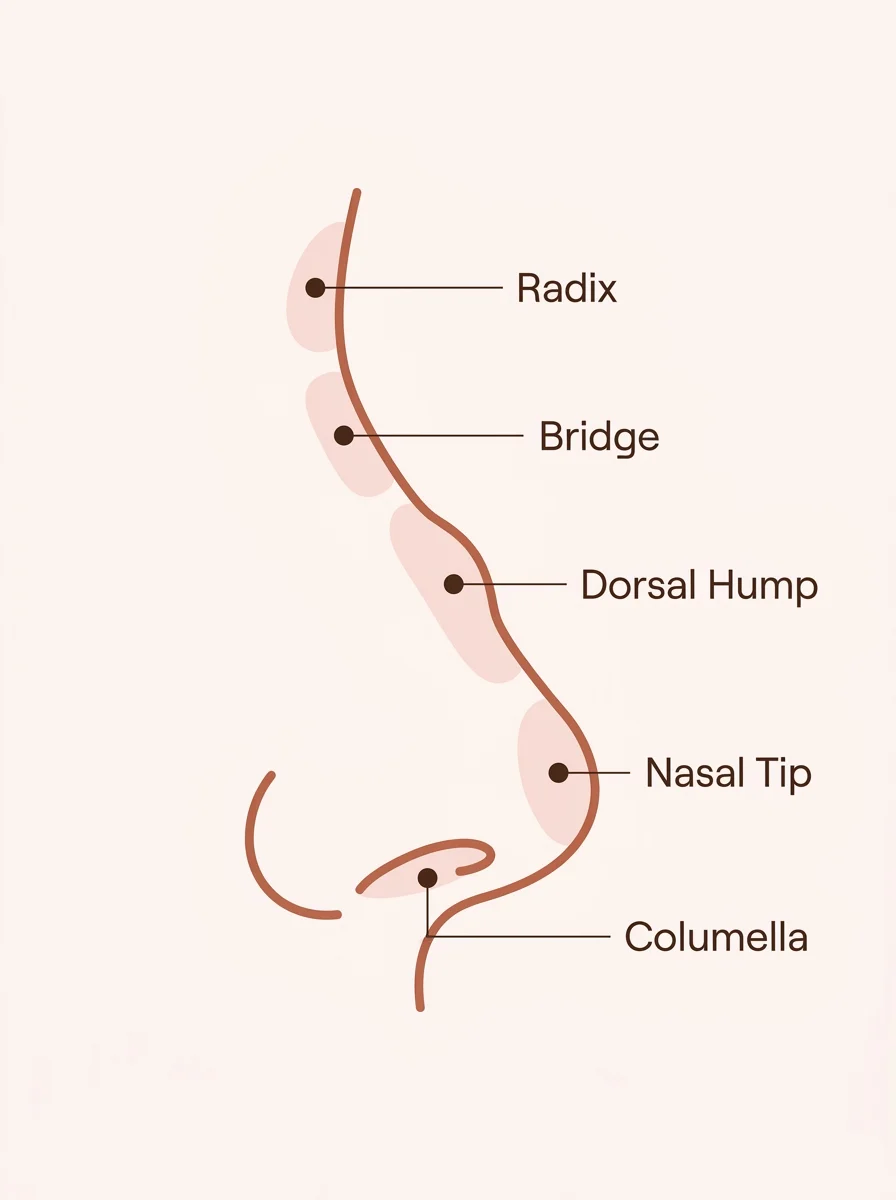
Liquid rhinoplasty is the injection of hyaluronic acid dermal filler into precise locations along the nasal bridge, tip, or radix (the zone between the bridge and forehead) to reshape the nose without surgery. The filler is placed to smooth bumps, lift a drooping tip, enhance the profile, or correct mild asymmetry — a camouflage technique that adds volume strategically rather than altering bone or cartilage.
The procedure is also called a non-surgical nose job, injectable rhinoplasty, or liquid nose job. Among cosmetic injectables, nasal work requires the highest level of anatomical precision — patients should expect a thorough evaluation before any product is injected. A key advantage of HA-based injectables is reversibility: because Desert Bloom uses only HA fillers for nasal work, the product can be dissolved with hyaluronidase if the result is unsatisfactory or if there is a vascular concern. See dermal filler removal for how that process works.
This page covers filler-based liquid rhinoplasty at our Scottsdale office. For thread-based nose lifting using absorbable PDO sutures, see PDO nose thread lift — a related but mechanically different approach Dr. Borakowski often prefers for tip lifting because it carries no vascular occlusion risk.
What a Non-Surgical Nose Job Can Do
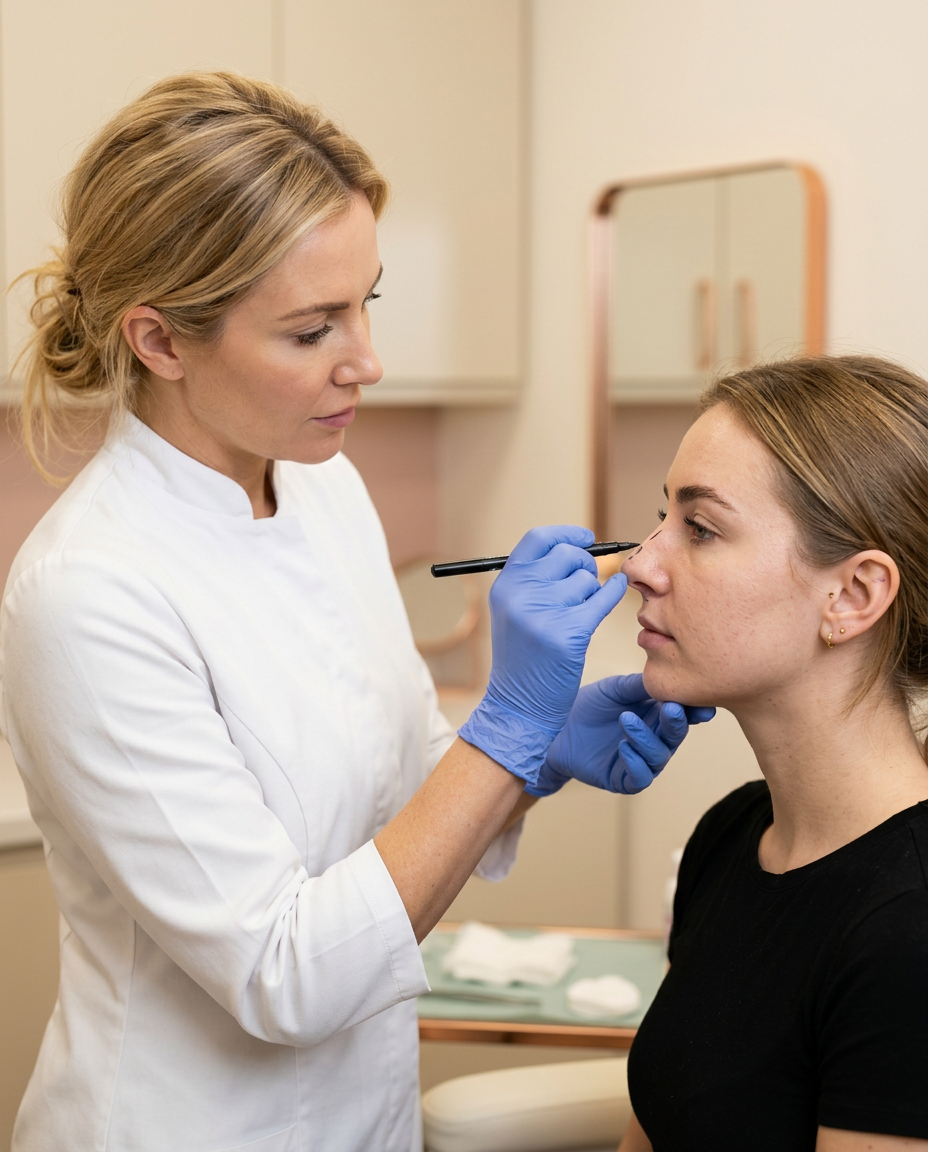
Liquid rhinoplasty is a volume-addition technique. Filler placed strategically along the nasal profile can camouflage a dorsal hump, lift a drooping tip, augment a flat bridge, or balance mild asymmetry. What it changes is the silhouette — not the underlying structure.
Concerns Liquid Rhinoplasty Addresses
Bridge contour
Dorsal hump or bumps
Filler placed above and below the hump fills the surrounding depressions and smooths the nasal profile, so the bump no longer reads as a high point.
Tip rotation
Drooping nasal tip
Columella and tip injection lifts the angle, giving the tip a more refined position without surgical cartilage work.
Projection
Flat or low bridge
Dorsum augmentation adds projection, height, and definition along the bridge — particularly useful when the upper third of the nose lacks structure.
Symmetry
Mild crookedness or asymmetry
Volume placed on the deficient side straightens the visual line of the nose, balancing left-right symmetry along the bridge.
Revision
Post-surgical irregularities
Minor contour depressions left after rhinoplasty can be camouflaged with filler — with caution, because prior surgery alters local vasculature.
What liquid rhinoplasty cannot do: it cannot make the nose smaller, reduce wide nostrils, fix a deviated septum, or improve breathing. Patients who need to correct nasal asymmetry beyond what filler can achieve, or who want size reduction or structural change, should consult a surgeon for surgical rhinoplasty.
Liquid Rhinoplasty vs. PDO Threads vs. Surgery
Three approaches to changing the look of the nose — each suited to different anatomy, goals, and risk profiles. The right choice is matched at consultation, not by default.
| Property | HA Filler (This Page) | PDO Nose Threads | Surgical Rhinoplasty |
|---|---|---|---|
| Mechanism | Volume addition via gel injection | Mechanical lift via absorbable sutures | Bone and cartilage reshaping |
| Best for | Bumps, bridge shape, tip drooping, mild asymmetry | Tip lifting, gradual collagen remodeling | Major structural change, size reduction |
| Onset of result | Immediate | Gradual (over weeks) | After swelling subsides (months) |
| Duration | 12–18 months | 12–24 months | Permanent |
| Vascular occlusion risk | Yes — requires experienced injector | No vascular occlusion risk | Surgical risks (not vascular occlusion from filler) |
| Reversible | Yes (hyaluronidase) | No (threads absorb naturally) | No |
| Downtime | 1–3 days | 3–5 days | 1–3 weeks |
| Cost range | $800–$1,500 per session | $500–$1,200 per session | $6,000–$15,000+ |
HA Filler (This Page)
- Mechanism
- Volume addition via gel injection
- Best for
- Bumps, bridge shape, tip drooping, mild asymmetry
- Onset of result
- Immediate
- Duration
- 12–18 months
- Vascular occlusion risk
- Yes — requires experienced injector
- Reversible
- Yes (hyaluronidase)
- Downtime
- 1–3 days
- Cost range
- $800–$1,500 per session
PDO Nose Threads
- Mechanism
- Mechanical lift via absorbable sutures
- Best for
- Tip lifting, gradual collagen remodeling
- Onset of result
- Gradual (over weeks)
- Duration
- 12–24 months
- Vascular occlusion risk
- No vascular occlusion risk
- Reversible
- No (threads absorb naturally)
- Downtime
- 3–5 days
- Cost range
- $500–$1,200 per session
Surgical Rhinoplasty
- Mechanism
- Bone and cartilage reshaping
- Best for
- Major structural change, size reduction
- Onset of result
- After swelling subsides (months)
- Duration
- Permanent
- Vascular occlusion risk
- Surgical risks (not vascular occlusion from filler)
- Reversible
- No
- Downtime
- 1–3 weeks
- Cost range
- $6,000–$15,000+
Liquid Rhinoplasty Safety — Risks and Side Effects
Common, temporary side effects include bruising, swelling, redness, and mild discomfort at the injection sites. These typically resolve within 1–3 days and require minimal recovery — most patients return to normal activities the same day.
HA-only policy. Desert Bloom uses only hyaluronic acid dermal fillers for nasal work — never Radiesse, never permanent fillers. This is a deliberate safety choice: HA can be dissolved immediately with hyaluronidase (Hylenex) if a vascular complication occurs. Several vials of hyaluronidase are kept on hand at every appointment so a vascular event can be addressed within minutes, not hours.
Patients with prior surgical rhinoplasty have an elevated complication profile because surgery alters the local vasculature in ways that are not always visible on the surface. Disclose your full nasal history at consultation. For more on managing filler complications and correction, see our dedicated page.
Liquid Rhinoplasty Cost in Scottsdale
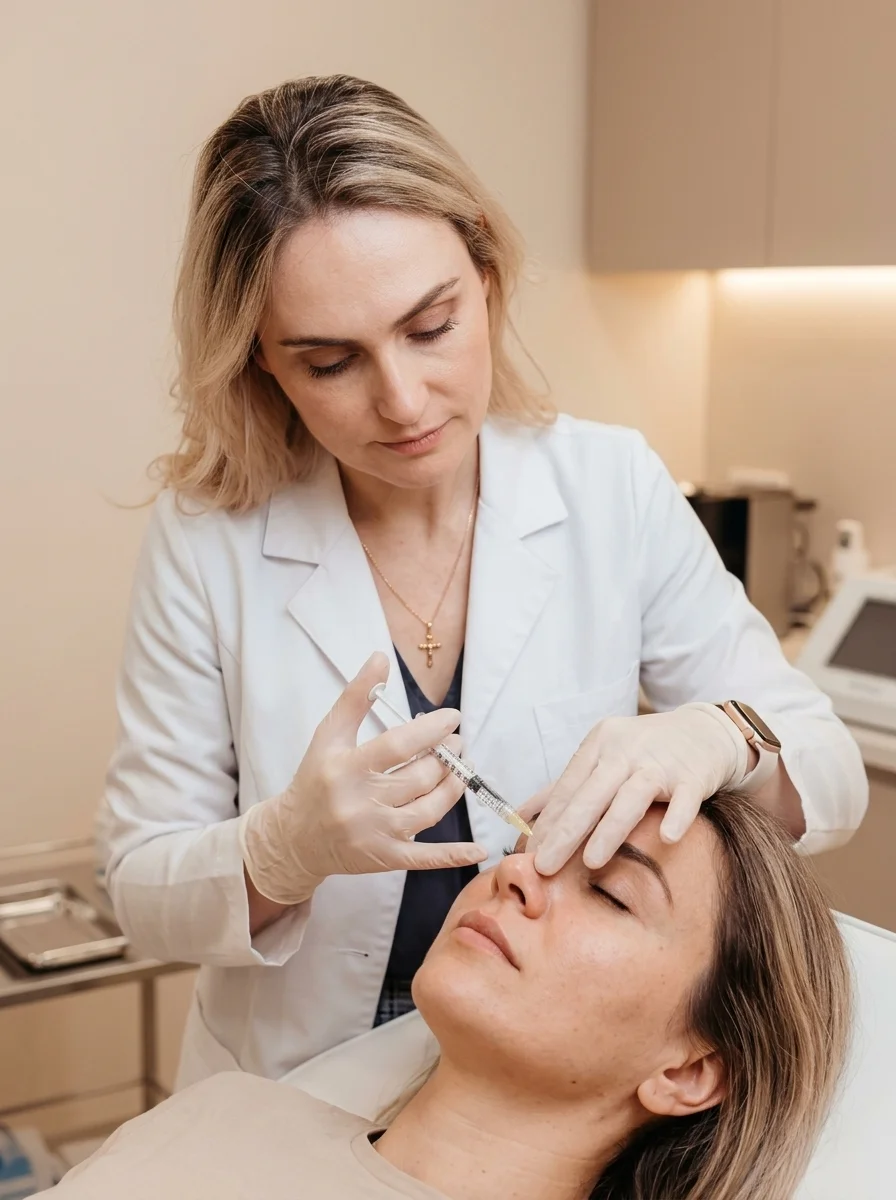
At Desert Bloom Skincare in Scottsdale, liquid rhinoplasty starts at $800 per session. Pricing depends on the filler type and volume needed — most patients use less than a full syringe for nasal work, though deeper bridge augmentation may require more. The typical regional range is $800–$1,500 per session. The initial consultation is complimentary.
Pricing
- Liquid Rhinoplasty$800
Results last 12–18 months, with maintenance typically annual. Patients who want a permanent solution may find surgical rhinoplasty more cost-effective over a long horizon. Liquid rhinoplasty offers a lower-commitment entry point — reversible, with a visible change you can evaluate before deciding on anything permanent. Some patients use an HA filler session to preview a shape adjustment before committing to surgery.
Why Choose Desert Bloom for Liquid Rhinoplasty

Nasal injection is a procedure where experience matters directly — to both safety and result. The vessel density in the nose and the connection to the ophthalmic artery system mean anatomical knowledge is the single largest determinant of patient safety. The aesthetic outcome an injector can achieve, and the complications they can avoid, are a direct function of technique and understanding of facial anatomy in this zone.
Dr. Natalya Borakowski, NMD is the founder and lead aesthetic physician at Desert Bloom Skincare. With 17 years in aesthetic medicine and a Naturopathic Doctorate from Southwest College of Naturopathic Medicine, she brings advanced injectable training and deep facial anatomy expertise to every liquid rhinoplasty procedure.
Dr. Borakowski presented at the IMCAS World Congress in Paris (2025) and serves as adjunct faculty at the University of Bridgeport, where she teaches aesthetic medicine to licensed practitioners. Every nasal filler plan begins with an honest consultation — not a sales pitch. If filler is not the right approach for your anatomy, you will hear that directly, and Dr. Borakowski will recommend PDO threads or surgical referral as appropriate.
“The nose is a very risky and delicate area to treat with dermal filler. There is a high risk of vascular occlusion which can be avoided with proper technique. The second risk is delayed vascular compromise, which is not always entirely avoidable. HA filler can also migrate or cause transient swelling even months after injection. This is why I often prefer PDO threads for nose work — they are safer and, for the right patient, more effective.”
Frequently Asked Questions About Liquid Rhinoplasty
How long does liquid rhinoplasty last?
Is liquid rhinoplasty safe?
How much does liquid rhinoplasty cost?
Can liquid rhinoplasty fix a crooked nose?
Does liquid rhinoplasty hurt?
Can liquid rhinoplasty make my nose smaller?
Medically reviewed by
Founder, Desert Bloom Skincare · 17 Years Experience · Adjunct Faculty, University of Bridgeport
References
- 1.
Song D, Wang X, Yu Z.. Nonsurgical Rhinoplasty: An Updated Systematic Review of Technique, Outcomes, Complications, and Its Treatments. Aesthetic Plastic Surgery; 2024;48(23):4902–4915.
DOI: 10.1007/s00266-024-04161-4
9,657 patients pooled; 99.08% satisfaction; 0.27% severe vascular complications — the data underlying our risk framing.
- 2.
DeLorenzi C.. Complications of Injectable Fillers, Part 2: Vascular Complications. Aesthetic Surgery Journal; 2014;34(4):584–600.
Foundational reference for vascular occlusion recognition and hyaluronidase rescue protocol.
- 3.
Bertossi D, Lanaro L, Dorelan S, Johanssen K, Nocini P.. Nonsurgical Rhinoplasty: Nasal Grid Analysis and Nasal Injecting Protocol. Plastic and Reconstructive Surgery; 2019;143(2):428–439.
DOI: 10.1097/PRS.0000000000005224
Anatomy-based grid protocol that informs our injection planning for nasal filler.
This content is for educational purposes and does not replace a professional medical consultation. Individual results vary. All procedures carry risks that should be discussed with your provider. Desert Bloom Skincare provides complimentary consultations to assess candidacy and develop a personalized treatment plan. Last updated: April 2026.