
Longer-Term Hair Reduction, Matched to Your Skin Tone
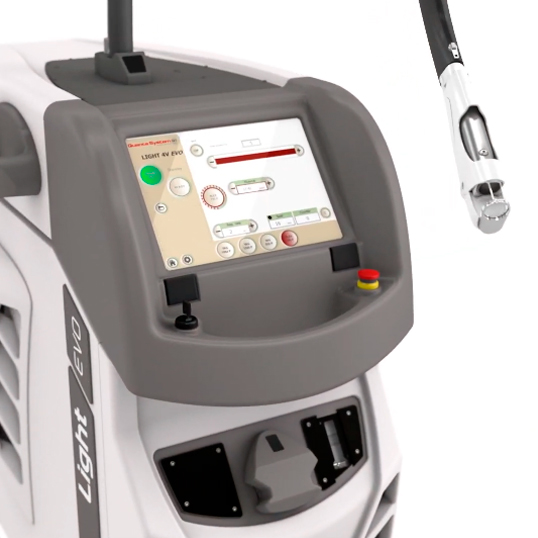
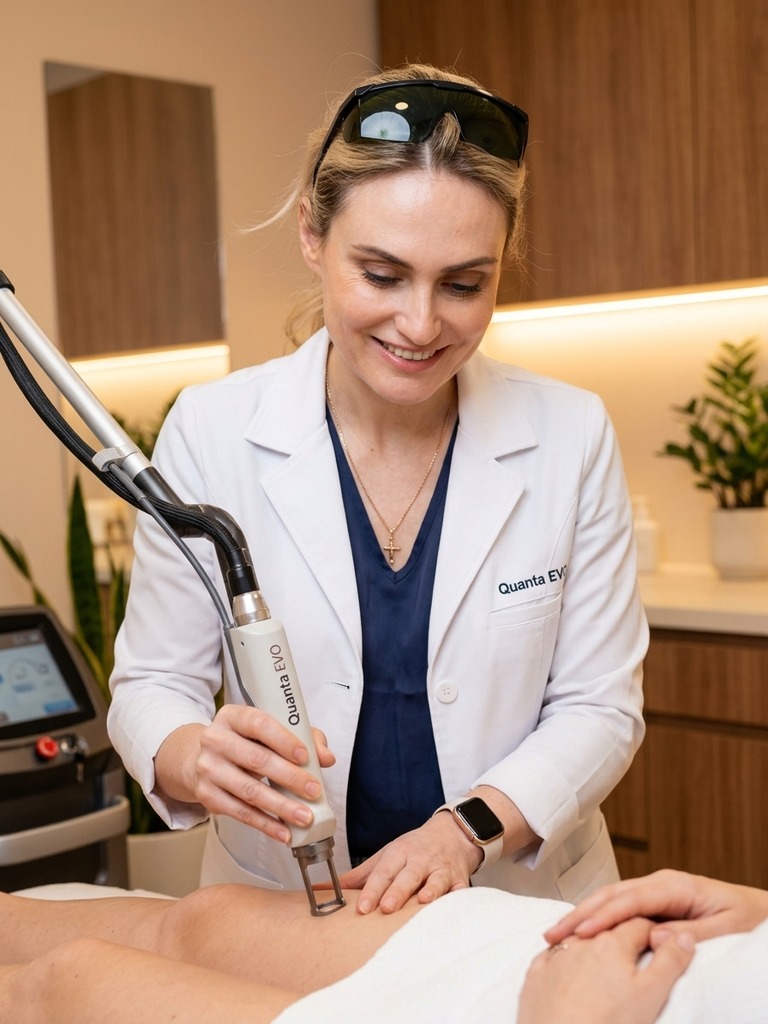
Tired of constant shaving, waxing every few weeks, and ingrown hairs in between? Laser hair removal targets hair follicles directly — delivering long-term hair reduction without relying on the endless cycle of shaving or waxing. At Desert Bloom in Scottsdale, AZ, we use a Quanta EVO Alexandrite 755nm for Fitzpatrick I–III (lighter skin) and Nd:YAG 1064nm for Fitzpatrick IV–VI (darker skin tones). Your wavelength is selected during consultation based on your skin type, hair color, and treatment area.
Laser hair removal in Scottsdale is a common treatment request at Desert Bloom, alongside CO2 laser resurfacing, IPL photo facial, and RF microneedling. Explore the full laser treatment options at Desert Bloom.
At a Glance
- 70–90% permanent reduction after 6–8 sessions
- Quanta EVO Alexandrite 755nm + Nd:YAG 1064nm — matched to your skin tone
- All Fitzpatrick skin types treated (I–VI)
- Minimal downtime — resume normal activities same day
- Starts at $30/session; see full pricing
- Performed under Dr. Borakowski’s direct medical supervision
What Is Laser Hair Removal?
Laser hair removal is a medical procedure that uses concentrated light energy to target hair follicles and reduce their ability to regrow hair, producing long-term hair reduction. The laser wavelength is absorbed by melanin — the pigment inside your hair — converting to heat that damages the follicle at its root.
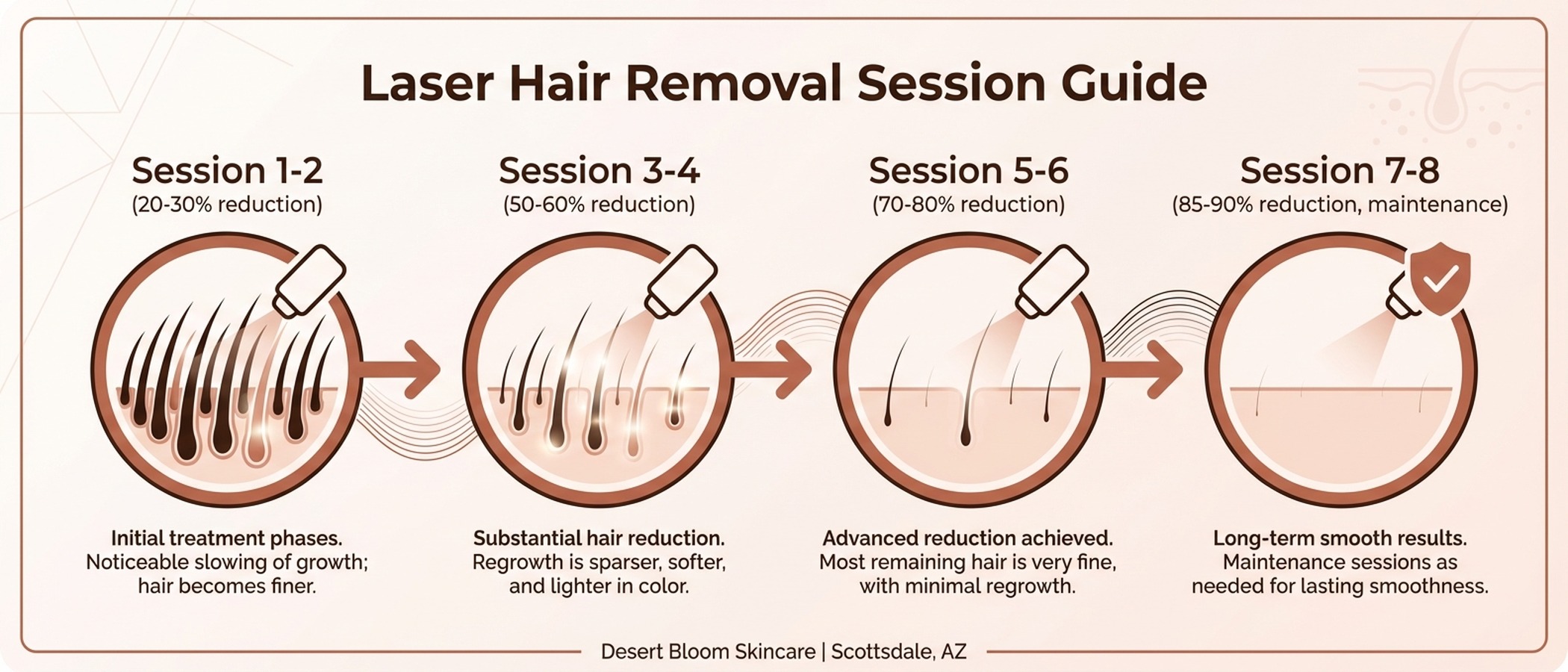
This process is called selective photothermolysis: targeting the darker structure (hair) without harming the surrounding skin. The FDA classifies this as “permanent hair reduction,” not permanent removal. After a complete series of 6–8 sessions, clinical studies confirm 70–90% reduction in unwanted hair (results vary by individual). Annual touch-ups maintain results long-term.
It’s one of the most effective, evidence-based ways to significantly reduce unwanted body hair — for patients treating facial or body hair, including women and men.
How Does Laser Hair Removal Work?
Our Quanta EVO Alexandrite 755nm laser penetrates deep into the dermis where melanin in the hair shaft absorbs the laser energy, converting it to heat. That heat damages the germinal cells in the follicle bulb and bulge — the structures responsible for hair regrowth. For darker skin tones (Fitzpatrick IV–VI), we use the Nd:YAG 1064nm wavelength, which bypasses epidermal melanin to safely reach the follicle below.
Only 20–30% of hairs are in the active growth phase (anagen) at any time — and laser energy is most effective on follicles in anagen. That’s why multiple sessions are needed: each appointment catches a new wave of follicles in their growth window, supporting more complete reduction across the treated area.
The sensation? Most patients describe tiny rubber band snaps — brief, tolerable, and over quickly. The Quanta EVO platform and built-in cooling support a more comfortable treatment experience across a wide range of skin types.
Treatment Areas and Sessions
| Area | Sessions | Spacing |
|---|---|---|
| Face (upper lip, chin) | 6–8 | 4–6 weeks |
| Underarms / armpits | 6–8 | 4–6 weeks |
| Brazilian / bikini | 6–8 | 4–6 weeks |
| Legs (full or lower) | 6–8 | 6–8 weeks |
| Back / chest | 6–8 | 6–8 weeks |
| Arms | 6–8 | 6–8 weeks |
Spacing is individualized by area, hair density, and hormonal pattern; Dr. Borakowski may recommend tighter spacing, especially for hormonally influenced or dense-growth areas, because consistency affects results.
We treat both women and men across all body hair areas. Shedding begins after session 2–3; each time hair returns it comes back thinner and sparser. Female chin and male back are among the more challenging areas — hair density and hormonal factors often require additional treatments beyond the initial series.
“Laser hair reduction can only destroy already active hair follicles. If these are hormonally stimulated, new hair will continue to grow and laser treatments must continue to manage that. Regular sessions are recommended every 4 weeks to achieve the best possible hair reduction — if the patient is not consistent, the results are not guaranteed.”
Dr. Natalya Borakowski, NMD
Are You a Good Candidate for Laser Hair Removal?
Ideal candidates have dark hair on any skin tone. We use the right wavelength for each skin type.
- Dark hair (black to medium brown) — highest melanin absorption
- Any skin tone — Alexandrite 755nm for Fitzpatrick I–III, Nd:YAG 1064nm for Fitzpatrick IV–VI
- Tired of constant shaving, waxing, or ingrown hairs
- Committed to completing 6–8 session series
- Chronic ingrown hairs — laser targets the follicle to help prevent ingrown hairs
- Light brown or auburn hair — may respond but results less predictable
PCOS and Hormonal Patients
If you have PCOS or another hormonal condition, laser hair removal can still be very useful — but expectations need to be realistic. Recommendations are the same as for any patient, but hormonal stimulation means new hair follicles will continue to become activated over time, particularly in areas like the chin, upper lip, and bikini. For these patients, laser becomes an ongoing therapy rather than a one-time series.
In Dr. Borakowski’s experience, PCOS patients typically need more treatments than the standard 6–8, and periodic maintenance sessions (every few months rather than once or twice a year) keep results looking their best. We discuss this clearly at your first appointment so your treatment plan reflects how hormonal hair growth behaves.
Struggling with chronic ingrown hairs? Laser hair removal addresses the structural cause by reducing the follicle’s ability to produce regrowth. It’s a clinically validated approach to prevent ingrown hairs and reduce the ingrown cycle over time.
Pregnancy (precautionary — not studied; hormonal changes also reduce efficacy)
Active tan or recent sun exposure (wait 4–6 weeks)
Photosensitizing medications or isotretinoin within 6 months
Active infection, open wounds, or tattoos in the treatment area
History of keloid scarring
Rare adverse events to be aware of: paradoxical hair growth (increased hair density in surrounding areas, more common in hormonal conditions or darker skin) and post-inflammatory hyperpigmentation (PIH), particularly in Fitzpatrick IV–VI. Both are uncommon when the correct wavelength and device settings are used.
Dr. Borakowski personally assesses skin type, hair color, and medical history during your consultation to determine whether laser is the right choice and which technology is safest for your skin tone. A good consultation does not always end with a treatment plan — sometimes it ends with clarity about a better option.
If you are unsure whether your hair color, skin tone, medications, or sun exposure make you a candidate, schedule a free consultation before starting treatment.
How to Prepare for Laser Hair Removal
- Stop waxing, plucking, or threading 4–6 weeks before — the root must be present for the laser to target
- Shave 24 hours before your appointment — shaving preserves the root while removing surface hair
- Avoid sun exposure and tanning beds for 4–6 weeks before treatment
- Pause retinoids 2–5 days beforehand
- No self-tanners or spray tan on treatment area
Results — What to Expect
Treated hairs shed over 1–3 weeks after each session — this is normal, not regrowth. Each time, hair returns thinner and lighter. After completing 6–8 sessions, most patients achieve 70–90% long-term hair reduction.
Published studies support the general long-term efficacy of laser hair removal when treatments are properly spaced and completed consistently, though outcomes vary by device, wavelength, hair color, skin type, and hormonal factors. Touch-up sessions 1–2 times per year maintain results.
Results vary depending on hair color, skin type, and the areas treated. Hormonal areas may require periodic ongoing maintenance. See our Before & After Gallery for examples of outcomes across multiple treatment areas. Individual results vary.
Post-Treatment Care
- SPF 50+ daily for one week post-treatment
- No hot baths, saunas, or vigorous exercise for 48 hours
- Cool compresses for mild redness (normal, resolves within hours)
- No waxing or plucking between sessions — shaving is fine
- Minimal downtime — resume normal activities same day
Unusual pain beyond mild discomfort
Signs of infection (warmth, pus, increasing redness)
Any unexpected reaction after treatment
Laser vs. Waxing, Electrolysis, and IPL
| Factor | Laser (Alexandrite / Nd:YAG) | IPL | Electrolysis | Waxing |
|---|---|---|---|---|
| Result | Permanent reduction 70–90% | Temporary reduction | Permanent removal | Temporary |
| Speed | Fast | Moderate | Very slow (hair by hair) | Moderate |
| Pain level | Mild (rubber band snap) | Similar | Higher | Moderate–high |
| Skin tones | I–VI | I–III best | All | All |
| Sessions | 6–8 | 8–12 | Months–years | Ongoing |
| Long-term cost | Moderate (series + touch-ups) | More sessions needed | Highest (time) | Highest (lifetime) |
For most patients, laser is the most effective and time-efficient option. IPL uses broad-spectrum light — less precise, less effective on darker skin. Electrolysis is the only FDA-recognized “permanent removal” method, but it treats one hair at a time, making it impractical for large areas. In comparative research, Alexandrite 755nm has shown strong hair-reduction outcomes and often performs better than IPL, though individual results depend on hair color, skin type, treatment area, and consistency. Over a lifetime, laser typically saves money compared to years of waxing or shaving.
Laser Hair Removal Cost in Scottsdale
Pricing starts at $30 per session, serving Scottsdale, Phoenix, and the greater Arizona area. Cost depends on treatment area, number of sessions, and hair density. For complete per-area pricing, visit our treatment price list. For an accurate estimate based on your specific goals and treatment plan, contact us directly.
Patients searching for laser hair removal near Scottsdale often come to Desert Bloom for physician-supervised treatment planning and skin-type-specific wavelength selection. Over time, a complete series can be more cost-effective than years of ongoing waxing or shaving.
Why Choose Desert Bloom
- Dr. Natalya Borakowski performs under direct medical supervision — wavelength selection and candidacy guided by medical assessment
- Quanta EVO Alexandrite 755nm and Nd:YAG 1064nm — matched to your skin tone
- Fitzpatrick I–VI safely treated with wavelength-matched technology
- Personalized care with honest candidacy evaluation — if laser isn’t right for you, we’ll tell you
- Nearly two decades of aesthetic medicine experience providing effective laser hair removal treatments
- Clinical aesthetics approach — evidence-based, not trend-chasing
Related Laser Treatments
Addresses skin texture, scars, and wrinkles with fractional CO2 technology.
Learn more →Targets sun damage, pigmentation, and redness for more even skin tone.
Learn more →Skin tightening and texture improvement using radiofrequency energy.
Learn more →Your Provider
All laser hair removal treatments at Desert Bloom are performed under Dr. Natalya Borakowski’s direct supervision. With nearly two decades of aesthetic medicine experience, Dr. Borakowski personally assesses each patient’s skin type, hair color, and history to determine the safest and most effective treatment approach.


“Laser hair reduction is not a one-size-fits-all procedure — it’s a wavelength decision. I match the technology to your skin tone and hair type, and I set honest expectations from the first visit. For my patients with PCOS or hormonal hair growth, I explain that we’re managing a process, not ending it with eight sessions. Consistency and the right device make the difference.”
Frequently asked questions
How much does laser hair removal cost?
Pricing varies by treatment area and number of sessions. Visit our price list for current per-area rates, or contact us for a personalized estimate based on your goals and the areas you want treated.Is laser hair removal permanent?
Laser hair removal produces permanent hair reduction — typically 70–90% fewer hairs after a series of 6–8 sessions. Annual touch-up sessions 1–2 times per year maintain long-term results. It is not a single-treatment solution.Does laser hair removal hurt?
Most patients describe it as tiny rubber band snaps — brief, tolerable, and comfortable overall. Our Quanta EVO laser is designed for patient comfort. Sensitive areas like bikini and underarms may feel more intense than other areas, but mild discomfort is the norm.How many sessions do I need?
Typically 6–8, spaced 4–8 weeks apart depending on the treatment area. Multiple sessions are needed because the laser only affects follicles in their active growth phase — and only 20–30% are in that phase at any one time. Your specialist will help you understand the number needed during your consultation.Is laser hair removal safe for dark skin?
Yes — when properly assessed. Dr. Borakowski uses the Nd:YAG 1064nm wavelength for Fitzpatrick IV–VI, which bypasses surface melanin to safely reach the follicle. A consultation helps us determine the right wavelength and settings for your skin type, ensuring safe and effective treatment.How long do results last?
Long-term. After completing your series, most patients maintain much smoother skin with significantly reduced hair growth through 1–2 touch-up sessions per year. Hormonal changes may require periodic additional maintenance.Can I get laser hair removal while pregnant?
No — we defer treatment during pregnancy as a precaution. There is no evidence of harm, but the procedure has not been studied in pregnant patients, and hormonal changes also reduce treatment effectiveness.Does laser hair removal cause cancer?
No. Laser hair removal uses non-ionizing light that penetrates only superficial skin layers. It does not cause DNA damage or increase cancer risk. Laser hair removal has been widely used in medical aesthetics for decades when performed with appropriate settings and patient selection.Book a Laser Hair Removal Consultation in Scottsdale
Every consultation at Desert Bloom — for any treatment — starts with a complimentary assessment. Dr. Borakowski evaluates your skin type, hair color, and medical history, discusses your goals, and recommends a treatment plan — including whether laser hair removal is the right approach or whether a different procedure better serves your needs.
Desert Bloom Skincare
10752 N 89th Place, Suite 122B, Scottsdale, AZ 85260
(480) 567-8180
References
- “Selective photothermolysis: precise microsurgery by selective absorption of pulsed radiation..” Science. 1983. DOI(PMID: 6836297)
- “Laser Hair Removal..” StatPearls [Internet]. 2024. (NBK507861)
- “Laser hair removal: a review..” Dermatol Surg. 2013. DOI(PMID: 23332016)
- “Long-term efficacy and safety of 755-nm Alexandrite laser for axillary hair removal: a comparative analysis of single vs. dual flash lamp systems..” JMIR Dermatol. 2025. (PMID: 41270270, PMC12638035)
- “Effectiveness of single-wavelength 755 nm laser compared to dual-wavelength 755 nm and 1064 nm laser in hair removal: a split-body design with blinding..” Health Sci Rep. 2026. (PMID: 42005695, PMC13087534)
- “Efficacy of laser in hair removal: a network meta-analysis..” J Cosmet Laser Ther. 2023. (PMID: 37493187)
- “Medical laser hair removal: a new rotational approach..” Lasers Med Sci. 2025. (PMC12364753)
- “Laser and light-based therapies for hirsutism management in women with polycystic ovarian syndrome: a systematic review..” JAMA Dermatol. 2024. DOI(PMID: 38630483)
Individual results may vary. Laser hair removal outcomes depend on hair color, skin type, hormonal factors, and treatment adherence. A consultation with Dr. Borakowski is required before treatment.
Content reviewed by Dr. Natalya Borakowski, NMD — Last updated April 2026
Consultation in skin care clinic
Desert Bloom Skincare Center offers personalized skincare consultation to help you achieve a flawless and radiant complexion. Book your appointment today and let our expert team of skincare professionals address your specific concerns and help you reach your skincare goals.
Similar treatments
Visit Our Scottsdale Aesthetic Center
Address
10752 N 89th Place, Suite 122B,Scottsdale, AZ 85260.
Phone:(480) 567-8180
E-mail:info@desertbloomskincare.com
Get Directions →Location & Directions
Desert Bloom Skincare is conveniently located in the Shea Corridor of North Scottsdale, within Edwards Professional Park I — minutes from HonorHealth Scottsdale Shea Medical Center and the Mayo Clinic Scottsdale Campus.
Areas We Serve
We proudly provide expert non-surgical rhinoplasty and PDO thread lifts to patients across the Southwest:
- ScottsdaleNorth Scottsdale · McCormick Ranch · Gainey Ranch
- Paradise Valley
- PhoenixArcadia · Biltmore · North Phoenix
- Fountain Hills
- Cave Creek & Carefree