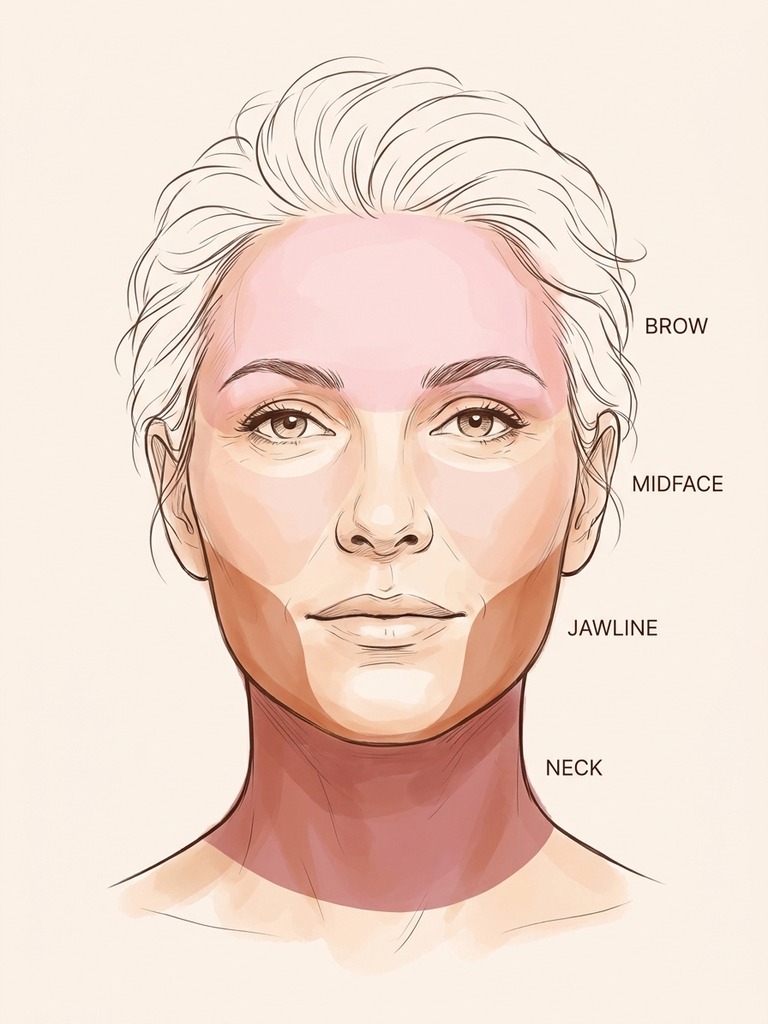
If you are looking for a non-surgical facelift in Scottsdale, this page covers what the category actually includes — PDO sutures, dermal fillers, RF microneedling, botulinum toxin, and laser treatments — and how to think about which combination fits your anatomy and goals.
At Desert Bloom Skincare, Dr. Natalya Borakowski evaluates each face individually before recommending a plan. Every plan starts with an assessment — not a sales pitch. This page sits alongside PDO thread lift, dermal fillers, and botulinum toxin in the broader non-surgical treatment category.
What it is: A category combining PDO sutures, dermal fillers, RF microneedling, and botulinum toxin — used alone or together.
Typical results: Often 6 months to 2 years, depending on method, product, and individual response.
Recovery: Most options 1–5 days. Threads 2–3 days. Laser resurfacing 1–2 weeks.
Common side effects: Redness, swelling, bruising, tenderness. Serious complications rare when performed by an experienced provider.
Ideal candidate: Mild-to-moderate skin laxity, localized volume loss, early signs of aging. Severe descent typically requires surgical referral.
Cost in Scottsdale: Typical range $1,500–$4,500.
A non-surgical facelift is a category of treatments that lift, smooth, or volumize the face without incisions or general anesthesia. The term covers several different tools — injectable fillers, neuromodulators, energy-based skin tightening, PDO sutures, and resurfacing lasers — used individually or in combination to address fine lines, sagging skin, and volume loss.

Non-surgical facelift procedures offer minimal downtime compared to plastic surgery or cosmetic surgery options. Some produce immediate results — a PDO suture lift or filler placement shows change on the table. Others, like RF microneedling and energy-based resurfacing, rely on collagen remodeling and develop gradually over two to three months. Both approaches have a place, and they are often combined.
What they share is what they cannot do: none of these treatments replace a surgical facelift for significant skin redundancy. If you have advanced laxity or heavy jowling, a non-surgical plan will not give you the outcome you want.
Most non-surgical facelift plans are built from one lifting or collagen-support treatment (such as threads or a biostimulatory injectable) plus one volume or wrinkle treatment (filler or neuromodulator), with optional skin-quality work (RF microneedling, laser resurfacing, or chemical peels). The right combination depends on your anatomy, concern priorities, and what your tissue will support.

Absorbable sutures lift tissue and stimulate collagen. Often a fit for mild-to-moderate skin laxity and early descent. Results typically last 12–18 months.
Learn more →Restore lost volume in cheeks, temples, jawline, and chin. HA fillers last 6–18 months; biostimulators like Sculptra build gradual collagen correction over time.
Learn more →Radio frequency energy plus microneedling tightens skin and improves texture. Minimal downtime; gradual improvement over several weeks as new collagen develops.
Learn more →Botox or Dysport softens dynamic wrinkles — crow’s feet, frown lines, forehead creases. Commonly paired with filler or threads for a more complete result.
Learn more →Laser resurfacing and chemical peels address sun damage, skin texture, and uneven tone. Often layered after structural work. Downtime ranges from none to 1–2 weeks depending on depth.
Learn more →A PDO thread lift uses the same polydioxanone material used in general surgery for decades, placed through a fine cannula to reposition tissue and create support along the jawline, midface, and brow. A full liquid facelift — dermal filler used strategically across multiple areas to restore facial volume — typically falls in the $1,500–$4,500 range, though the final cost varies with the products and amounts chosen.
PDO sutures are absorbable — polydioxanone, the same material used in general surgery since the 1970s. They are placed through small entry points (often hidden in the hairline at the temple) using a blunt cannula that glides between the skin and muscle in the superficial fat layer.

A full lower-face correction often requires multiple threads per side; the exact number depends on your anatomy, skin quality, and the goals of the treatment plan. Two things happen once the sutures are in place. First, the barbs on the threading grip the tissue and produce an immediate mechanical lift — tissue that had started to descend is repositioned and held. Second, the threads create a controlled healing response in the dermis, which stimulates collagen production around them over the following weeks. That collagen remains after the threads dissolve, which is why results often continue to improve in the first two to three months.
Ideal candidates have mild-to-moderate skin laxity, localized descent, or volume loss, preferring less downtime and gradual improvement over surgical correction.
Activity of the underlying facial muscles also matters — heavy muscle pull in certain areas can shorten how long threads or filler hold their position, which is why muscle activity is part of the assessment.
A PDO thread session at Desert Bloom runs 60–90 minutes under local anesthetic. Dermal filler and neuromodulator appointments are shorter — typically 30–60 minutes. You are awake throughout; the anesthetic numbs the entry points so the placement is not painful, though there is pressure and some sensation as the cannula moves.

For patients who tend to feel anxious, comfort measures beyond local anesthetic can be discussed at the consultation and adjusted to your needs.
Swelling, tenderness, and bruising peak. Acetaminophen OK; avoid ibuprofen and aspirin. Sleep on your back with head elevated. Cold compresses and arnica help.
Bruising and swelling typically subside. Avoid strenuous exercise, saunas, and hot yoga. No facial massage or dental work. Many patients comfortable in social and professional settings by day 5-7, depending on bruising.
Threads and fillers begin to settle. Some mild asymmetry or temporary dimpling may appear as tissue adjusts. Aggressive facial treatments (laser, microneedling) should wait per your provider’s guidance.
Initial swelling resolved, final contour visible. Collagen-stimulating treatments continue developing over 2-3 months as new collagen forms.
With threads and dermal fillers you typically see an immediate change at the appointment — improved jawline definition, midface support, and softening of nasolabial folds. Over the following 2–3 months, the collagen-stimulating treatments (PDO sutures and RF microneedling) continue to develop as new collagen forms.

Duration depends on the tool and can vary significantly between patients. Neuromodulators typically last about three to four months. HA-based dermal fillers typically last 6–18 months depending on product and area. PDO threads often hold for around 12–18 months. Biostimulators like Sculptra and the structural improvement from RF microneedling can extend past two years with maintenance. Most patients see gradual, natural improvement in facial proportions — the kind that feels like your face, just better supported.
PDO lift for structure plus HA filler for volume restoration — covers both axes of descent.
Learn more →Filler for static volume plus neuromodulator for dynamic lines — the classic liquid lift.
Learn more →Thread support plus collagen-stimulating skin tightening for added quality improvement.
Learn more →Sculptra builds gradual structure while Botox softens movement — both long-game approaches.
Learn more →Costs for non-surgical facelift services in Scottsdale typically fall in the $1,500–$4,500 range, depending on the combination of services. A PDO thread lift alone at Desert Bloom often begins around $2,500, though the final number varies with how many threads are used, the areas treated, and the chosen maintenance schedule. Factors influencing cost include the specific treatments chosen, the products and amount of filler needed, and provider expertise.
Relative to plastic surgery — where a traditional facelift runs well above $15,000 and requires general anesthesia and weeks of recovery — a well-designed non-surgical plan is often a meaningful step for the right candidate before considering surgery.
Expected temporary effects. Redness, swelling, bruising, and tenderness at injection or entry sites. Typically resolve within several days to a week. Mild tightness or pressure sensation during the first 48 hours is normal.
Uncommon but usually self-limited. Prolonged swelling beyond a week, mild asymmetry that resolves as tissue settles, temporary palpable thread under the skin, or brief numbness near entry points. These often resolve on their own or improve with follow-up evaluation and minor adjustment when needed.
Pregnant or nursing patients are generally not treated. Specific contraindications and personal health history are reviewed at the consultation.
Dr. Natalya Borakowski is a licensed naturopathic physician (NMD) with extensive training in facial anatomy, minor surgery, and injectable technique. Desert Bloom Skincare is based in Scottsdale, Arizona, and the practice is built around one principle: the right treatment for the right candidate, not the treatment that pays best today.
Dr. Borakowski will recommend the combination that fits your anatomy and goals, or tell you directly if surgery would serve you better. Patients who are not good candidates for non-surgical approaches get that conversation up front.

“A non-surgical facelift plan is always the sum of individual decisions — which layer needs correction, which tool is right for your anatomy, and how to sequence the visits. It is not one treatment. It is a strategy.”
At Desert Bloom, every plan starts with an assessment — not a sales pitch. Dr. Borakowski will evaluate your skin laxity, volume, muscle activity, and goals, then walk you through the options that make sense for you. If a non-surgical facelift is the right choice, she will build the plan. If it is not, she will say so.
Desert Bloom Skincare
10752 N 89th Place, Suite 122B, Scottsdale, AZ 85260
(480) 567-8180
PDO sutures are FDA-cleared for soft tissue approximation. Their use in aesthetic thread lifting is an off-label application performed by trained medical professionals. Content medically reviewed by Dr. Natalya Borakowski, NMD. Last updated April 2026. Individual results may vary.
Desert Bloom Skincare Center offers personalized skincare consultation to help you achieve a flawless and radiant complexion. Book your appointment today and let our expert team of skincare professionals address your specific concerns and help you reach your skincare goals.
Phone:(480) 567-8180
E-mail:info@desertbloomskincare.com
Get Directions →Desert Bloom Skincare is conveniently located in the Shea Corridor of North Scottsdale, within Edwards Professional Park I — minutes from HonorHealth Scottsdale Shea Medical Center and the Mayo Clinic Scottsdale Campus.
We proudly provide expert non-surgical rhinoplasty and PDO thread lifts to patients across the Southwest: