Thread Lift Gone Wrong

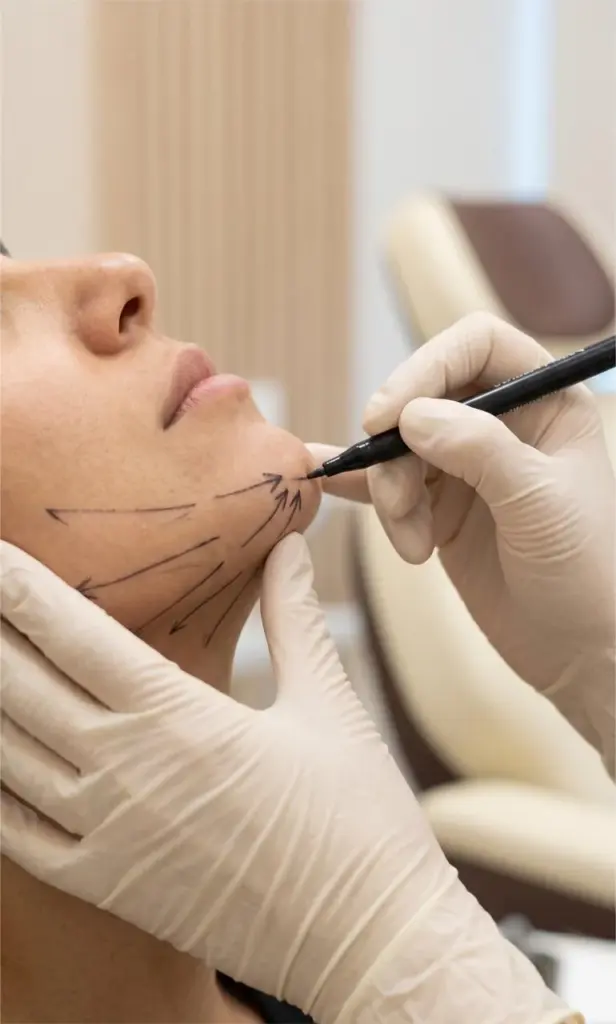
In this blog post, we will take you through everything you need to know about PDO thread lifts - from their FDA regulations to potential complications and real-life stories of thread lift gone wrong. We'll provide tips on how to prevent complications and how to handle them if they occur. Lastly, we'll discuss how to make an informed decision about whether a PDO lift is right for you and the importance of seeking professional consultation before undergoing any cosmetic procedure.
Overview
A thread lift may be going wrong if persistent dimpling, protruding thread tips, new asymmetry past the first week, sharp one-sided pain, infection signs, or sudden numbness appear. Mild tightness and tenderness in the first few days are expected — the symptoms above are not.
Many common PDO thread lift complications can be managed when evaluated early. This guide explains what is normal, what is urgent, and which corrective options may match migration, dimpling, asymmetry, visible threads, infection, or nerve-related symptoms.
Thread Lift Trouble at a Glance
- Common Issues
- Migration, asymmetry, dimpling, protruding thread tips, infection, prolonged edema, allergic reactions
- When to Act
- Sharp one-sided pain, fever, spreading redness, persistent dimpling, protruding threads, numbness or muscle weakness
- Correction Options
- Natural resorption, in-office trimming or removal of exposed tips, repositioning, HA filler camouflage, dermatology or plastic-surgery referral for severe cases
- Related Reads
- PDO Thread Lift · Botched Treatment · Facial Asymmetry · Patient Case Studies
Not Sure Where You Stand?
Jump to the guide that matches your situation.
Considering a thread lift?
→Thread lift overview — What PDO threads can and can't do
Worried about side effects?
→Side effects guide — Normal healing versus real red flags
Threads or a facelift?
→Thread lift vs facelift — How the two approaches compare
A nose thread problem?
→Nose thread lift gone wrong — Specific to nasal thread complications
Want to see real results?
→Before & after — A six-month before-and-after case study
What to Do If Your Thread Lift Went Wrong
Many common complications can be managed more effectively when addressed in the right window. The path forward depends on which complication you face, how severe it is, and how soon you act.
Step 1: Document What You See
Photograph the affected area in consistent light from front, three-quarter, and side angles. Note the date symptoms began, what they look like, and how they have changed over 24 to 72 hours. Pain that worsens after Day 2 is clinically meaningful, as is edema that does not respond to ice.
Step 2: Contact the Injector Who Placed the Threads
Call the provider who performed the procedure first. They know the thread type, placement vectors, and anchor points. Many issues — early dimpling, palpable lumps, asymmetry from initial edema — resolve within two to three weeks or with minor in-office adjustment. A reputable injector will see you promptly and discuss options without defensiveness.
If you have fever, spreading redness, skin color change, sudden numbness, or weakness, seek same-day medical evaluation even if the original provider is unavailable.
Step 3: Match the Correction to the Complication
- Migration or protruding thread tip: manual repositioning, in-office trimming or removal under local anesthetic when clinically appropriate, or natural resorption for absorbable threads. A visible tip warrants prompt evaluation regardless of timeline.
- Dimpling at anchor points: often improves as swelling settles and tissue accommodates the thread. If it persists beyond two to three weeks, a qualified provider may consider provider-directed release, steroid treatment, HA filler camouflage, or thread removal in selected cases.
- Asymmetry: initial unevenness from uneven edema typically settles by Day 10 to 14. Past three weeks, asymmetry suggests uneven tension or vector imbalance — corrected by repositioning, selective removal, or compensating filler placement.
- Infection: oral antibiotics first; if soft-tissue infection does not resolve in 48 to 72 hours, removal may be required. Facial infections can progress rapidly — do not delay.
- Persistent pain or numbness: suggests possible nerve irritation or compression. Requires physician evaluation, not the standard “wait and see” pathway.
Step 4: When to Get a Second Opinion
If the original injector dismisses your concern, will not schedule a follow-up, blames you (“you must have slept on it wrong”), or recommends an aggressive intervention before trying conservative measures — get a second opinion. A board-certified dermatologist, plastic surgeon, or experienced aesthetic physician should examine the area in person, review your photos, and tell you whether the outcome falls within expected recovery or represents a complication requiring intervention.
Technique
Why Placement Depth Decides the Outcome
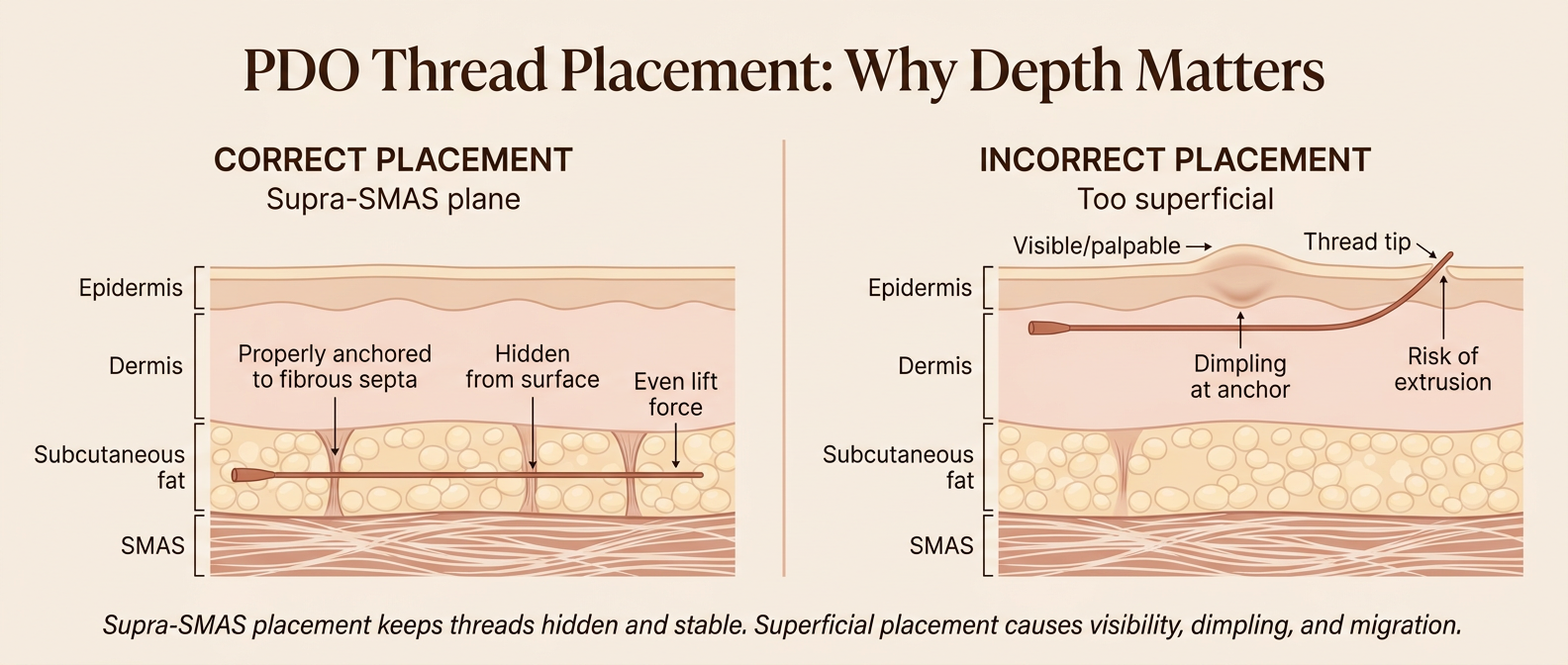
The correct plane for a PDO thread lift is the supra-SMAS layer — superficial to the SMAS fascia but deep enough to sit within fibrous tissue that can hold the barbs. At this depth threads remain hidden, anchor stably, and translate the lift evenly across the treated zone. Most well-trained practitioners place at this layer; the visual reference shows that placement.
When threads are placed superficially — too close to the dermis — the result is what patients see in “thread lift gone wrong” photos: visible cords, palpable ridges, dimpling at the entry sites, and accelerated migration as the threads lose their anchor. Depth, not the brand of thread, is the single biggest predictor of whether the result reads as natural or obvious.
Recovery guide
When to Wait, When to Call, When to Act
Thread lift recovery: how to read your symptoms after a PDO thread lift.
These can be expected (Days 1–7):
Mild edema
Tenderness at insertion points
Tightness or pulling sensation
Temporary mild unevenness
What to do: Manage with ice and rest.
Within 24–48 hours:
Persistent dimpling past 2 weeks
Visible thread tip near surface
Worsening edema after Day 3
New asymmetry after 1–2 weeks
Sharp tenderness on one side
What to do: Often manageable with evaluation.
Same-day care:
Fever or pus at insertion site
Spreading redness or warmth
Sharp one-sided pain not improving
Sudden numbness or muscle weakness
Skin color changes (white, dusky, or blue)
What to do: Do not wait — call your provider or seek emergency care.
Anatomy
Where Threads Belong: Placement Anatomy
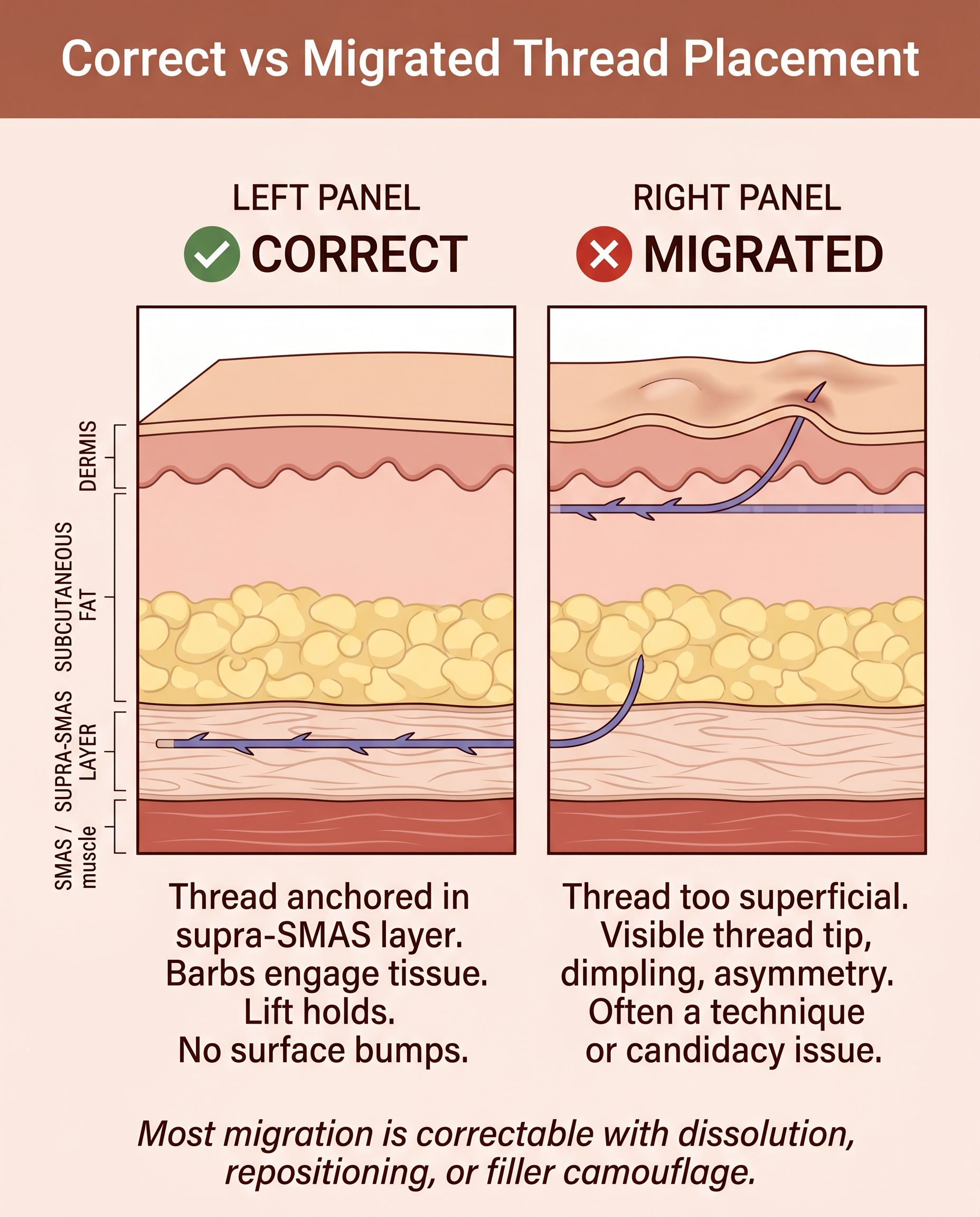
Most thread complications trace back to a single technical question — at what depth was the thread placed? The target plane is the deep subcutaneous / supra-SMAS plane — superficial to the SMAS, but deep enough to keep the thread away from the dermis. Threads anchored there engage solid tissue, hold the lift, and stay invisible from the surface.
Placed too superficially — closer to the dermis — the patient feels them, sees them, and develops the dimpling and asymmetry that brings them in for a second opinion. Superficial-placement issues are often manageable with clinical evaluation; options may include natural resorption, repositioning, trimming, or filler camouflage by a qualified injector.
Recovery Timeline: What’s Normal, What Isn’t
Days 1–3
Acute Healing
Mild swelling and tenderness expected. Cold compresses, no makeup, no saunas, no strenuous exercise. Severe pain or fever is not normal — contact your provider.
Days 4–7
Early Recovery
Most swelling resolves. Patient returns to normal activities. Persistent dimpling, visible threads, or new asymmetry should be reported.
Weeks 2–4
Tissue Settling
Threads integrate. Initial mechanical lift visible. Mild tightness or pulling sensations are normal as tissue accommodates the threads.
Months 1–3
Collagen Response
Biostimulation phase. Skin texture and firmness improve gradually as new collagen forms around the gradually resorbing thread material.
Month 6+
Full Outcome
Threads are mostly resorbed; collagen scaffold maintains the result. Final aesthetic outcome is best evaluated at six months, not immediately post-procedure.
Prevention
What Lowers the Risk Before You Sit in the Chair
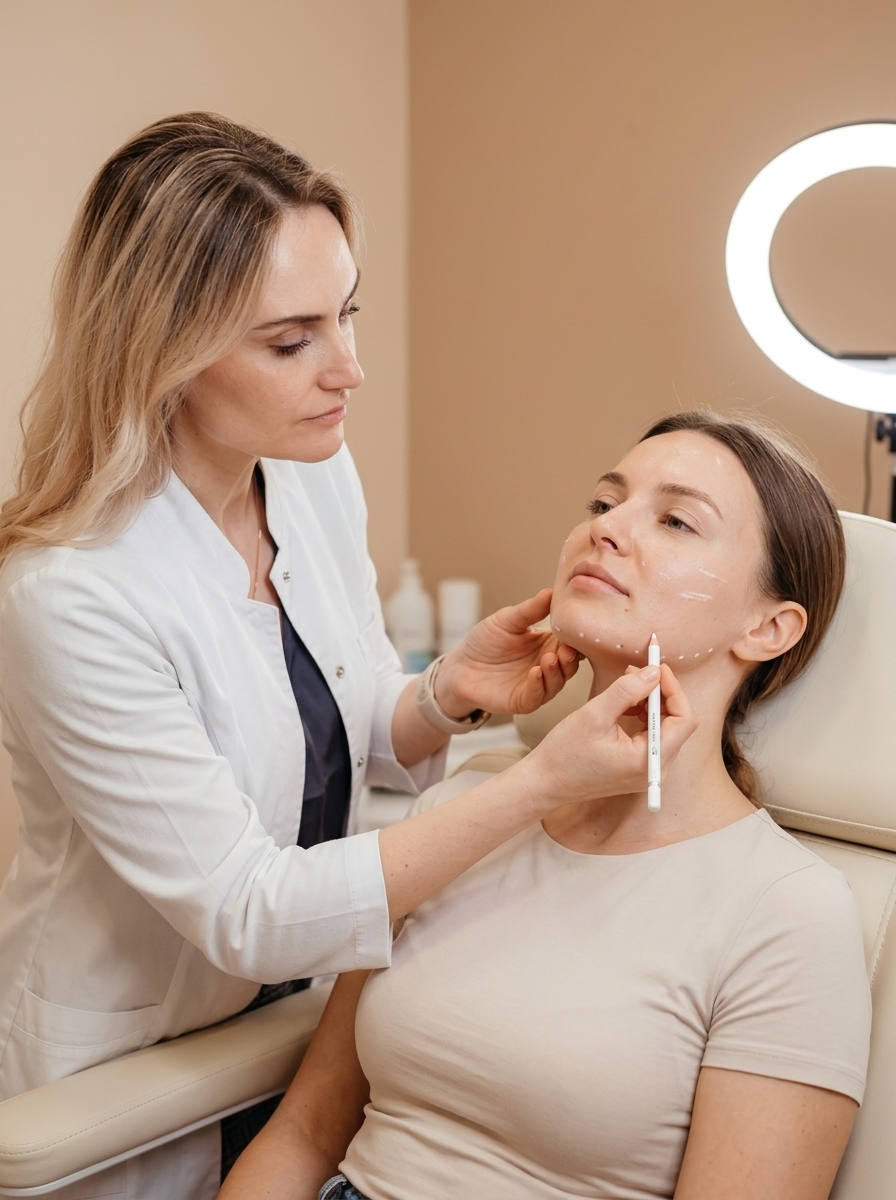
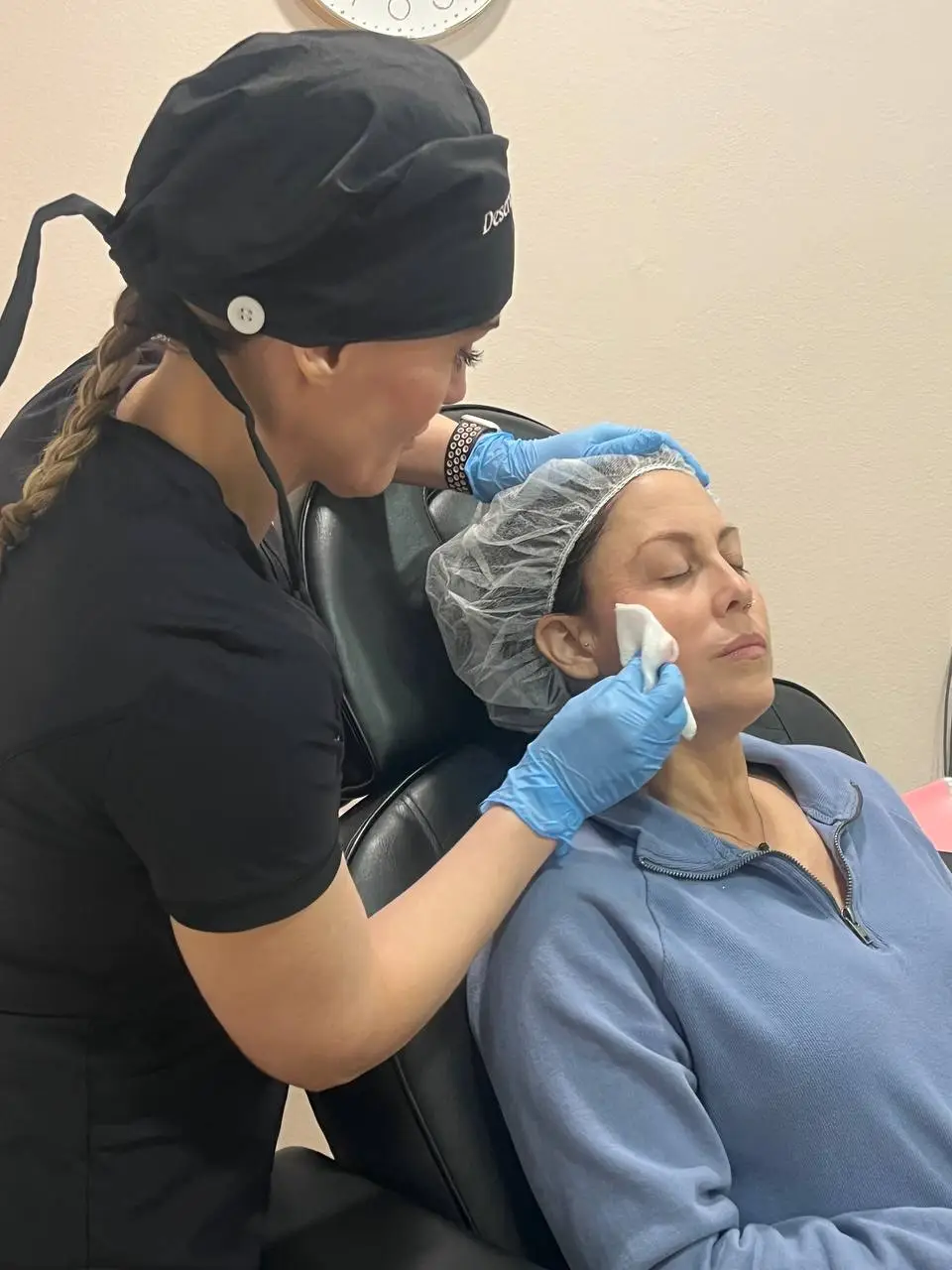
Technique matters more than setting. Ask any injector you are considering: can they show their work on tissue similar to yours? That single question filters most of the risk. Pre-procedure facial mapping is a hallmark of careful technique — every vector planned before the cannula touches the skin. Follow pre-procedure instructions: pause blood thinners (aspirin, ibuprofen, fish oil) and alcohol for one week prior when medically appropriate.
Where Thread Lifts Fit Among Other Options
Thread lifts sit between fillers (volume-based correction) and surgical facelifts (excision and structural repositioning). Knowing where they fit — and where they do not — prevents most disappointment. For a full primer, see our PDO thread lift page and our overview of PDO threads.
| Option | Thread lift | Dermal fillers (HA) | Surgical facelift | RF microneedling |
|---|---|---|---|---|
| Best for | Mild–moderate soft-tissue descent, early jowling | Volume loss, deflated mid-face | Significant laxity, excess skin | Skin laxity + texture (surface) |
| Mechanism | Repositions tissue + collagen induction | Adds volume in tissue planes | Repositions or removes tissue | Collagen induction via heat |
| Recovery | Days, mild swelling | Hours–days | 2–4 weeks | 1–3 days |
Thread lift
- Best for
- Mild–moderate soft-tissue descent, early jowling
- Mechanism
- Repositions tissue + collagen induction
- Recovery
- Days, mild swelling
Dermal fillers (HA)
- Best for
- Volume loss, deflated mid-face
- Mechanism
- Adds volume in tissue planes
- Recovery
- Hours–days
Surgical facelift
- Best for
- Significant laxity, excess skin
- Mechanism
- Repositions or removes tissue
- Recovery
- 2–4 weeks
RF microneedling
- Best for
- Skin laxity + texture (surface)
- Mechanism
- Collagen induction via heat
- Recovery
- 1–3 days
When Negligence Is Suspected
Most thread-lift complications are not negligence — they are known risks of a clinical procedure on living tissue with individual healing patterns. In rare cases where the procedure was performed by someone without appropriate qualifications, in an unsanitary environment, or with technique that fell measurably below professional standards, patients may have legal recourse. Document everything, retain consent forms and procedure notes, and consult an attorney familiar with medical aesthetics if the harm and the standard-of-care gap are both clear. This pathway is uncommon and should not be the first step.
This section is informational and not legal advice. If you are considering legal action, consult an attorney licensed in your jurisdiction.
Second Opinion
A Word on the Second-Opinion Consultation
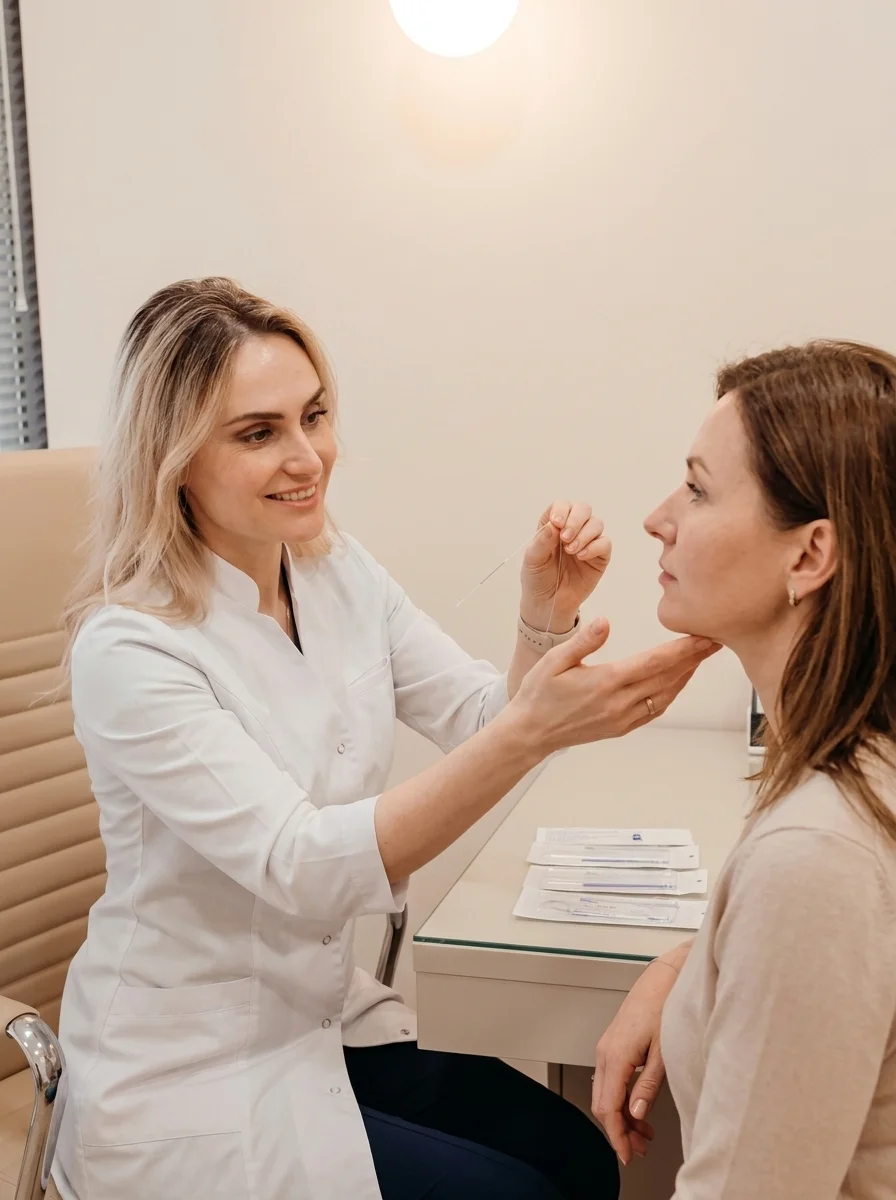
A useful second-opinion provider can explain — without defensiveness — thread depth, vector planning, tissue candidacy, correction limits, and when referral is safer than revision. Be cautious if a provider promises immediate “dissolution” of PDO threads (the threads resorb over months, not on demand), dismisses red-flag symptoms as “normal” without examining you, or refuses to refer when the situation falls outside their training.
At Desert Bloom, Dr. Natalya Borakowski, NMD offers second-opinion consultations specifically for thread-lift complications from procedures performed elsewhere — no upsell, no pressure to revise. The goal is clarity on what is happening, what is reasonable to do next, and when a different specialist is the right answer.
Disadvantages of PDO Thread Lifts (An Honest Doctor’s Take)
PDO threads are a genuinely useful tool — but they’re oversold, and they’re wrong for a lot of the people who ask for them. Here’s what I tell patients about the real downsides before they book.
1. The result is temporary. The threads dissolve in about 4–6 months; the lift you keep comes from the collagen they stimulate, and that typically holds 12–18 months — not forever. Maintaining the effect means repeating the treatment.
2. They don’t replace a facelift. Threads reposition tissue, they don’t remove it. With significant laxity, heavy jowls, or excess skin, a thread lift will underwhelm you — where that line falls is covered in PDO Thread Lift vs. Facelift Surgery.
3. The candidate window is narrow. Threads work best on mild-to-moderate laxity in skin that still has elasticity — often patients in their late 30s to 50s. Very thin skin can show or feel the threads; very heavy or very lax faces won’t hold the lift.
4. The lift is subtle and gradual. This is a “refreshed,” not “dramatic,” result. Expecting an obvious day-one before/after usually leads to disappointment — the collagen effect builds over weeks.
5. It’s heavily operator-dependent. More than almost any injectable, outcomes hinge on the injector’s anatomy knowledge and placement depth — the wrong plane is exactly how a thread lift goes wrong. A cheap price from an undertrained provider is the most expensive mistake here.
6. Cost compounds over time. Because results are temporary, the honest figure is cost per year of result, not cost per session. Over several years, repeated lifts can approach the cost of a one-time surgical option — worth doing the math if longevity is your priority.
None of this makes threads “bad.” On the right candidate, in the right hands, they’re an excellent non-surgical option — they just have to be the right tool for your face. For medical reactions like swelling and bruising, see PDO Thread Lift Side Effects.
Frequently Asked Questions
What does a thread lift gone wrong look like?
Can a botched thread lift be fixed?
How long should I wait before deciding my thread lift went wrong?
What should I do if my provider won't address my concerns?
Are thread lifts more risky than other facial procedures?
Can I have another thread lift after a bad experience?
Can PDO threads be dissolved?
If a thread lift did not go as planned, or you are considering one and want a clear-eyed clinical assessment of candidacy, we are happy to discuss your situation. Learn about PDO thread lift at Desert Bloom Skincare or schedule a second opinion or candidacy review.
“Most thread-lift complications come down to candidacy, not technique. When the patient's tissue and the practitioner's plan don't match, the result is the kind of asymmetry or migration that brings someone in for a second opinion. The good news: most of it is correctable without surgery, if it's caught early and addressed by an experienced injector.”
For documented patient outcomes from thread-lift procedures performed correctly, see our patient case studies — including a six-month thread-lift case and a jawline contouring case.
Individual results vary. Content reviewed by Dr. Natalya Borakowski, NMD. Last updated April 2026.

Have a concern like this one?
Start with a screening. We'll tell you whether a procedure is the right tool — and which one.
Visit our Scottsdale aesthetic center
Address
10752 N 89th Place,
Ste 122B · Scottsdale, AZ 85260
Phone: (480) 567-8180
E-mail: info@desertbloomskincare.com
Get directionsLocation & directions
Conveniently located in the Shea Corridor of North Scottsdale, within Edwards Professional Park I — minutes from HonorHealth Scottsdale Shea and the Mayo Clinic Scottsdale Campus.
From the North / South: Take Loop 101 and exit at E Shea Blvd, just East of the freeway.
Parking: Ample free parking directly in front of Suite 122B.
Areas we serve
Scottsdale
North Scottsdale · McCormick Ranch · Gainey Ranch
Paradise Valley
Cave Creek & Carefree