Jawline Filler in Scottsdale, AZ 85260

Jawline Filler in Scottsdale, AZ
It usually starts with a photo. Not a dramatic change — just a softness where there used to be an edge. The jawline that once framed your face now blends into the neck, or a shadow along the chin has shifted into something less defined. Jawline filler is a non-surgical procedure that restores structural definition along the mandible and chin using dermal fillers at Desert Bloom. Dr. Natalya Borakowski assesses facial anatomy, skin quality, and bone structure to determine the right filler type, placement, and volume for natural-looking results — with minimal downtime and no surgery.
At a Glance
Non-surgical jawline definition with hyaluronic acid or calcium hydroxylapatite fillers. 45-minute procedure, 1–3 syringes, $600–$720 per syringe. Complimentary consultation. Results last 12–24 months.
Jawline filler is one of several dermal filler treatments at Desert Bloom, alongside cheek filler, chin filler, temple filler, and lip augmentation.
What Is Jawline Filler?
Jawline filler refers to dermal fillers injected along the mandibular angle, jawline body, and pre-jowl sulcus to add structural support, sharpen facial contours, and reduce the appearance of jowls or sagging skin. The non-surgical procedure takes approximately 45 minutes and requires no general anesthesia.

Two filler families are most commonly used. Calcium hydroxylapatite (CaHA) fillers like Radiesse are the primary choice for jawline contouring at Desert Bloom — non-diluted Radiesse provides structural scaffolding and stimulates the body’s natural collagen production over several months. For patients who prefer a reversible option, firm hyaluronic acid (HA) fillers such as Restylane Lyft, Restylane Defyne, or Restylane Contour deliver immediate volume through a cross-linked gel matrix. The choice depends on facial structure, aesthetic goals, and whether reversibility matters to the patient.
Jawline filler is not one-size-fits-all. The mandibular angle, jawline body, and chin projection each respond differently, which is why a careful assessment of bone structure, soft tissue behavior, and skin quality determines the approach before any injection.
What Jawline Filler Can Improve
A sculpted jawline does more than shape the lower face — it anchors the entire profile. When volume and facial structure diminish over time, the effect shows in ways that feel disproportionate to the actual change. Filler treatment can address several of these concerns simultaneously:
- Weak or receding jawline definition: adding volume along the mandibular body to create a visible, refined contour
- Early jowling and pre-jowl sulcus: restoring volume to smooth the transition between chin and jaw
- Asymmetry along the mandible: balancing the left and right sides for a more symmetrical lower face
- Weak chin: combining jawline filler with chin filler to complete the profile for a more cohesive, balanced result
- Facial balance: improving the relationship between the upper and lower face through facial balancing with fillers
- Volume loss from aging or weight changes: including facial volume loss related to rapid weight reduction (sometimes called “Ozempic face”), where the jawline loses structure even in younger patients
Jawline Filler for Women vs. Men
For women, Dr. Borakowski generally does not recommend filler along the mandibular body unless there is a genetically weak bone structure. Widening the jawline’s appearance can create a masculine look that conflicts with feminine facial proportions. Instead, most women benefit from chin filler for projection and contour — creating a more tapered, feminine profile without adding bulk to the jaw itself. For women whose primary concern is a square or wide jaw, masseter Botox is the recommended approach: slimming the masseter muscle narrows the lower face width without adding volume where it doesn’t belong.
For men, jawline filler is the primary treatment. Men typically seek a stronger gonial angle, sharper mandibular definition, and a more angular profile overall. Jawline filler for men often includes filler in the chin area as well, building a cohesive masculine jawline with width and definition. Dr. Borakowski adjusts filler type and placement accordingly — a masculine jawline requires a different injection strategy than a feminine one.
Replace weight loss for submental fullness: filler shapes and defines the jaw but does not address a double chin caused by excess fat
Permanently change bone structure: results are temporary, lasting 12 to 24 months depending on the product
Replace surgery: significant jowling with tissue descent requires repositioning, not volume alone
Who Is a Good Candidate?
Ideal candidates for jawline filler:
- Mild to moderate loss of jawline shape and definition
- Desire for non-surgical jawline enhancement
- Adequate skin quality (mild laxity is acceptable)
- Realistic expectations about what cosmetic procedures can achieve
- Good skin health, no active infections along the jaw area
- Not currently taking blood thinners or aspirin (or can pause under physician guidance)
- No history of allergic reaction to HA or CaHA fillers
- No active autoimmune conditions such as lupus or scleroderma
Types of Dermal Fillers for Jawline Definition
| Feature | Hyaluronic Acid (HA) Fillers | Calcium Hydroxylapatite (CaHA) |
|---|---|---|
| Products | Restylane Lyft, Restylane Defyne, Restylane Contour | Radiesse (non-diluted) |
| How it works | Adds immediate volume with cross-linked HA gel | Provides structural support + stimulates natural collagen production |
| Duration | 12–18 months typically | 15–24 months in some patients |
| Reversibility | Yes — hyaluronidase can dissolve HA fillers | Not reversible |
| Best for | Patients wanting a reversible option; first-time filler | Patients seeking long-lasting results with structural support |
| Texture | Smooth gel | Slightly firmer, more structural |
Radiesse vs. Restylane Defyne vs. Restylane Lyft: Which Is Right for Your Jaw?
Jawline filler selection depends on what the lower face actually needs: immediate structure, reversibility, or collagen-stimulating support over time. Restylane Defyne is a flexible, firm HA filler well-suited for jawline contouring — it moves naturally with facial expressions while maintaining structural support. Restylane Lyft is a denser, high-lifting HA filler that delivers strong projection and is effective along the mandibular body and lateral jaw. Radiesse (CaHA) occupies a different category entirely: a biocompatible synthetic filler associated with collagen stimulation over time in addition to immediate structural support — long-lasting and structurally robust, but not reversible.
For patients who want to restore a more youthful appearance with a natural-looking, sculpted jawline, the choice between these products depends on anatomy, goals, and whether a reversible safety net matters. Dr. Borakowski discusses these options during the consultation based on your individual facial features and desired outcome.
HA fillers remain a popular choice for jawline treatment because they offer visible results immediately and can be adjusted or dissolved if needed. CaHA fillers appeal to patients who want a longer-lasting structural scaffold. If filler is ever placed incorrectly, dermal filler removal is available for HA products.
For patients seeking gradual improvement through collagen stimulation rather than immediate volume, poly-L-lactic acid (PLLA) products like Sculptra biostimulator offer another pathway — stimulating natural collagen production over several months.
What to Expect During Your Jawline Filler Appointment
The procedure follows a deliberate sequence. Rushing injections along the mandible is how problems happen — precision matters more than speed in this area.
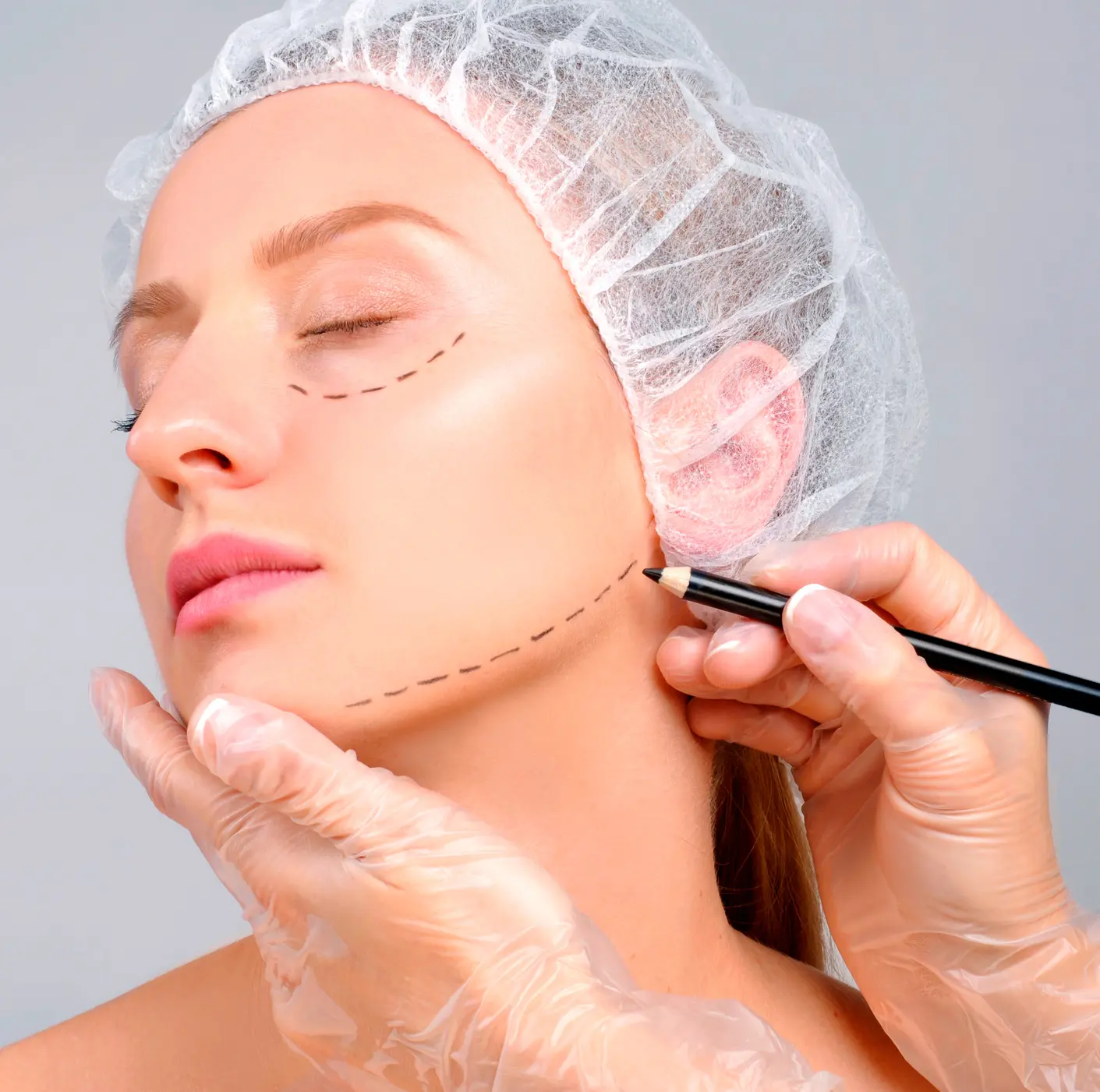
Dr. Borakowski evaluates bone structure, skin quality, the masseter muscle boundary, and aesthetic goals. This first step determines whether jawline filler is the right approach and what natural-looking results are achievable.
Dr. Borakowski uses face-mapping as a standard pre-injection protocol, evaluating filler type, injection sites, and number of syringes based on individual anatomy. Most patients need 2 to 3 syringes for full jawline definition.
Extra-strength topical numbing cream is applied 45 minutes before injection. Most HA fillers also contain lidocaine, which further reduces discomfort. Patients typically describe the sensation as a slight pinch.
Filler is placed along the mandibular angle and jawline body using a thin needle or cannula technique. The approach adapts to individual anatomy — cannula for broader volume distribution, needle for targeted definition. The procedure takes approximately 45 minutes.
Immediate results are evaluated in real time. Adjustments are made if needed. Final, natural-looking results become visible once the healing process completes — typically around two weeks.
Jawline Filler Results: What to Expect
Results from jawline filler depend on the product used and the individual patient’s anatomy. Initial results are visible immediately after treatment — the most natural-looking, refined contour becomes visible once swelling resolves, typically at the two-week mark.
Visible jawline shape and structural improvement. Mild swelling and possible bruising are normal — the jaw area tends to swell more than other facial zones.
Swelling resolves and filler settles into its final position. Natural-looking results become fully visible. Patients often describe the outcome as looking like what they used to look like — not like something was added.
For CaHA fillers (Radiesse), collagen production continues building over this period. The structural result may actually improve during this window as the skin firms in response to new collagen.
Depending on filler type, gradual resorption occurs. HA fillers typically last 12–18 months. CaHA fillers may last 15–24 months. Touch-up treatment maintains the result without starting from scratch.
Long-lasting results depend partly on metabolic rate — patients with faster metabolisms process filler more quickly. Skin quality, nicotine use, sun exposure, and overall health also affect how long results hold.
Side Effects and Safety of Jawline Filler
Jawline filler has a well-established safety profile when performed by an experienced provider with detailed knowledge of facial anatomy. The jaw area involves critical vascular structures — specifically the facial artery, which crosses the mandibular border just anterior to the masseter muscle, making this area an important vascular danger zone during lower-face injection (Piagkou et al., 2024, PMID 39376351) — which is why provider expertise and precise injections are non-negotiable safety factors.
Mild skin discoloration or tenderness at the treatment area
Temporary numbness along the jawline
All typically resolve within days
Severe pain disproportionate to injection
Any vision changes
Blue-gray skin color changes near the injection area
These may signal vascular occlusion and require urgent attention.
Aftercare instructions are provided at every appointment. Following them — including avoiding strenuous physical activities for 24+ hours, avoiding saunas or heat for several days, and not pressing on the jaw area — reduces common side effects and supports the best possible results.
How Much Does Jawline Filler Cost in Scottsdale?
At Desert Bloom Skincare, jawline filler costs $600 to $720 per syringe, depending on the product selected. Most patients need 1 to 3 syringes for jawline contouring, investing $600 to $2,160 for their initial treatment. The consultation is complimentary. Every treatment includes consultation, filler, and a follow-up assessment to review final results.
The total investment is an ongoing commitment — touch-ups every 12 to 24 months maintain the defined jawline contour. The total cost per year is often less than patients expect once longevity is factored in. Cost should not be the deciding factor for any non-surgical facial procedure — the provider’s experience, the quality of the products, and the assessment process matter far more than price per syringe.
Jawline Filler vs. Other Options
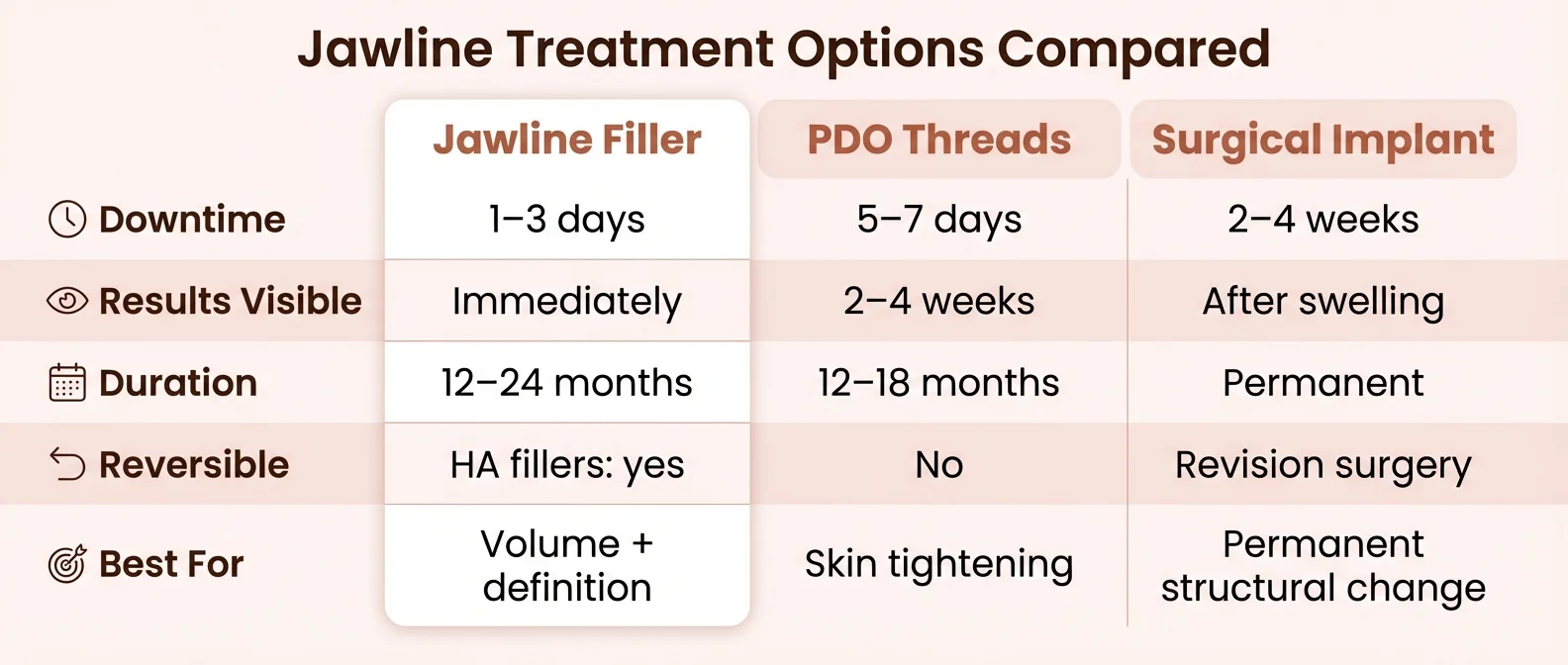
| Factor | Jawline Filler | PDO Threads | Surgical Implant |
|---|---|---|---|
| Procedure time | ~45 min | 30–60 min | 1–2 hours |
| Downtime | 1–3 days | 5–7 days | 2–4 weeks |
| Results visible | Immediately | 2–4 weeks | After swelling |
| Duration | 12–24 months | 12–18 months | Permanent |
| Reversible | HA fillers: yes | No | Revision surgery |
| Best for | Volume + shape | Skin tightening + lift | Permanent structural change |
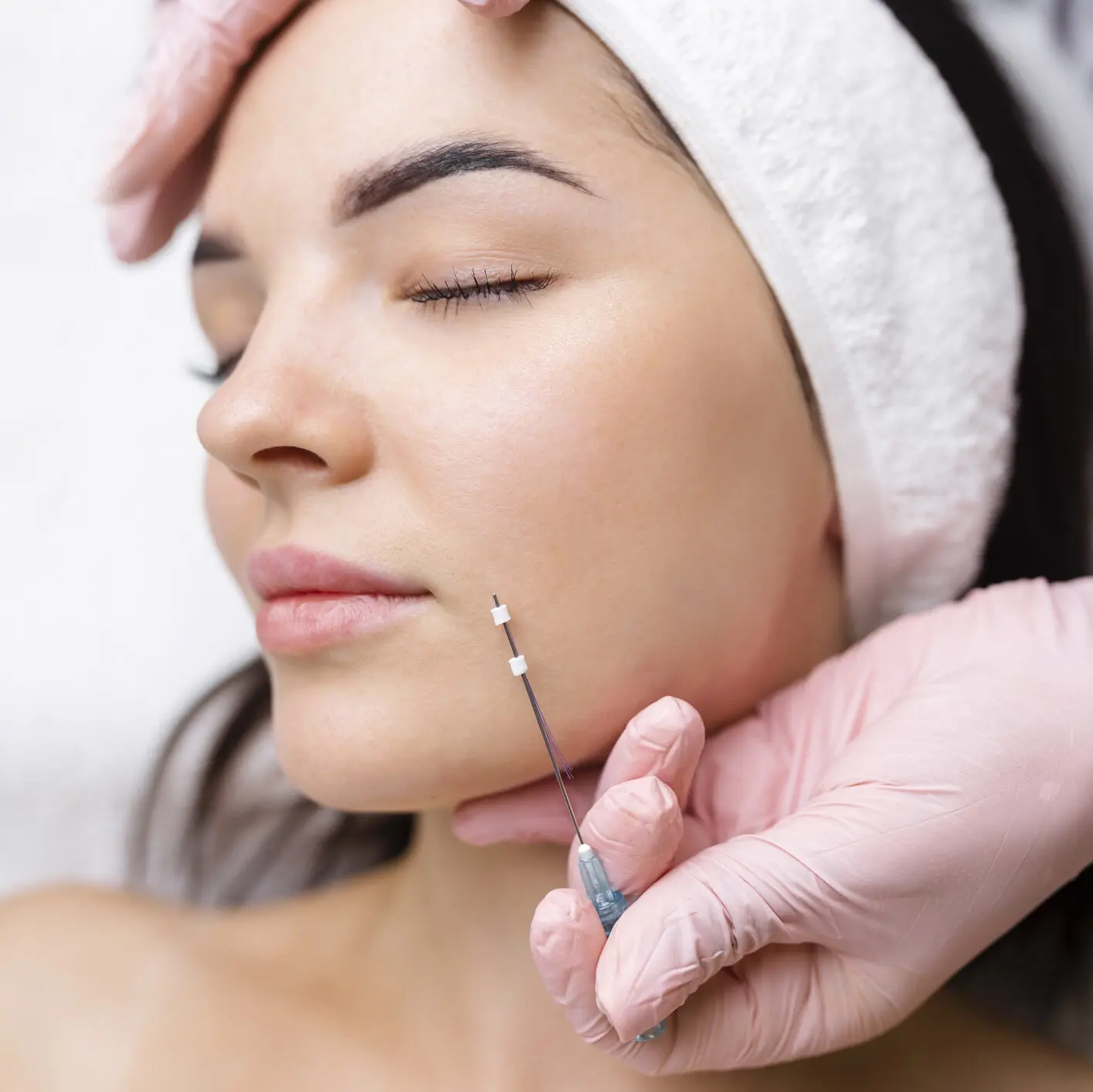
A PDO thread lift works differently than filler — it lifts and repositions tissue rather than adding volume. For patients whose primary issue is skin laxity rather than volume loss, threads may produce better results. Some patients benefit from combining both approaches through a non-surgical facelift that addresses multiple concerns simultaneously.
Treatment Alternatives: Masseter Botox for Women
For women who want a more tapered, feminine jawline, masseter Botox is often the better approach — not jawline filler. Dr. Borakowski does not combine masseter Botox and jawline filler in the same session; these are typically alternatives to each other based on what the patient’s anatomy actually needs.
- Masseter Botox slims the lower face by relaxing the masseter muscle, reducing the appearance of a square or wide jaw. This is the primary recommendation for women whose concern is jaw width rather than structural definition. Results build over 4–6 weeks and are repeatable.
- Jawline filler (for women) is reserved for patients with a genetically weak bone structure — where the goal is to add structural support where volume is missing, not to widen an already-present jaw. Most women benefit more from chin filler for projection rather than mandibular body filler.
- For men, jawline filler and chin filler are frequently combined in the same session to build a cohesive masculine jawline — this is the standard male treatment plan at Desert Bloom.
The right choice depends on a single key question: does this patient need more volume, or less width? The consultation answers that question before any injection is planned.
Complementary Options
For men, creates a cohesive lower face contour. A weak chin treated alongside the jawline creates the sharper angle and profile balance most patients are seeking.
Learn more →Restores mid-face volume that supports facial balance between the upper and lower face.
Learn more →Addresses hollowing that becomes more visible once the jawline is restored.
Learn more →Tightens and improves skin quality along the jawline, supporting natural collagen production in the overlying skin.
Learn more →Why Choose Desert Bloom Skincare
Dr. Natalya Borakowski, NMD begins every jawline filler consultation with a facial anatomy assessment — evaluating bone structure, skin quality, existing volume, masseter muscle size, and goals before selecting a product or planning a single injection point. Her naturopathic training gives her a whole-face perspective: she considers how the jawline relates to the chin, cheeks, and temples rather than injecting in isolation.

She is familiar with both HA and CaHA filler behavior, and she selects between Restylane Defyne, Restylane Lyft, Restylane Contour, and Radiesse based on what the individual jaw anatomy actually needs — not on what is quickest or most available. Her philosophy is to build visible results gradually — adding volume in stages so patients can see how their face responds, rather than over-correcting in a single session. Facial sculpting that addresses multiple zones produces more harmonious, natural-looking results than treating one area at a time.
“Jawline definition is about proportion and balance — not just adding volume along the mandible. Often, augmenting the chin and jawline together delivers the most natural-looking results. Every face has a framework, and the goal is to support what is already there.”
Frequently asked questions
How long does jawline filler last?
HA fillers typically last 12 to 18 months. Calcium hydroxylapatite fillers like Radiesse may last 15 to 24 months in some patients. Duration depends on the product, metabolism, and volume injected. Skin quality, nicotine use, and lifestyle factors also play a role.How many syringes do I need for jawline filler?
Most patients need 1 to 3 syringes for noticeable jawline contouring. Dr. Borakowski determines the exact amount during the consultation based on facial structure and aesthetic goals.Is jawline filler painful?
Most patients report mild discomfort — closer to a slight pinch than significant pain. Extra-strength topical numbing cream is applied 45 minutes before treatment, and most HA fillers contain lidocaine. The procedure takes approximately 45 minutes.Can jawline filler help with jowls?
Filler can reduce the appearance of early jowling by restoring volume along the pre-jowl sulcus. Significant jowling with saggy skin and tissue laxity may respond better to a PDO thread lift or a surgical approach.What is the difference between jawline filler and chin filler?
Jawline filler adds definition along the mandibular body and angle, widening and sharpening the jaw’s appearance. Chin filler projects the chin forward and improves profile balance. Many patients benefit from both for complete lower face contouring — particularly when a weak chin is contributing to the imbalance.Is jawline filler safe?
Jawline filler is generally considered safe when performed by a qualified, experienced provider with detailed knowledge of facial anatomy. The most serious risk, though rare, is vascular occlusion — the facial artery near the jawline is an area that requires precise injections and anatomical training to protect. Provider selection is the single most important safety decision.Do men get jawline filler?
Yes. Men commonly seek jawline filler for a more defined, angular jaw. Goals differ from female patients — men typically want a stronger gonial angle, a more angular facial profile, and a sharper masculine jawline with clear definition. Dr. Borakowski adjusts technique, product choice, and volume accordingly.Can jawline filler be reversed?
Hyaluronic acid fillers can be dissolved with hyaluronidase — this is an important safety net for first-time patients. Calcium hydroxylapatite (Radiesse) is not reversible and must be allowed to metabolize naturally.What should I avoid after jawline filler?
Avoid strenuous physical activities for 24 hours or more. Do not touch or press the injection sites. Avoid saunas, steam, or direct heat for several days. Sleep elevated the first night. Follow the aftercare instructions provided at your appointment.How soon can I see results?
HA fillers show visible results immediately, though mild swelling may take 1 to 2 weeks to fully resolve. CaHA fillers continue improving over several months as natural collagen production increases beneath the skin.Should I get jawline filler or masseter Botox?
This depends on your goal. If you want a more defined, angular jaw — especially as a man — jawline filler adds structural volume along the mandible. If you want to slim a wide or square jaw — especially as a woman — masseter Botox relaxes the muscle that creates that width. Dr. Borakowski does not combine these two treatments in the same session; most patients need one or the other based on their anatomy and goals.Book Your Jawline Filler Consultation
Jawline filler starts with understanding what your face actually needs — a plan built around your anatomy, your goals, and what cosmetic procedures will serve you best. At Desert Bloom Skincare in Scottsdale, Dr. Borakowski offers a complimentary consultation to assess facial structure, evaluate skin quality, and determine whether jawline filler treatment, a combination approach, or a different procedure is the right path.
Desert Bloom Skincare
10752 N 89th Place, Suite 122, Scottsdale, AZ 85260
(480) 567-8180
← Explore all dermal filler treatments at Desert Bloom
References
- “Avoiding and treating blindness from fillers: a review of the world literature.” Dermatologic Surgery. 2015. DOI
- “Injectable filler techniques for facial rejuvenation, volumization, and augmentation.” Facial Plastic Surgery Clinics of North America. 2015. DOI
- “Facial artery anatomy and clinical implications for aesthetic procedures.” Surgical and Radiologic Anatomy. 2024. (PMID 39376351)
- “Plastic surgery statistics report.” ASPS National Clearinghouse. 2024. (plasticsurgery.org annual statistics)
Content reviewed by Dr. Natalya Borakowski, NMD. Last updated: April 2026. This information is intended for educational purposes only and does not replace professional medical advice. Individual results vary. Dermal fillers are FDA-cleared for specific indications; off-label use is at the provider’s discretion.
Jawline Filler price
- Jawline Filler$600+45 min
Consultation in skin care clinic
Desert Bloom Skincare Center offers personalized skincare consultation to help you achieve a flawless and radiant complexion. Book your appointment today and let our expert team of skincare professionals address your specific concerns and help you reach your skincare goals.
Similar treatments
Visit Our Scottsdale Aesthetic Center
Address
10752 N 89th Place, Suite 122,Scottsdale, AZ 85260.
Phone:(480) 567-8180
E-mail:info@desertbloomskincare.com
Get Directions →Location & Directions
Desert Bloom Skincare is conveniently located in the Shea Corridor of North Scottsdale, within Edwards Professional Park I — minutes from HonorHealth Scottsdale Shea Medical Center and the Mayo Clinic Scottsdale Campus.
Areas We Serve
We proudly provide expert non-surgical rhinoplasty and PDO thread lifts to patients across the Southwest:
- ScottsdaleNorth Scottsdale · McCormick Ranch · Gainey Ranch
- Paradise Valley
- PhoenixArcadia · Biltmore · North Phoenix
- Fountain Hills
- Cave Creek & Carefree