Wegovy Face Changes: Why Your Face Looks Different After Semaglutide & How We Treat It in Scottsdale


Wegovy Face Changes: Why Your Face Looks Different After Semaglutide & How We Treat It in Scottsdale If you've been losing weight on Wegovy, Ozemp
If you’ve been losing weight on Wegovy, Ozempic, or Mounjaro, you may have noticed something unexpected in the mirror: hollow cheeks, deeper lines, or loose skin along your jawline. This phenomenon—often called “Wegovy face” or “Ozempic face”—catches many patients off guard. At Desert Bloom Skincare Center in Scottsdale, Dr. Natalya Borakowski helps patients address these facial changes with customized, non-surgical treatment plans.
Key Takeaways
- What it is
- Wegovy face — facial hollowing, sagging skin, and wrinkles from rapid GLP-1 weight loss. Not a direct medication side effect.
- Root cause
- Fat loss reveals pre-existing sun damage and reduced skin elasticity; the medication does not destroy collagen.
- Our approach
- Dr. Borakowski restores volume in cheeks, jawline, and temples using non-surgical options only.
- Treatment options
- HA fillers (RHA, Restylane), biostimulators (Sculptra, Radiesse), RF microneedling (Virtue RF), lasers, PDO thread lifts.
- First step
- Individualized assessment — no package deals. Request a consultation to discuss your anatomy and timeline.
What Is “Wegovy Face” and How Fast Can It Happen?
Wegovy face describes the hollowed appearance, deep nasolabial folds, sunken eyes, and sometimes loose skin around the jaw and neck that develop over 3–12 months of significant weight loss on semaglutide or similar weight loss medications.
Patients often describe it as: “I love my body, but my face looks tired or older.”
This is a visual change, not an official diagnosis. The underlying mechanism involves facial fat pads—particularly in the midface, temples, and under-eyes—shrinking faster than many body areas. As underlying fat disappears, bone structure becomes more prominent and skin folds deepen.
In Dr. Borakowski’s Scottsdale practice, most noticeable changes appear after losing around 15–30 pounds, especially when that loss happens in under 6–9 months. Similar facial changes occur after bariatric surgery or aggressive dieting. The cause is rapid fat loss, not something unique to Wegovy itself.
Why Weight Loss Medications Change Your Face
Semaglutide and other GLP-1 medications aid weight loss by reducing appetite and slowing gastric emptying, creating a calorie deficit that leads to total body weight reduction—including in the face.
- Wegovy is not “melting” collagen or destroying skin cells
- The face looks older because fat pads shrink while pre-existing sun damage and age-related changes become more obvious
- Collagen production declines with age, becoming more pronounced in patients over 40—making these changes more visible in older patients
Main Anatomic Changes
| Area | What Happens |
|---|---|
| Midface/cheeks | Loss of fat pad volume creates gaunt appearance |
| Temples | Hollowing exposes bone structure |
| Nasolabial folds | Deeper creases from mouth to nose |
| Jawline | Development or worsening of jowls |
| Under-eyes | Tear trough hollows become more visible |
What Happens
- Midface/cheeks
- Loss of fat pad volume creates gaunt appearance
- Temples
- Hollowing exposes bone structure
- Nasolabial folds
- Deeper creases from mouth to nose
- Jawline
- Development or worsening of jowls
- Under-eyes
- Tear trough hollows become more visible
Risk factors that make facial changes more pronounced:
- Age over 40–45
- Long-term Arizona sun exposure
- Smoking history
- Thin or dry skin types
- Very rapid weight loss (more than ~2 pounds per week)
How Common and How Severe Are Wegovy-Related Face Changes?
Not everyone on medications like Ozempic develops dramatic facial changes. Mild hollowing is common, but more severe gauntness tends to appear in those with larger or faster weight loss—for example, 30–60+ pounds in under a year.
The 2021 STEP 1 trial (Wilding et al., NEJM, DOI: 10.1056/NEJMoa2032183) reported average weight loss of 14.9% body weight at 68 weeks in patients on semaglutide 2.4 mg. For a 200-pound person, that’s roughly 30 pounds—enough to trigger noticeable facial appearance changes in many patients.
- Subtle cheek deflation visible only in photos
- Obvious hollowed appearance with sharp cheekbones
- Loose skin along the jawline, especially in postmenopausal women and men over 50
The face often shows these changes before the body catches up with toning. Many patients are surprised when friends comment on their changed facial appearance more than their overall weight loss progress.
The reassuring news: most changes are modifiable through effective treatments tailored to your anatomy.
Can Wegovy Face Improve on Its Own?
Some mild skin laxity and fine lines may improve naturally over 6–18 months after weight stabilizes, especially in younger patients with good elasticity and minimal sun damage.
- Large weight losses (40–50+ pounds) significantly limit how much skin can “snap back”
- Older age reduces natural recovery
- Deep hollowing or jowls rarely resolve fully without treatment
- Regaining a few pounds can partially refill facial volume, but may come with uneven fat distribution and health consequences
Non-Surgical Treatments for Wegovy Face
At our Scottsdale clinic, all injectable, laser, and thread treatments are personally performed by Dr. Natalya Borakowski, NMD. Every Wegovy face plan is individualized after a full-face assessment including frontal and profile views, animation analysis, and skin quality evaluation.
Dr. Borakowski's Three Treatment Priorities
Every Wegovy face plan is staged in this order after a full-face assessment.
She avoids “overfilling” to chase pre-diet fullness, instead aiming for proportional harmony between facial contours and your healthier new body weight.
Combination therapy is common—for example, filler plus RF microneedling or PDO threads—because Wegovy face usually involves both lost volume and skin laxity.
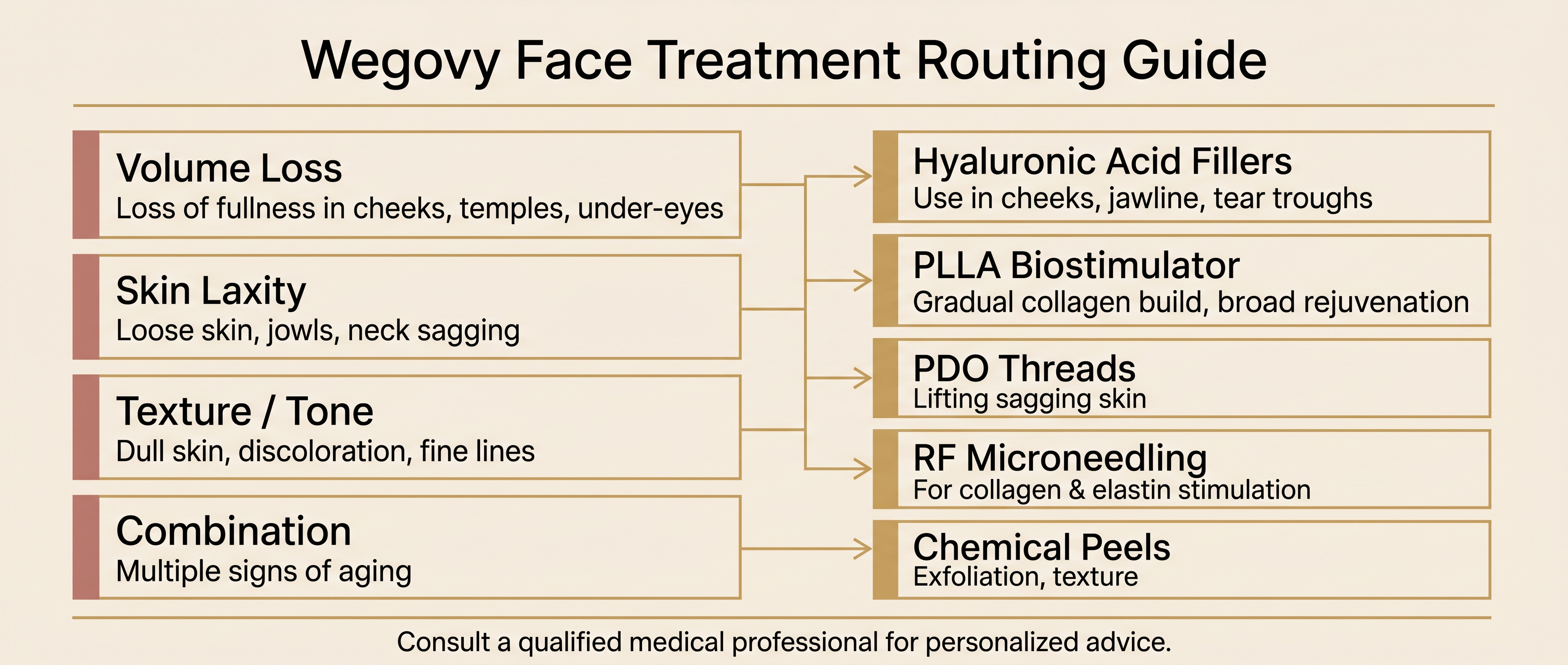
Which Treatment Fits Your Concern?
Because Wegovy face involves multiple anatomical changes, choosing where to start depends on your primary concern. Use this guide as a first orientation—Dr. Borakowski will refine the path during your assessment.
Treatment Routing Guide
| Primary Concern | Starting Point |
|---|---|
| Hollow cheeks, sunken under-eyes, lost midface volume | Dermal fillers (HA: Restylane, RHA) for immediate, precise correction |
| Global facial deflation across temples, cheeks, and lower face | Sculptra or Radiesse biostimulators for gradual, widespread rebuilding |
| Mild to moderate jawline sagging or jowling | PDO thread lift for mechanical lift + collagen stimulation |
| Crepey, thin, or loose skin texture | Virtue RF microneedling or laser resurfacing to thicken and firm |
| Surface dullness, uneven tone, or “tired” look | Advanced facials & chemical peels for maintenance and radiance support |
Starting Point
- Hollow cheeks, sunken under-eyes, lost midface volume
- Dermal fillers (HA: Restylane, RHA) for immediate, precise correction
- Global facial deflation across temples, cheeks, and lower face
- Sculptra or Radiesse biostimulators for gradual, widespread rebuilding
- Mild to moderate jawline sagging or jowling
- PDO thread lift for mechanical lift + collagen stimulation
- Crepey, thin, or loose skin texture
- Virtue RF microneedling or laser resurfacing to thicken and firm
- Surface dullness, uneven tone, or “tired” look
- Advanced facials & chemical peels for maintenance and radiance support
Restoring Lost Facial Volume with Dermal Fillers
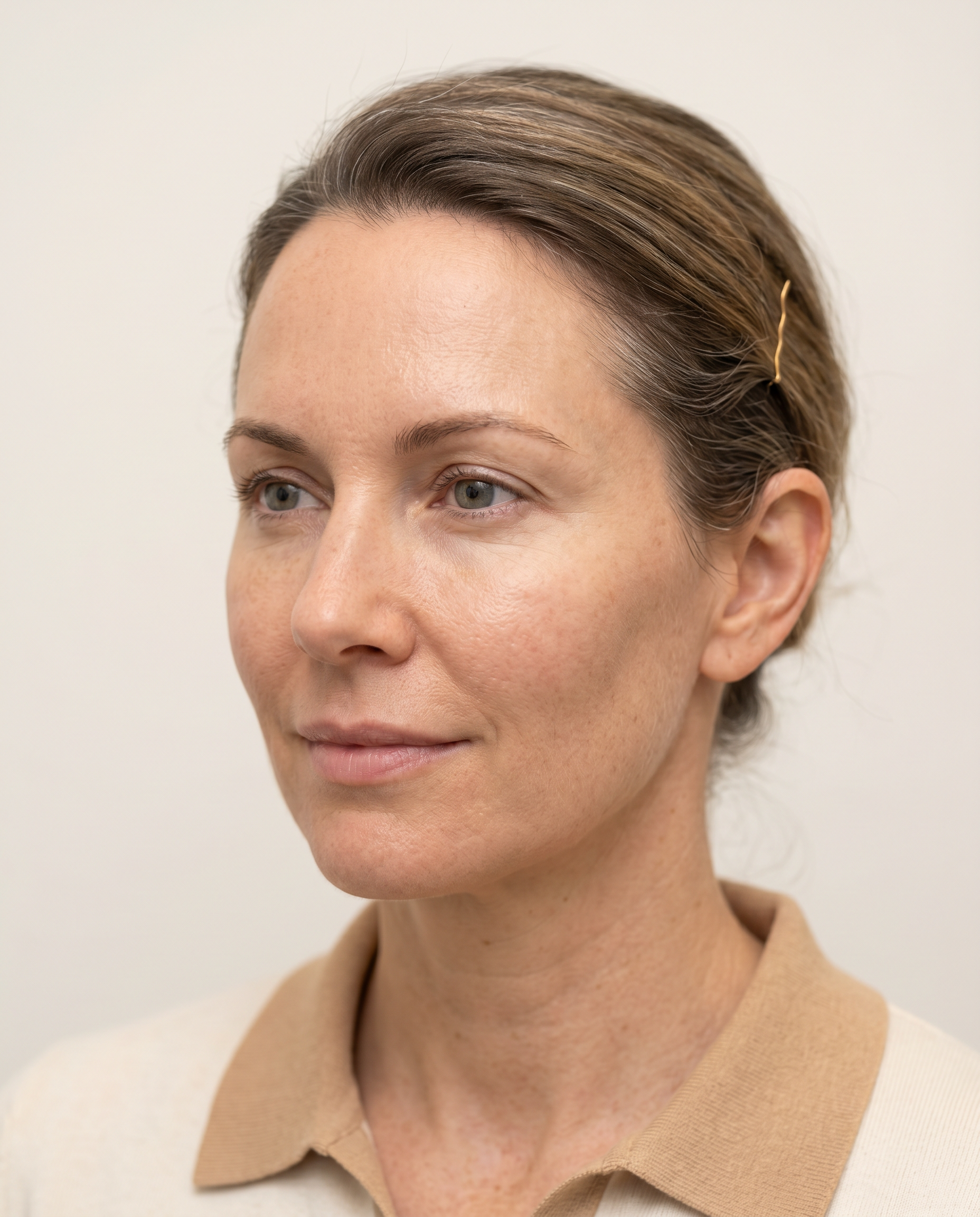
Dermal fillers are injectable gels used to restore volume, smooth wrinkles, and gently lift tissues. At Desert Bloom, we primarily use RHA fillers and the Restylane family—HA products that integrate naturally with facial anatomy and can be dissolved if refinement is needed.
Common Treatment Areas for Wegovy Face
| Area | Recommended Products |
|---|---|
| Midface/cheeks | Restylane Lyft for deeper support |
| Under-eyes | Restylane Eyelight for tear troughs |
| Nasolabial folds | Restylane Defyne/Refyne |
| Marionette lines | RHA collection for dynamic areas |
| Lips | Restylane Kysse or Silk if loss made lips appear thinner |
Recommended Products
- Midface/cheeks
- Restylane Lyft for deeper support
- Under-eyes
- Restylane Eyelight for tear troughs
- Nasolabial folds
- Restylane Defyne/Refyne
- Marionette lines
- RHA collection for dynamic areas
- Lips
- Restylane Kysse or Silk if loss made lips appear thinner
Treatment plans emphasize conservative dosing first—typically 2–4 syringes over 1–2 sessions—with reassessment at 2–4 weeks for fine-tuning.
Results are immediate, with best outcomes appearing after 1–2 weeks as swelling resolves. Typical longevity ranges from 9–18 months depending on product, location, and metabolism. These HA fillers can be dissolved if adjustments are needed, offering precise, adjustable correction with flexibility built in.
Biostimulatory Fillers for Global Facial Rebuilding
Biostimulatory fillers stimulate collagen production rather than simply filling space—ideal for larger, more diffuse facial volume loss common after significant weight loss. Where HA fillers excel at targeted correction, biostimulators are the better tool when the entire facial framework needs rebuilding.
Two Biostimulatory Options
Both stimulate collagen production rather than simply filling space — ideal for larger, more diffuse facial volume loss.
Dr. Borakowski often combines small amounts of hyaluronic acid filler for precise contouring with Sculptra or diluted Radiesse for broader volume restoration. Treatment typically involves 2–3 sessions spaced 4–8 weeks apart, with gradual rather than overnight results.
Patients who’ve lost 30+ pounds are often better served by starting with biostimulators to rebuild the deeper framework first—then adding precise HA correction once the foundation is established.
PDO Thread Lifts for Mild to Moderate Sagging
PDO thread lifts provide mechanical lift and stimulate collagen in patients with mild to moderate sagging skin who are not candidates for—or don’t want—surgical intervention.
Dr. Borakowski performs PDO Thread Lift, Neck Thread Lift, and Brow Lift (threads) herself, selecting vector patterns based on where weight loss has created jowls, flattened cheeks, or descended brows.
Threads work especially well for patients with good remaining volume but persistent sagging appearance along the jawline, marionette area, or neck.
- Subtle lift visible immediately
- Continued improvement over several months as collagen forms
- Results typically last 12–18 months
- Minimal downtime; minor bruising possible in first days
Thread lifts are best for mild to moderate laxity—not for very heavy or extremely lax skin. They work most effectively when combined with volume restoration: fillers or biostimulators to re-inflate deflated compartments, threads to redrape the overlying skin. If laxity is severe or skin has lost significant structural integrity, Dr. Borakowski will be direct about the limits of non-surgical options.
RF Microneedling and Laser Resurfacing
Significant weight loss often reveals thin, crepey facial skin that used to be stretched over fuller fat. Radiofrequency microneedling and laser treatments address these skin quality changes directly—working at the dermal level to rebuild collagen, improve firmness, and smooth texture.
Virtue RF Microneedling:
- Combines tiny needles with RF energy to stimulate collagen and elastin
- Improves firmness, fine lines, and mild laxity
- Suitable for face and neck; typically 2–3 sessions for full benefit
Laser options:
- CO2 Laser Resurfacing or CO2 Cool Peel for etched lines and texture
- Erbium Laser or Elluminate Glow for lighter resurfacing with shorter downtime
For darker skin tones (Fitzpatrick IV–VI): We avoid Alexandrite 755 nm and instead use PRX-T33 (Unicorn Facial), gentler Custom Chemical Peels (Dermaquest), and Flawless Skin Iontophoresis to address pigmentation safely. For vascular concerns such as telangiectasia or redness common after rapid weight loss in Fitz IV–VI, Nd:YAG 1064 nm (Elluminate Mini) is appropriate and safe across all skin tones.
Downtime ranges from minimal redness (RF microneedling, Cool Peel) to several days of social downtime for full CO2 resurfacing.
Advanced Facials and Skin Care Support
While facials cannot restore facial fat or deep volume, they meaningfully improve surface quality, hydration, and overall skin appearance—addressing the “tired” look that often accompanies rapid fat loss.
Services performed by our Master Aesthetician, under Dr. Borakowski’s oversight:
- HydraFacial
- HydroGlass Facial (HydroPeptide)
- Organic Desert Bloom Signature Facial
- PRX-T33 (Unicorn Facial)
- Custom Chemical Peel (Dermaquest)
Home care essentials:
- Daily high-SPF sunscreen (critical in Scottsdale)
- Retinoids where tolerated
- Vitamin C antioxidants
- Barrier-supportive moisturizers
Dr. Borakowski often alternates in-clinic collagen-stimulating procedures with maintenance facials every 4–8 weeks to monitor skin response and maintain treatment gains during ongoing lifestyle changes.
Designing an Individualized Wegovy Face Plan
There is no “standard Wegovy face package” at Desert Bloom. Each plan is built after assessing facial structure, weight loss treatment timeline, medical history, budget, and tolerance for downtime.
Consultation process:
- Detailed history (medication start date, dose, total pounds lost, weight stability)
- Photo review and multi-angle facial analysis
- Discussion of patient priorities
Example Treatment Paths
| Patient Profile | Recommended Approach |
|---|---|
| 42-year-old, 25 lb loss | Cheek/under-eye filler + RF microneedling |
| 58-year-old, 50 lb loss | Sculptra series, Radiesse jawline, PDO thread lift |
Recommended Approach
- 42-year-old, 25 lb loss
- Cheek/under-eye filler + RF microneedling
- 58-year-old, 50 lb loss
- Sculptra series, Radiesse jawline, PDO thread lift
Dr. Borakowski sequences treatments to minimize risk and maximize synergy—typically biostimulators first, thread lift next, then resurfacing once tissues stabilize.
To request a facial anatomy assessment with Dr. Borakowski and discuss which approach fits your anatomy and timeline, schedule a consultation online or review patient case studies for more context.
Frequently Asked Questions
How soon after starting Wegovy or Ozempic should I consider aesthetic treatment?
Can I prevent Wegovy face without stopping my medication?
Is it better to use filler or Sculptra/Radiesse for Wegovy face?
What if I’m still losing weight — will my filler or thread lift be wasted?
Are Wegovy face treatments safe for all skin tones and ages?

Medically reviewed by
Founder, Desert Bloom Skincare · 17 Years Experience
Keep reading
Have a concern like this one?
Start with a screening. We'll tell you whether a procedure is the right tool — and which one.
Visit our Scottsdale aesthetic center
Address
10752 N 89th Place,
Ste 122B · Scottsdale, AZ 85260
Phone: (480) 567-8180
E-mail: info@desertbloomskincare.com
Get directionsLocation & directions
Conveniently located in the Shea Corridor of North Scottsdale, within Edwards Professional Park I — minutes from HonorHealth Scottsdale Shea and the Mayo Clinic Scottsdale Campus.
From the North / South: Take Loop 101 and exit at E Shea Blvd, just East of the freeway.
Parking: Ample free parking directly in front of Suite 122B.
Areas we serve
Scottsdale
North Scottsdale · McCormick Ranch · Gainey Ranch
Paradise Valley
Cave Creek & Carefree