Droopy Eyelid
A droopy eyelid — whether from aging, brow descent, or muscle weakness — can make you look tired and even affect your field of vision. Dr. Borakowski offers non-surgical options including Botox brow lifts, thread lifts, and volume restoration to lift and open the eye area.
See all treatments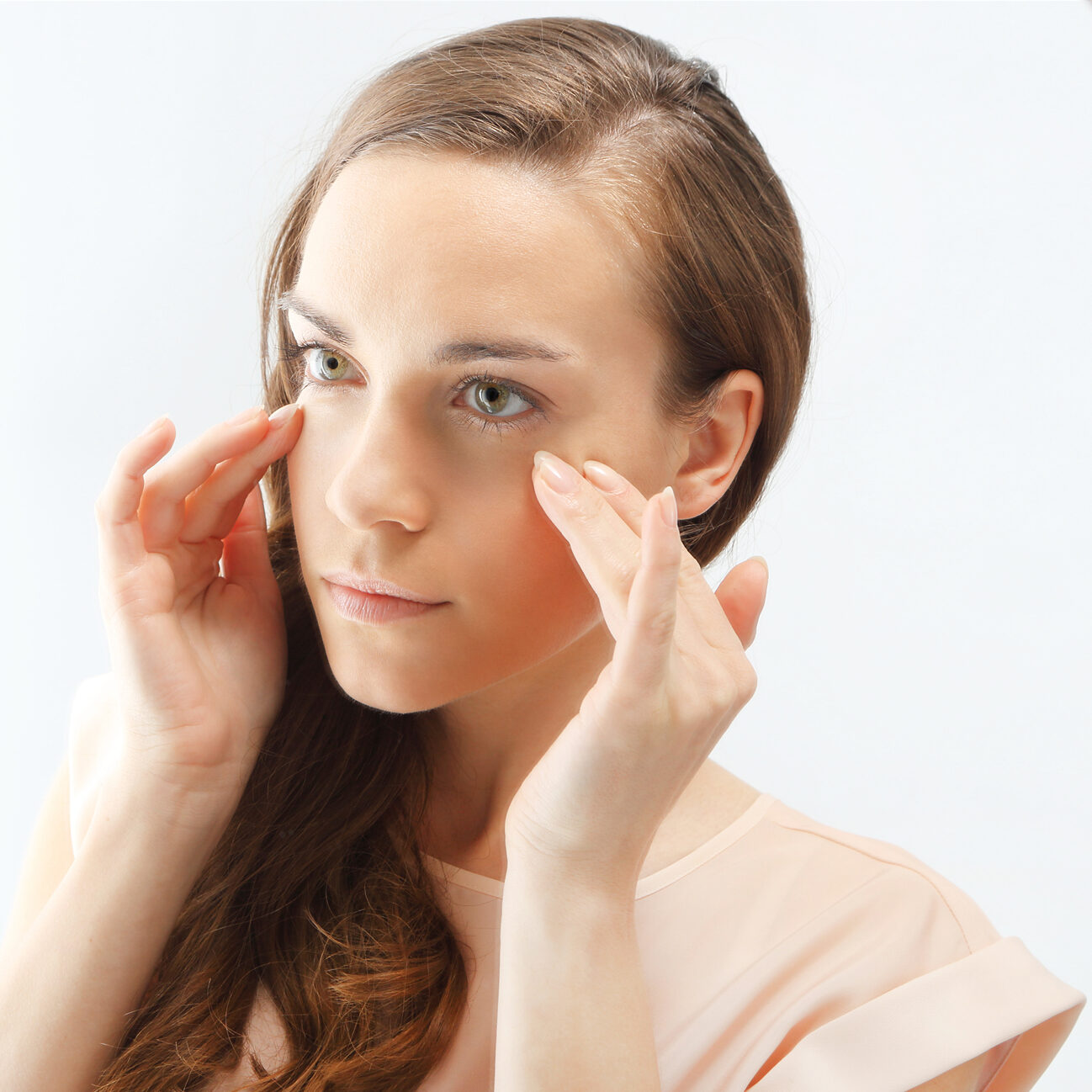
Non-surgical brow lift, thread repositioning, and laser — physician-led routing for drooping eyelids in Scottsdale.
Find Your Treatment
Heavy, Hooded, or Drooping Eyelids
Droopy eyelids — heavy, hooded, or sagging upper eyelids that make you look tired — almost always look like one problem but come from several different sources. A low-sitting eyebrow, redundant upper eyelid skin, deflated temples, or a combination. Most patients referred for eyelid surgery don’t actually need it: targeted non surgical treatments resolve the visible heaviness in the majority of cases — once we identify which structure is actually dropping.
Dr. Natalya Borakowski, NMD starts every droopy-eyelid consultation by asking: what is actually descending? The eyebrow, the lid skin, the temple scaffolding, or all three? Each has a different non-surgical answer. A short clinical exam identifies which tool belongs in your plan — and whether any findings suggest a medical cause that belongs with an ophthalmologist instead.
This page covers cosmetic droopy eyelid correction. For the medical framework — true levator ptosis, ptosis surgery, and when to see an oculoplastic surgeon — see our Ptosis page. If one eyelid sits noticeably lower than the other, see our Asymmetrical Face page.
At a Glance
Scope. Four non-surgical paths for drooping eyelids: Botox brow lift (first-line, mild–moderate), Thread Brow Lift (structural repositioning, 12–18 months), Temple Filler (lateral re-elevation when hollowing is a driver), and CO2 Laser Resurfacing (for redundant upper eyelid skin / dermatochalasis). True levator ptosis or vision obstruction = surgical referral only.
Provider & candidacy. Dr. Borakowski oversees all treatment planning. Botox, threads, and temple filler work across Fitzpatrick I–VI. CO2 laser is first-line for Fitzpatrick I–III; Erbium or RF alternatives for darker skin. Contraindications vary by treatment — mapped at consultation.
Downtime & how to start. Botox and temple filler: zero downtime. Thread brow lift: 1–3 days tenderness. CO2: 5–10 days recovery. A 30-minute consultation is where Dr. B identifies which driver is doing the most visible work and builds the right sequence.
What Causes Droopy Eyelids?
Two distinct problems look identical from the outside. True ptosis involves the eyelid muscle itself — the levator loses strength and the lid margin physically drops. Pseudo-ptosis, which is far more common in an aesthetic practice, happens when the forehead has descended, the temples have deflated, or the upper eyelid skin has become lax — and the actual lid is working fine. Most drooping eyelids that land in our chair are pseudo-ptosis, and the treatment is entirely different for each cause.
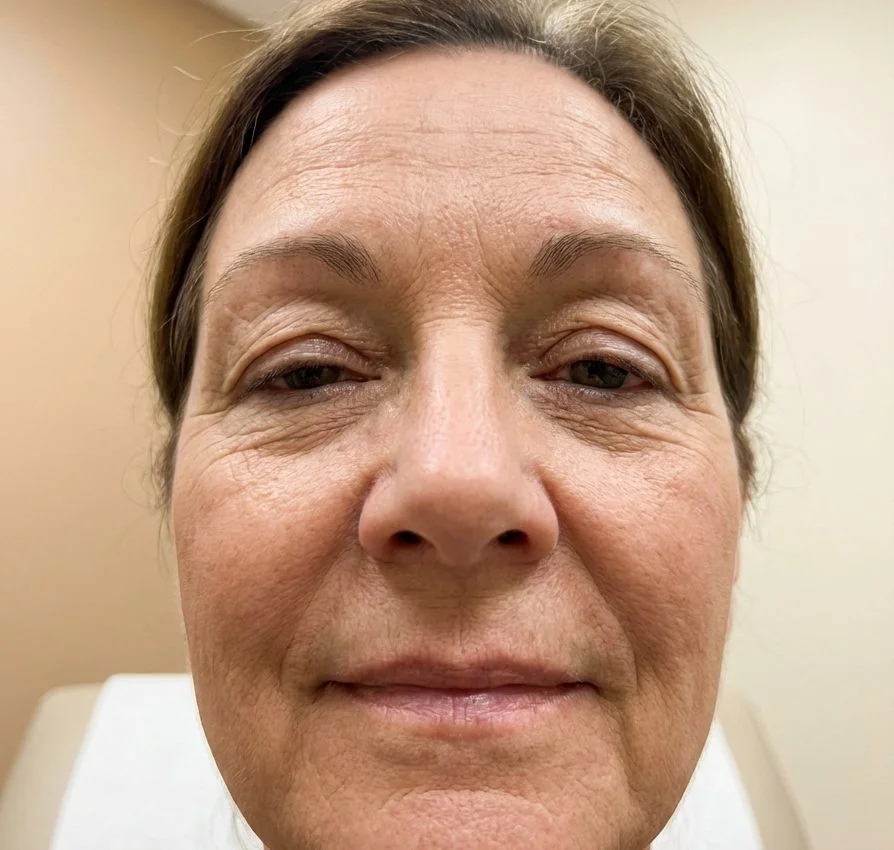
Aponeurotic change — the tendon connecting the levator muscle to the upper tarsal plate stretches with age, chronic contact-lens wear, or prior eye surgery — and the lid margin slowly loses height. This is sometimes labelled acquired ptosis in clinical notes.
Eyebrow descent is the single most common driver of what patients describe as drooping eyelids. As the forehead soft tissue slips downward, the eyebrow sits lower on the orbital rim and pushes redundant skin over the upper lid. The lid itself is unchanged — the tissue above it has fallen.
Temple hollowing is the driver most patients haven’t considered. The temporal fat pad deflates with age, and the lateral eyebrow loses its scaffolding; when the outer brow bone drops, the outer lid looks heavier even if the rest of the eyelid is fine.
Dermatochalasis — redundant upper eyelid skin draping over the lid margin — develops from chronic UV exposure, declining skin elasticity, and natural aging. Heavy, crepey lid skin can fold over the lid margin and obscure the eyelid crease even when eyebrow position is normal. When sagging skin becomes severe enough to obstruct the upper visual field, blepharoplasty becomes the right conversation. A small minority of patients have true levator ptosis — a medical condition involving the eyelid muscles or their innervation — covered in depth on our Ptosis page.
Non-Surgical Treatments for Droopy Eyelids
Non-surgical eyelid drooping treatment starts with identifying which structure is actually dropping — eyebrow position, lid skin excess, temple volume, or a combination. Each has a different first-line answer. Here’s how Dr. Borakowski routes the most common presentations.


Droopy eyelid treatment often involves addressing more than one driver at once. The full list below includes additional options — Dysport for patients who haven’t responded well to other neuromodulators, RF microneedling when skin laxity is mild and ablative laser is too much, and Aesthetic Facial Balancing when forehead and eyebrow concerns coexist with broader facial asymmetry. If you suspect the issue isn’t really cosmetic — your eyelid dropped suddenly, you have double vision, or the drooping is strongly asymmetric — that’s a different lane, and our Ptosis page walks through when to see an oculoplastic surgeon instead.
Which Treatment Matches Your Anatomy?
The right treatment for drooping eyelids depends entirely on which structure is doing the dropping. Same appearance, different drivers, different answers.
Eyebrow Descent — the Most Common Driver
When the forehead soft tissue slips downward, the eyebrow sits lower on the orbital rim and pushes skin over the upper lid. The eyelid muscles are fine; the problem is what’s sitting above. If eyebrow position responds to a lift with your fingers, that’s your primary target.
Mild–moderate descent: Botox relaxes depressor muscles so the frontalis lifts the eyebrow unopposed. Best first-line for muscular descent.
Structural descent: Thread Brow Lift physically repositions tissue when muscular lift has reached its ceiling. Duration ~12–18 months vs. Botox’s 3–4 months.
Start with: Botox → escalate to Thread Brow Lift if neededTemple Hollowing — the Overlooked Driver
The temporal fat pad deflates with age, and the outer eyebrow loses its scaffolding — even when the central forehead appears normal. Patients who’ve tried Botox without much improvement on the outer lid often have this as a contributing factor.
Temple Filler restores the scaffolding that holds the lateral eyebrow in position — an indirect lift without threads or toxin near the brow bone. Works specifically when hollow temples are visible on exam; does little when the descent is central.
Start with: Temple Filler (lateral only) · Combine with Botox if central descent also presentDermatochalasis — Redundant Upper Eyelid Skin
Some patients have a normally positioned eyebrow but heavy, crepey skin has accumulated on the upper eyelid. The eyelid crease becomes hidden. This is dermatochalasis: a skin-envelope problem, not a forehead or muscle problem.
CO2 Laser Resurfacing contracts redundant upper eyelid skin and stimulates new collagen — working on the skin rather than the eyebrow. Fitzpatrick I–III first-line; when dermatochalasis is severe enough to obstruct vision, blepharoplasty becomes the correct answer.
Start with: CO2 Laser · Surgical referral if vision is blockedAge-Related Tendon Thinning (Aponeurotic Change)
The levator aponeurosis stretches with age, contact lens wear, or after eye surgery — and the lid margin slowly descends. This is acquired ptosis: mild cases often coexist with eyebrow descent and respond to Botox; more significant descent requires oculoplastic surgery.
If the lid margin droops even when you raise your eyebrows fully, that shifts the presentation toward the medical lane we cover on our Ptosis page.
Mild: Botox + CO2 combination · Significant: oculoplastic referralCompare All Options
| Feature | Botox | Thread Brow Lift | Temple Filler | CO2 Laser |
|---|---|---|---|---|
| Best for | Mild–mod brow descent (muscular) | Structural brow descent post-Botox ceiling | Hollow temples + lateral droop | Dermatochalasis — normal brow, heavy lid |
| Mechanism | Relax depressors → frontalis lifts unopposed | PDO threads physically reposition + hold brow | Restore temple volume → passive lateral re-elevation | Ablate redundant skin + stimulate collagen |
| Sessions | 1 (repeat q3–4 mo) | 1 procedure (~12–18 mo) | 1 (touch-up at 12–18 mo) | 1–2 (deeper ablation) |
| Fitzpatrick range | I–VI | I–VI | I–VI | I–III first-line; Erbium for IV–VI |
| Downtime | None | 1–3 days tenderness | None–minimal bruising | 5–10 days recovery |
When to See a Doctor First
Most drooping eyelids we see are cosmetic and respond to the non-surgical options above. A small minority are medical — severe ptosis, acquired ptosis from trauma, neurologic disease, or vision obstruction — and those require an ophthalmologist or oculoplastic surgeon, not an aesthetic clinic. Contact an eye doctor or your primary physician before booking cosmetic treatment if any of the following applies:
Sudden onset. A droopy eyelid that appeared within hours or days is a neurologic red flag — not the gradual years-long change that defines cosmetic drooping eyelids.
Double vision or pupil changes. Drooping combined with diplopia, blurry vision, or asymmetric pupils on the same side warrants urgent evaluation.
Fatigability. A lid that sits normally in the morning and drops through the day — or worsens with sustained upward gaze — can signal myasthenia gravis.
Asymmetric drooping that doesn’t ease when you raise your eyebrows — a marker of true levator dysfunction requiring oculoplastic assessment.
Vision obstructed by the eyelid. If the lid physically blocks your upper visual field, blepharoplasty becomes a functional procedure often covered by insurance — the right specialist is an oculoplastic surgeon, not an aesthetic clinic.
Pediatric case. A child’s drooping eyelid is evaluated by a pediatric ophthalmologist; untreated congenital ptosis in the visual-development years can lead to amblyopia (lazy eye).
For the full medical framework — ptosis symptoms, ptosis surgery, and when ptosis repair is indicated — see our Ptosis page.
Frequently asked questions
What causes droopy eyelids?
The most common drivers are eyebrow descent (the eyebrow sits lower and pushes skin over the lid), temple hollowing (the outer eyebrow loses its scaffolding), and dermatochalasis (excess upper eyelid skin). Aponeurotic thinning of the levator tendon — age-related stretching of the tissue that connects the levator to the tarsal plate — is another contributor in adults. Most patients have more than one driver at once, which is why the right eyelid drooping treatment depends on which one is doing the most work.Can droopy eyelids be fixed without surgery?
In most cases, yes. Eyebrow descent, temple hollowing, and mild-to-moderate dermatochalasis all respond to non-surgical options — Botox, thread lifts, temple filler, and CO2 laser resurfacing. True levator ptosis and severe functional visual obstruction are exceptions that require surgical ptosis repair by an oculoplastic surgeon, and blepharoplasty is sometimes the cleanest fix for very heavy redundant lid skin even when non-surgical options could technically be stacked.Does Botox lift droopy eyelids?
Botox can lift the eyebrow two to three millimeters by relaxing the muscles that pull it downward, which opens the appearance of the upper eyelid. It’s most effective when eyebrow descent is the main driver of heaviness and the lid skin itself is not the problem. It cannot lift redundant eyelid skin, cannot reposition descended soft tissue structurally, and cannot treat true levator ptosis — which is muscle weakness (not overactivity) and requires surgery.When does a droopy eyelid need surgery?
Surgery — upper blepharoplasty or ptosis repair — is the right answer when the drooping is true levator ptosis, when the lid physically obstructs the upper visual field, when drooping follows trauma or prior eye surgery, when a neurologic cause is suspected, or when the degree of descent is beyond what non-surgical treatment can reach. This is eye surgery performed by oculoplastic surgeons — outside Desert Bloom’s scope; we refer out.Is a droopy eyelid a sign of a serious condition?
Usually not — most adult drooping is age-related and benign. However, sudden onset, double vision, blurry vision, pupil changes, strong asymmetry, or drooping that fatigues through the day can point to neurologic conditions like myasthenia gravis, third-nerve palsy, or Horner syndrome. Those ptosis symptoms warrant prompt medical evaluation from an eye doctor, not cosmetic treatment.What is the difference between droopy eyelids and hooded eyes?
Hooded eyes are a natural anatomic variation — the brow bone protrudes forward and upper lid skin tucks under it from birth. Drooping eyelids are an acquired change from eyebrow descent, dermatochalasis, or levator issues. Some people are born with hooded eyes and develop drooping on top of that later; treatment still follows the same logic — identify which structure is actually descending.How much does droopy eyelid treatment cost in Scottsdale?
Cost depends on which treatment or combination your consultation identifies. Botox is the lowest-commitment starting point; thread lift, temple filler, and CO2 laser each sit in different ranges. For most patients, addressing drooping eyelids is a multi-year plan — we sequence by which driver is doing the most visible work first. Your Scottsdale consultation produces a per-treatment quote tailored to your anatomy.Working With Dr. Borakowski on Droopy Eyelids
Dr. Natalya Borakowski, NMD has been practicing aesthetic medicine for over twenty years. Her approach to drooping eyelids is built around a simple diagnostic question: what’s actually descending? The eyebrow, the lid skin, the temple scaffolding — or all three at once? Most patients arrive with an idea about which treatment they want. She starts with the anatomy instead.
She is candid about when non-surgical treatments are the right answer and when they aren’t. If your drooping eyelids need blepharoplasty or ptosis surgery, she will say so — and help you find the right oculoplastic surgeon rather than push a procedure that won’t solve the real problem. If they don’t need surgery, she’ll build a plan that matches what’s actually there.
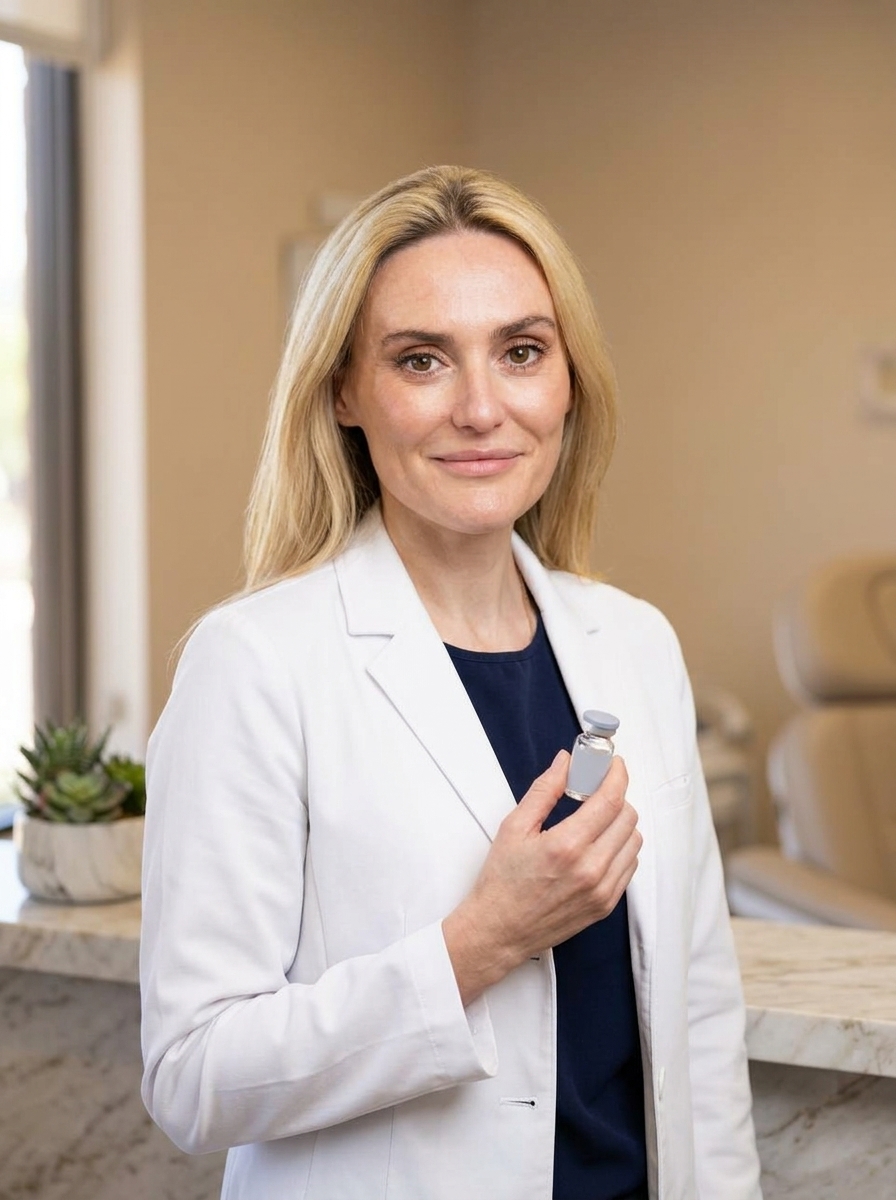
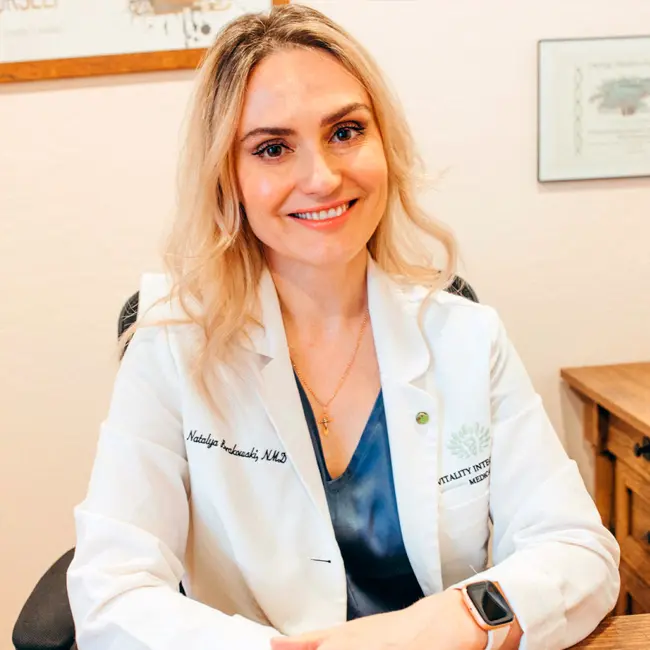
“The question I start with isn’t ‘which treatment do you want?’ — it’s ‘what’s actually descending?’ Pick the wrong structure and nothing we do will land. Pick the right one, and most drooping eyelids don’t need surgery at all.”
Start With a Droopy Eyelid Consultation in Scottsdale
A consultation here starts with anatomy — not a menu of treatments. Dr. Borakowski identifies whether the driver is eyebrow descent, temple hollowing, dermatochalasis, or a combination, and sequences the plan accordingly. Some consultations end with a treatment booking. Some end with a referral. Complimentary 30-minute consultations are available; if your drooping eyelids need a surgeon, she will tell you that directly.
References
- “Temporal Brow Lift Using Botulinum Toxin A..” Plast Reconstr Surg. 2000. DOI(105(3):1129–1135)
- “Temporal hollowing causes, classifications, and treatment options: A systematic review..” J Cosmet Dermatol. 2022. DOI(21(9):3709–3717)
- “Ptosis: Causes, Presentation, and Management..” Aesthetic Plast Surg. 2003. DOI(27(3):193–204)
- “Functional Indications for Upper Eyelid Ptosis and Blepharoplasty Surgery: A Report by the American Academy of Ophthalmology..” Ophthalmology. 2011. DOI(118(12):2510–2517)
Treatments
- Botox in Scottsdale, AZ | Cost, Areas & Results | Desert Bloom$10.50/unit15 min
- CO2 Laser Resurfacing$150060 minutes
- Daxxify Injections Near Me | Cost & Units | Scottsdale AZ$6/unit15 min
- Dysport$3.5/Unit15 minutes
- Facial Balancing$1,600+60 min
- Microcurrent non-surgical facelift$11045 minutes
- Non-Surgical Facelift$250060 and up
- Non-Surgical Facial MasculinizationOn demand60 min
- Non-surgical Facial FeminizationOn demand60 and up
- PDO Thread Lift$118015 minutes and up
- RF Microneedling$80090 and up
- Temple Filler$800+15 and up
- Thread Brow Lift$180060 minutes
Consultation in skin care clinic
Desert Bloom Skincare Center offers personalized skincare consultation to help you achieve a flawless and radiant complexion. Book your appointment today and let our expert team of skincare professionals address your specific concerns and help you reach your skincare goals.
Visit Our Scottsdale Aesthetic Center
Address
10752 N 89th Place, Suite 122B,Scottsdale, AZ 85260.
Phone:(480) 567-8180
E-mail:info@desertbloomskincare.com
Get Directions →Location & Directions
Desert Bloom Skincare is conveniently located in the Shea Corridor of North Scottsdale, within Edwards Professional Park I — minutes from HonorHealth Scottsdale Shea Medical Center and the Mayo Clinic Scottsdale Campus.
Areas We Serve
We proudly provide expert non-surgical rhinoplasty and PDO thread lifts to patients across the Southwest:
- ScottsdaleNorth Scottsdale · McCormick Ranch · Gainey Ranch
- Paradise Valley
- PhoenixArcadia · Biltmore · North Phoenix
- Fountain Hills
- Cave Creek & Carefree