The Future of Skin Smoothness: Skinvive by Juvéderm FDA-Approved

Say hello to SkinVive by Juvéderm - a revolutionary treatment that has been FDA-approved to improve skin smoothness. But what is it, and how does it work? In this blog, we will dive deep into the science behind SkinVive and how it can benefit your skin.
Why SkinVive Is the One Juvéderm Product We Kept
Let’s be direct about something: SkinVive is not a filler. I know that sounds strange when it’s made by Juvéderm — a brand most people associate with volume. But SkinVive occupies a different category entirely, and understanding that difference matters if you want to choose the right treatment for what you’re actually experiencing.
At Desert Bloom, we made a deliberate decision. We chose to step away from the Juvéderm volume line — Voluma, Volux, Vollure, Volbella, Ultra XC. Our HA volume work now runs on Restylane and RHA, and we’re not apologetic about that shift. SkinVive is the one Juvéderm product we still use, because it does something the others don’t: hydrate without volumizing. It fills a specific clinical gap that very little else addresses as cleanly.
Treatment Snapshot
- Treatment
- SkinVive by Juvéderm (VYC-12) — microdroplet intradermal HA
- Primary Concern
- Skin dehydration, surface dullness, fine texture on cheeks
- Placement Zone
- Cheeks (intradermal microdroplet grid)
- Duration
- ~6 months per treatment cycle
- Downtime
- Minimal — most patients resume normal activity within hours
What This Treatment Actually Does — and What It Doesn’t
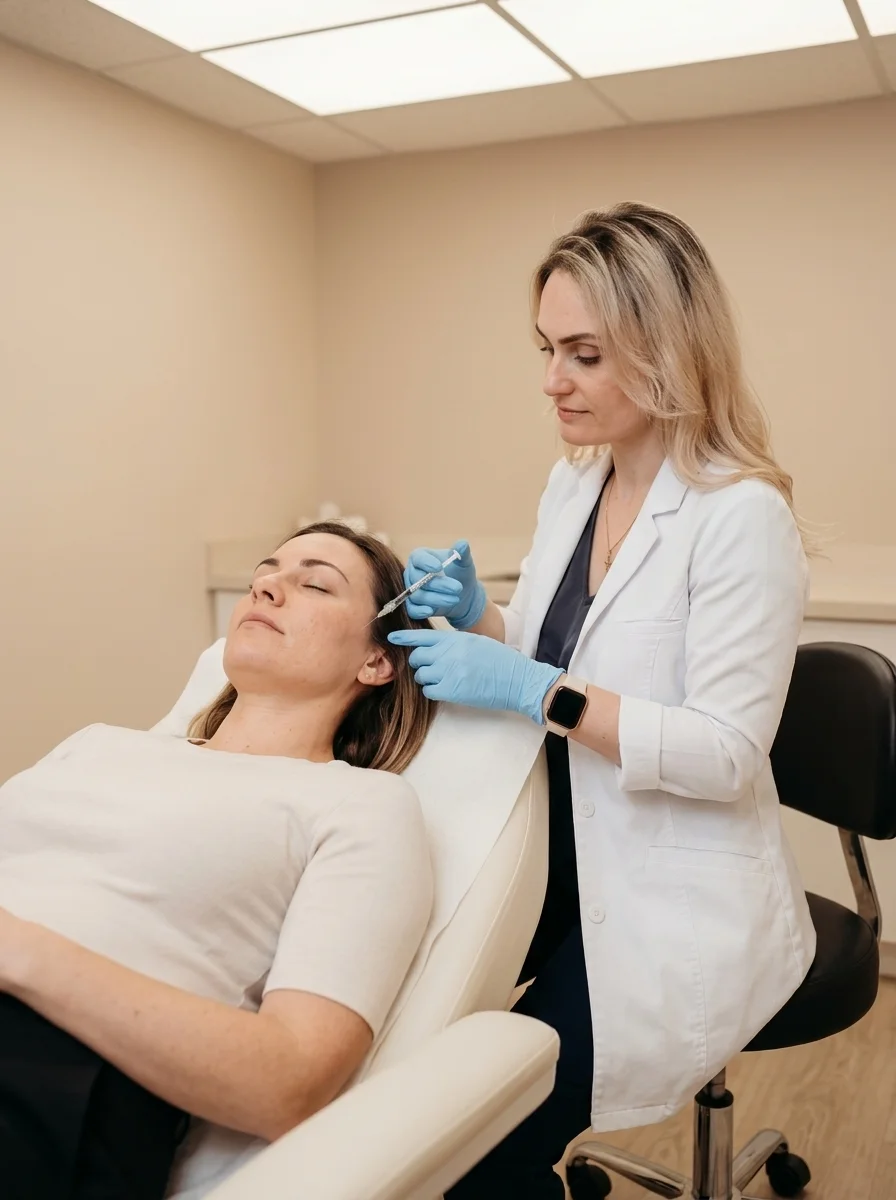
SkinVive (technically called VYC-12) is a hyaluronic acid formulation injected as microdroplets into the mid-dermis — the layer just beneath your skin’s surface. It doesn’t sit under muscle. It doesn’t add projection or lift. What the microdroplet HA does is create a reservoir within the dermal tissue itself, which your skin draws on for cellular hydration over the following months. The FDA cleared it in 2023 specifically for improving cheek skin smoothness — not for adding volume, not for sculpting contour.
This is worth pausing on. Most injectable treatments we discuss — Restylane, RHA, even biostimulators like Sculptra — work by adding or rebuilding structure. The mechanism here is simpler: hydration from within. If you’re someone who moisturizes religiously, drinks enough water, and still finds your skin looking flat and tired by midday, the issue may not be your routine. It may be intradermal dehydration — a depth your topicals genuinely cannot reach.
In the clinical trial that led to FDA clearance, 96% of treated patients reported improved cheek skin smoothness at month 1. These weren’t patients who had volume loss — they were patients with healthy facial structure and dehydrated, dull surface skin. The mechanism matched the complaint. That specificity is why SkinVive works when it works.
The Microdroplet Technique: Precision Over Volume
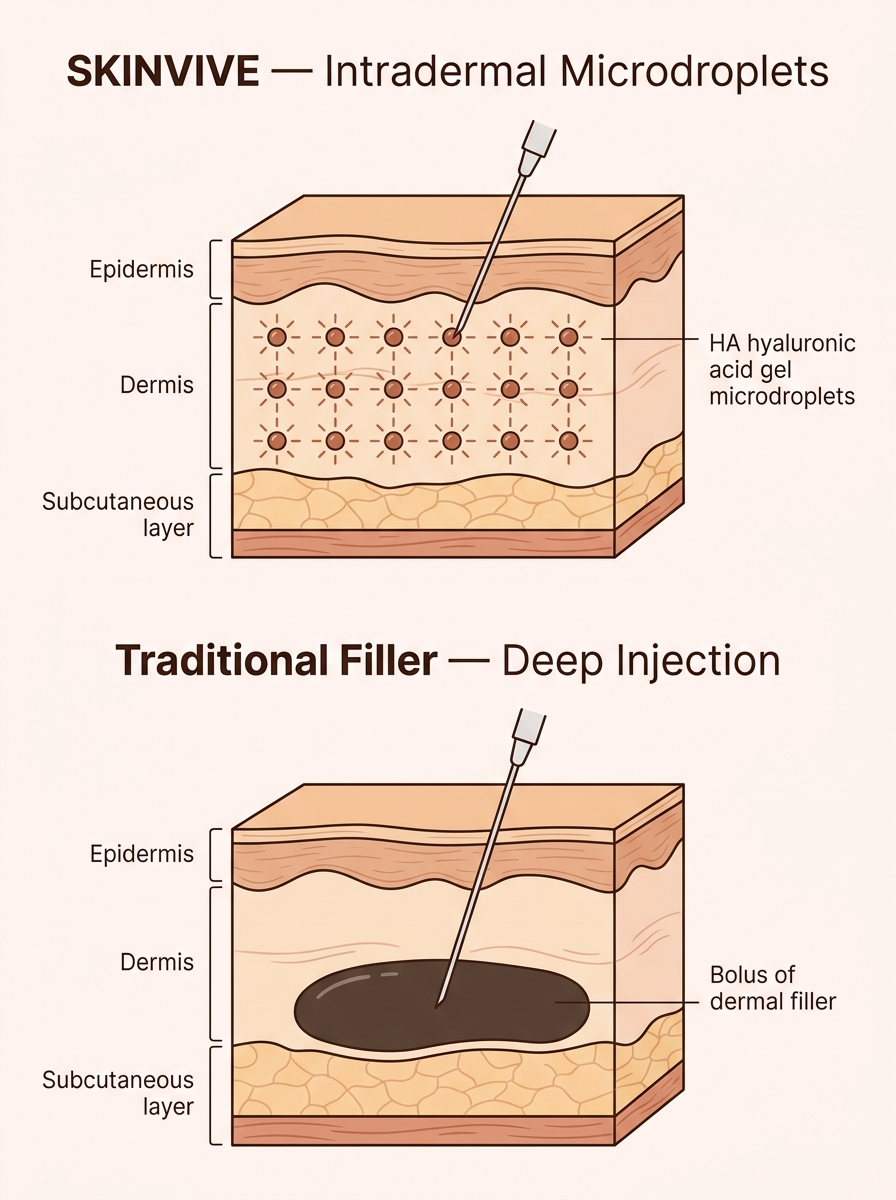
The placement technique for this approach is different from traditional filler work, and it’s worth explaining. Instead of depositing product in a bolus at a single point — the way you’d restore a cheek hollow or soften a nasolabial fold — the injector places dozens of small, evenly spaced microdroplets across the cheek dermis. Picture a grid: consistent spacing, consistent depth, consistent micro-volume per point. The goal is uniform hydration distribution, not anatomical reshaping.
Cheeks are the FDA-approved zone, and they make clinical sense as the starting point. The cheek skin is thinner and more prone to visible dehydration and surface texture changes — it’s often where dullness and fine surface roughness show up first. For patients at Desert Bloom who want to extend the effect, I assess whether adjacent areas might benefit from off-label placement, but I always have that conversation explicitly. The cheek result alone is typically what motivates most patients to return.
The Glow Question — and What It’s Actually Describing
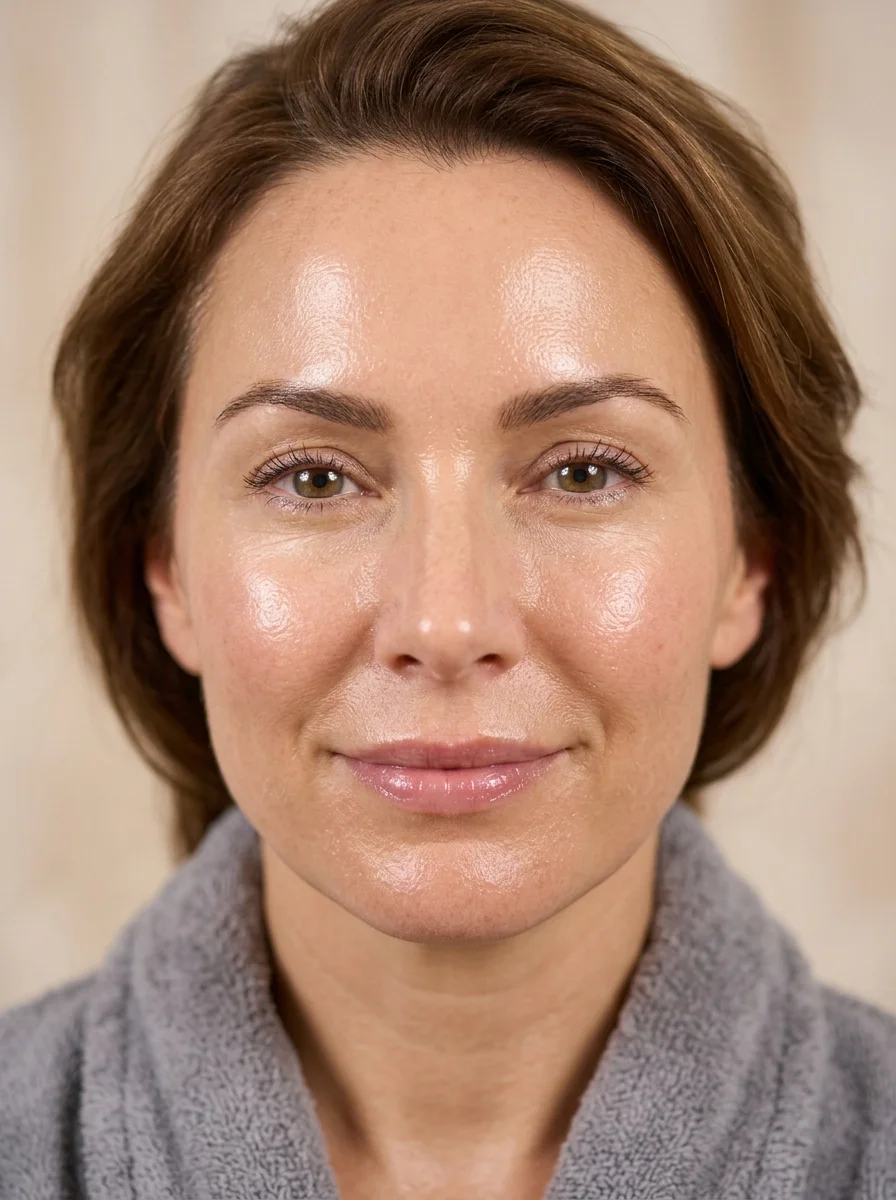
Patients often describe the result as “a glow.” I understand why, and I also want to be precise about what’s actually happening. When skin is well-hydrated at the dermal level, it reflects light more evenly — the surface becomes less textured, less matte in a flat way, more luminous in the way genuinely healthy skin looks. It’s not sparkle. It’s the visual signature of skin that’s doing its job well. That’s the glow: restored function made visible.
The effect builds over the first few weeks as the HA integrates and draws water into the surrounding tissue. Most patients notice a visible change around the 2–4 week mark, with peak results typically at 4–8 weeks. From there, the effect sustains through roughly 6 months before gradual reabsorption. This is not a treatment where you’ll see a dramatic change the next morning — and that’s actually a feature, not a limitation. Subtle, progressive improvement is harder to identify as “something you had done,” which most of my patients prefer.
| Feature | SkinVive (VYC-12) | Traditional HA Filler | HydraFacial |
|---|---|---|---|
| Primary mechanism | Intradermal hydration — HA microdroplets in dermis | Subdermal volume addition — structural support | Topical hydration + exfoliation + infusion |
| Depth of action | Mid-dermis (intradermal) | Deep dermis / subdermis | Epidermis / upper dermis |
| Adds volume | No | Yes | No |
| Best for | Dehydration, dullness, fine surface texture | Volume loss, hollowing, deep folds | Surface congestion, dryness, maintenance glow |
| Duration | ~6 months | 6–18 months depending on product | 1–4 weeks (maintenance series) |
| Downtime | Hours (micro-injection marks) | 1–3 days (swelling possible) | None |
| Injectable | Yes | Yes | No (topical device) |
| FDA clearance | Yes (cheek smoothness, 2023) | Yes (various indications) | No (device, not drug) |
SkinVive (VYC-12)
- Primary mechanism
- Intradermal hydration — HA microdroplets in dermis
- Depth of action
- Mid-dermis (intradermal)
- Adds volume
- No
- Best for
- Dehydration, dullness, fine surface texture
- Duration
- ~6 months
- Downtime
- Hours (micro-injection marks)
- Injectable
- Yes
- FDA clearance
- Yes (cheek smoothness, 2023)
Traditional HA Filler
- Primary mechanism
- Subdermal volume addition — structural support
- Depth of action
- Deep dermis / subdermis
- Adds volume
- Yes
- Best for
- Volume loss, hollowing, deep folds
- Duration
- 6–18 months depending on product
- Downtime
- 1–3 days (swelling possible)
- Injectable
- Yes
- FDA clearance
- Yes (various indications)
HydraFacial
- Primary mechanism
- Topical hydration + exfoliation + infusion
- Depth of action
- Epidermis / upper dermis
- Adds volume
- No
- Best for
- Surface congestion, dryness, maintenance glow
- Duration
- 1–4 weeks (maintenance series)
- Downtime
- None
- Injectable
- No (topical device)
- FDA clearance
- No (device, not drug)
Day of treatment
Micro-Injection Marks
Small injection points visible, mild redness. This is normal and expected. Most patients go about their day within a few hours — though I’d skip a formal event that same evening.
Days 1–3
Initial Settling
Micro-swelling resolves. The product is integrating into the dermis. Skin may feel slightly different — not dramatically changed yet.
Weeks 2–4
Hydration Builds
The HA begins drawing moisture into surrounding tissue. Most patients start noticing the difference here — skin looks less flat, has more natural luminosity.
Weeks 4–8
Peak Result
Full hydration effect visible. Cheek skin is smoother, more even in texture, reflective in a natural way. This is the result the FDA trial measured at 6 months.
Month 6
Gradual Reabsorption
HA slowly reabsorbs as the body metabolizes it. Results don’t disappear overnight — they fade gradually. Most patients return around the 5–6 month mark to maintain.
Frequently Asked Questions
Is SkinVive the same as a dermal filler?
Why did Desert Bloom keep SkinVive when it discontinued other Juvéderm products?
How long does SkinVive last?
Can SkinVive be combined with other treatments?
Who is NOT a good candidate for SkinVive?
What does the recovery look like?
Is SkinVive the same as skin boosters I’ve heard about?
“Most patients who ask me about this have already tried everything topical. The issue isn’t their routine. It’s that topicals don’t reach the dermis — and SkinVive does.”
Related reading: Dermal Fillers at Desert Bloom — for volume and structural concerns. HydraFacial — surface hydration and prep. Mesotherapy — diffuse skin hydration protocol. Skin Dehydration and Skin Dullness concern pages.
Individual results vary. Clinical content reviewed by Dr. Natalya Borakowski, NMD. Last updated April 2026.