Why do women over 40 need more facial fat?


This article discusses the common problem of facial fat loss in women over 40 and why it occurs. The loss of facial fat can lead to a more aged and tired appearance. The article also explores various solutions to this problem, including non-surgical options such as dermal fillers and fat transfer.
Why Faces Change After 40
Most women describe noticing it before they understand it. Something in the mirror looks different — not a specific wrinkle, not a particular line, but a quality of the face that has shifted. Shadows where there used to be fullness. A sharpness that wasn’t there before. The instinct is to call it “aging.” But that word flattens something that is actually a specific, trackable biological process — and once you understand it, the path forward becomes much clearer.
Here’s the reframe I offer every patient who comes in with this concern: it’s not “fat loss.” It’s redistribution of facial fat compartments — and it changes what your face needs. That distinction matters, because it determines what kind of support is actually useful.
Quick Take
- Why It Happens
- Estrogen decline drives fat-pad atrophy in cheeks and temples, bone resorption around the orbit, mandible and midface, and collagen and elastin loss — while descending fat creates jowls.
- What Helps
- Sculptra for collagen rebuilding over months, Radiesse as a CaHA biostimulator plus volume, Restylane / RHA for HA volume restore, PRP Biofiller (Velora) for growth-factor restore, and PDO Threads for structural lift plus collagen.
- What We Don’t Do
- Fat grafting is not offered here — we refer to a plastic surgeon when own-fat restoration is the right path.
- Related Reads
- Volume Loss, Hollow Temples, Sculptra, and Facial Balancing.
The Biology Behind It: What Actually Changes After 40

Your face has distinct fat compartments — the malar fat pad, the buccal fat pad, the temporal fat pad, orbital fat, and several others. These compartments don’t deflate uniformly. During perimenopause and menopause, estrogen decline triggers selective atrophy of the mid-face and temple compartments — the areas that create what we recognize as “lifted” and “full.” At the same time, fat in the lower face and jowl area can descend rather than disappear. The result is a face that looks simultaneously hollowed in the cheeks and heavier in the jaw — a combination that confuses most women because it doesn’t match the simple narrative of “my face got thinner.”
What makes this harder is that fat redistribution doesn’t happen in isolation. It’s happening alongside bone resorption — the mandible, orbital rim, and midface skeleton all lose volume with age, reducing the foundation the overlying soft tissue rests on. Collagen and elastin decline simultaneously, reducing the skin’s ability to drape smoothly over whatever structure remains. These three processes together — fat redistribution, bone loss, and connective tissue thinning — are why this shift can look so significant even in women who are otherwise healthy, active, and not dramatically changing in weight.
I want to be direct about something: this is not a failure of self-care. It is not caused by not using the right products, not eating well enough, or not managing stress. It is a structural change driven by hormonal biology — and it happens to virtually every woman who lives through perimenopause. The women I see who feel most surprised by it are often the ones who have taken excellent care of themselves. The biology doesn’t care. It just proceeds.
What Restoration Actually Looks Like
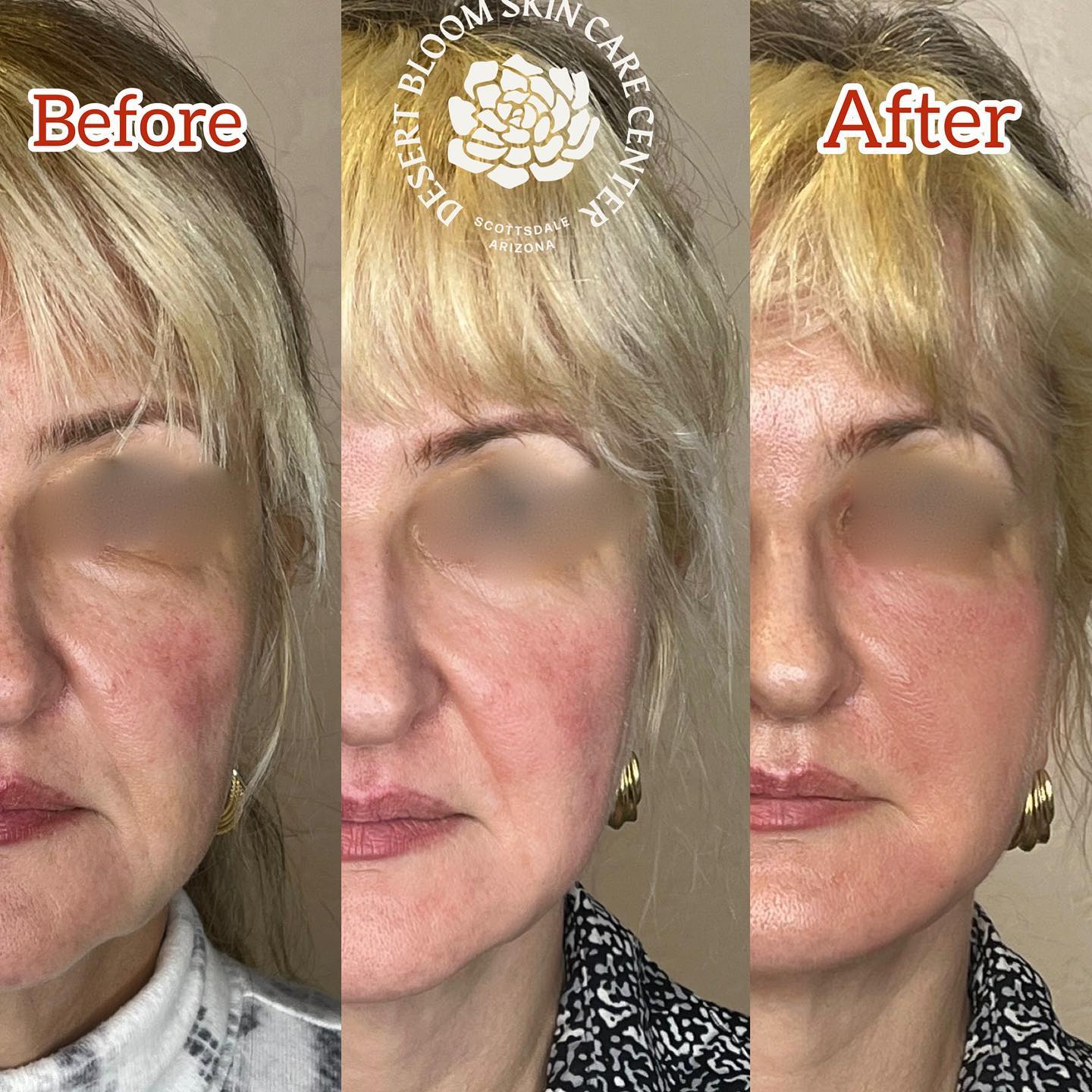
When we talk about supporting facial volume, we’re talking about two different strategies — and the right one depends on what’s driving the change in your specific face. Some patients need structural support rebuilt from the inside (biostimulators like Sculptra or Radiesse, which trigger your own collagen and work over months). Others need more immediate volume replenishment in targeted compartments (Restylane or RHA, which provide lift now and integrate naturally with surrounding tissue). Many benefit from a combination across a plan that unfolds over several months.
There is one path I don’t offer here: fat grafting — using your own harvested fat to restore facial volume. It’s a legitimate option that some patients are excellent candidates for, and when I see that pattern in a consultation, I refer to a plastic surgeon whose technique I trust. I’d rather tell you that directly than try to substitute something that doesn’t fully address what you need. What I do offer is a range of tools that, when matched carefully to anatomy and goals, can make a meaningful and natural-looking difference — non-surgical, precisely placed, and matched to your anatomy — the goal is a face that looks like you, restored.
The Role of Hormones — Including HRT

One question I get often: “Does hormone replacement therapy change any of this?” The honest answer is — yes, to a degree. Estrogen has receptors in skin and subcutaneous fat tissue, and there is reasonable evidence (based on observational data, not RCT-level evidence) that HRT can slow some aspects of the fat redistribution and collagen loss associated with menopause. It is not a reversal of structural changes that have already occurred, and it doesn’t eliminate the need for targeted support in women who are already noticing significant hollowing. But if you’re in perimenopause and working with a physician on HRT, it is worth having a frank conversation about skin and facial structure as part of that discussion. These systems are connected — and treating them as if they operate independently misses something important.
This is also where I believe naturopathic medicine has something particular to offer. The approach I was trained in looks at the whole hormonal picture — not just the face in isolation. A consultation here isn’t only about which filler goes where. It’s about understanding why your face is changing now, what’s driving the rate of change, and what combination of interventions — aesthetic, nutritional, hormonal support — makes the most sense for you specifically. Most clinics skip that part. I don’t.
Comparing Your Options: Which Approach Fits Your Situation
There’s no single right answer — the best approach depends on how much volume has been lost, where, how quickly you want to see results, and whether you’re primarily looking for collagen rebuilding or immediate structural support. This table gives you an honest side-by-side so you can come into a consultation with clarity rather than confusion.
| Option | Sculptra | Radiesse | Restylane / RHA | PRP Biofiller (Velora) | Fat Grafting |
|---|---|---|---|---|---|
| Mechanism | PLLA microspheres stimulate your own collagen over 3–6 months | CaHA microspheres provide immediate lift + stimulate collagen | Hyaluronic acid fills and hydrates targeted compartments directly | PRP + HA (Velora system) — growth factors support tissue quality | Your own harvested fat transplanted to hollow areas |
| Best for | Gradual, diffuse volume loss across cheeks and temples | Mid-face structure, cheekbones, jawline definition | Targeted hollowing (under-eyes, cheeks, lips, temples) | Skin quality + subtle volume — especially after multiple treatments | Significant deflation where sustained, natural-fat restoration is the goal |
| Timeline | Results build over 3–6 months; lasts 2+ years | Immediate + progressive; lasts 12–18 months | Immediate; lasts 9–18 months depending on product | Progressive over 4–6 weeks; repeat every 6–12 months | Long-lasting; some resorption expected (30–50% typical) |
| Recovery | Minimal — mild swelling, back to normal in 24–48 hrs | Minimal — similar to HA fillers | Minimal — possible bruising 3–5 days | Minimal — mild redness/swelling 24–48 hrs | Surgical — requires downtime 1–2 weeks |
| Offered at DB | Yes — see Sculptra | Yes — see Radiesse | Yes (Restylane, RHA) — see Dermal Fillers | Yes — Velora HA-PRP system | No — we refer to a plastic surgeon |
Sculptra
- Mechanism
- PLLA microspheres stimulate your own collagen over 3–6 months
- Best for
- Gradual, diffuse volume loss across cheeks and temples
- Timeline
- Results build over 3–6 months; lasts 2+ years
- Recovery
- Minimal — mild swelling, back to normal in 24–48 hrs
- Offered at DB
- Yes — see Sculptra
Radiesse
- Mechanism
- CaHA microspheres provide immediate lift + stimulate collagen
- Best for
- Mid-face structure, cheekbones, jawline definition
- Timeline
- Immediate + progressive; lasts 12–18 months
- Recovery
- Minimal — similar to HA fillers
- Offered at DB
- Yes — see Radiesse
Restylane / RHA
- Mechanism
- Hyaluronic acid fills and hydrates targeted compartments directly
- Best for
- Targeted hollowing (under-eyes, cheeks, lips, temples)
- Timeline
- Immediate; lasts 9–18 months depending on product
- Recovery
- Minimal — possible bruising 3–5 days
- Offered at DB
- Yes (Restylane, RHA) — see Dermal Fillers
PRP Biofiller (Velora)
- Mechanism
- PRP + HA (Velora system) — growth factors support tissue quality
- Best for
- Skin quality + subtle volume — especially after multiple treatments
- Timeline
- Progressive over 4–6 weeks; repeat every 6–12 months
- Recovery
- Minimal — mild redness/swelling 24–48 hrs
- Offered at DB
- Yes — Velora HA-PRP system
Fat Grafting
- Mechanism
- Your own harvested fat transplanted to hollow areas
- Best for
- Significant deflation where sustained, natural-fat restoration is the goal
- Timeline
- Long-lasting; some resorption expected (30–50% typical)
- Recovery
- Surgical — requires downtime 1–2 weeks
- Offered at DB
- No — we refer to a plastic surgeon
A Typical 6-Month Volume Restoration Plan
Most patients see the best results not from a single treatment but from a sequenced plan that builds on itself. Here’s how that typically unfolds.
Month 1
Assessment + Foundation
Comprehensive facial mapping consultation. Identify which compartments have lost most volume and which structural support is missing. First Sculptra session if collagen rebuilding is the primary goal, or initial HA filler placement for patients who need more immediate structural correction.
Month 2
Continued Biostimulation
Second Sculptra session (if indicated). Sculptra works in a series — spacing sessions 4–6 weeks apart allows collagen synthesis from session 1 to be underway before layering the second. At this point, most patients notice skin quality beginning to change even before volume fully builds.
Month 3
Targeted Refinement
Assessment visit. Evaluate what has built, what still needs targeted filling, and where PDO threads may add structural support that fillers alone cannot provide. Fine-tuning with Restylane or RHA in specific compartments (temples, tear trough, lip border) if needed.
Month 4–5
Integration Period
No treatment typically needed. The collagen building from biostimulators continues independently. Patients often report the most noticeable changes happening in this window — results that look natural because they built gradually, not overnight.
Month 6
Review + Maintenance Planning
Full review with photos. Establish a maintenance rhythm — for most patients this means one Sculptra touch-up and targeted HA refresh annually. PRP Biofiller can be layered in at 6-month intervals to continue improving skin quality alongside structure.
Frequently asked questions
Why does this happen specifically around 40?
Can I just gain weight to fix this?
Is HRT relevant to facial volume loss?
What’s the difference between Sculptra and a regular filler?
How do I know if I’m a candidate for PDO threads vs. fillers?
Why doesn’t Desert Bloom offer fat grafting?
How soon will I see results?
If You’re Wondering What’s Right for You
The thing I most want you to leave this article with is this: the changes you’re noticing are not a mystery, and they’re not a verdict. They are a specific biological process that we understand well — well enough to support, well enough to address thoughtfully, and well enough to be honest about when one approach is better than another. A good consultation doesn’t always end with a treatment plan. Sometimes it ends with clarity about why something is happening, what the options actually are, and which of those options actually fits your anatomy, your timeline, and your goals. That’s where I like to start. Explore your options on our aesthetic facial balancing page, or read more about Sculptra collagen rebuilding.
“The women I find most rewarding to work with are the ones who come in saying “I just want to understand what’s happening.” That question leads to better outcomes than “fix this.” Understanding what changed — and why — is where the right plan actually begins.”
Related treatment pages: Sculptra · Radiesse · Dermal Fillers · PDO Thread Lift · Aesthetic Facial Balancing
Related concern pages: Volume Loss · Hollow Temples
Individual results vary. Content reviewed by Dr. Natalya Borakowski, NMD. This article is for educational purposes and does not constitute medical advice. Last updated April 2026.