Solid Biostimulator – The Key to Youthful Skin

Want to prevent aging before it starts? Solid biostimulators are the ultimate solution for maintaining firm, youthful skin by naturally boosting collagen production. Perfect for those under 40, this scientifically backed treatment slows aging, improves elasticity, and delivers results that last up to 24 months. Discover why biostimulation is the #1 preventative anti-aging trend of 2025!
Why Biostimulators Work Differently
Biostimulators don’t fill — they teach. Over months, they signal your fibroblasts to make new collagen, gradually rebuilding the structural foundation that thinner skin needs. If you’ve been noticing diffuse softening — not one dramatic hollow, but a general loss of firmness and density — this is exactly the biology worth understanding before you choose a treatment.
Most patients who come in asking about biostimulators have done some research. They’ve heard the names: Sculptra, Radiesse, PDO threads. What’s often missing is clarity on how these options differ — and why the difference matters more than which one sounds newest. That’s what this article is for.
Biostimulators at a Glance
- What they do
- Stimulate your own collagen rather than fill space
- Main options
- Sculptra (PLLA), Radiesse (CaHA), PDO/PLLA threads
- Onset
- Gradual — 3 to 6 months, peaking up to 12
- Longevity
- 18–24+ months for most patients
- Best for
- Diffuse volume loss and declining skin quality
Sculptra (PLLA)
Gradual, Diffuse Collagen Rebuilding
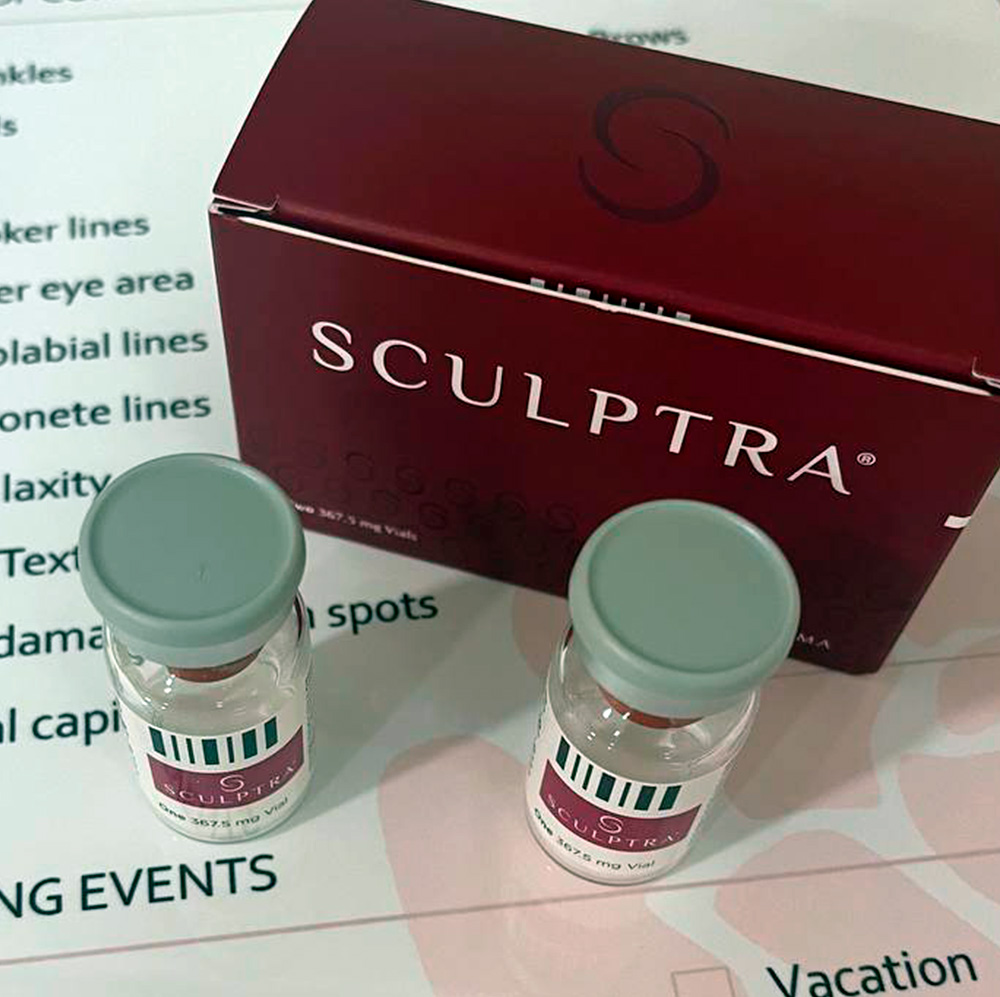
Sculptra’s active ingredient is poly-L-lactic acid (PLLA) — a biodegradable polymer that dissolves slowly over months. It doesn’t add volume directly. Instead, the microparticles trigger a controlled inflammatory response that recruits fibroblasts, the cells responsible for producing collagen type I and III. The result builds progressively: most patients see the structural improvement between months three and six, with the full effect reaching its depth around month nine to twelve.
This gradual timeline is not a limitation — it’s a design feature. Because Sculptra works diffusely across a treatment zone rather than in discrete deposits, it’s particularly suited for patients with broad-area volume loss: temples, cheeks, jawline, and the upper face as a whole. If you want results that look like your face on a good decade earlier, not results that look like you had something done, Sculptra’s mechanism is exactly why.
In my experience, Sculptra patients are often the ones who want the room to never know — they want the change to look like time, not like an intervention.
Radiesse (CaHA)
Immediate Scaffold Plus Long-Term Stimulation
Radiesse works on a different principle. Its calcium hydroxylapatite (CaHA) microspheres are denser than PLLA particles — they create an immediate scaffolding effect that adds visible definition the same day as treatment. The biostimulatory response layers on top of this: over the following three to six months, the CaHA scaffold is gradually resorbed while newly formed collagen matures around it, maintaining structure well after the initial volume effect subsides.
The practical implication is that Radiesse suits patients who want both immediate correction and long-term improvement — particularly for areas where definition matters most: the mid-face, chin, jawline, and hands. Because lidocaine is pre-mixed in the formulation, treatment comfort is generally higher compared to Sculptra. I lean toward Radiesse when a patient wants the result to register quickly but also keep building. It’s the closest thing we have to both at once. Peak collagen-stimulating results appear around months three to six, with longevity extending to eighteen to twenty-four months in most patients.
PDO and PLLA Threads: Mechanical Lift + Biostimulation Combined
Threads occupy a distinct category: they are the only collagen-inducing option that combines structural repositioning with collagen induction. A barbed PDO or PLLA thread physically lifts soft tissue along a vector — cheek, jowl, brow, neck — while simultaneously triggering a foreign-body collagen response along its entire length. The lift is immediate; the tissue thickening develops over two to four months as collagen encases the thread.
The honest conversation about threads is this: they work best when anatomy supports them. Moderate skin laxity in the right zone responds well. Heavy gravitational change, significant fat descent, or a patient who needs structural volume rather than repositioning — those are cases where injectable collagen stimulators or surgery serve better. I say this not to limit the option but because the best outcome always starts with the right match. If threads are appropriate for you, the PDO thread lift page covers technique and candidacy in detail.
Biostimulators vs. HA Fillers: Rebuild vs. Replace
Hyaluronic acid fillers are not in competition with biostimulators — they do a different job. HA adds volume by occupying space: it hydrates, it plumps, and it can be placed precisely in well-defined hollows. Results are immediate and reversible. But HA doesn’t change the underlying tissue. When it dissolves in six to twelve months, the structural deficit that prompted treatment is still there.
This approach, by contrast, addresses the substrate. These treatments don’t replace lost volume — they signal your own cells to produce the collagen that was lost. The improvement compounds over time rather than fading with it. For patients with diffuse skin quality decline alongside volume loss, this distinction is clinically meaningful. A plan that combines both — HA for defined hollows now, PLLA/CaHA stimulators for tissue quality over months — often makes more sense than choosing one at the expense of the other. That’s a conversation worth having at consultation.
How the Four Options Compare
A side-by-side look at mechanism, timeline, longevity, and best use for each collagen-building option.
| Feature | Sculptra (PLLA) | Radiesse (CaHA) | PDO/PLLA Threads | HA Fillers |
|---|---|---|---|---|
| Mechanism | Fibroblast recruitment via PLLA microparticles | CaHA scaffold + collagen induction | Mechanical lift + foreign-body collagen response | Volume replacement (space-occupying) |
| Onset of effect | 3–6 months gradual | Immediate + builds 3–6 months | Immediate lift, collagen builds 2–4 months | Same day |
| Peak result | 9–12 months | 3–6 months | 3–4 months post-treatment | Immediately after treatment |
| Longevity | 18–24+ months | 18–24 months | 12–18 months | 6–12 months |
| Best suited for | Diffuse volume loss, broad-area skin quality | Mid-face definition + hands | Moderate laxity with clear lift vector | Discrete hollows, lip, tear trough |
| Reversible? | No | No | Threads dissolve; not reversible acutely | Yes (hyaluronidase) |
| Sessions typical | 2–3 initial, maintenance yearly | 1–2 | 1 session usually sufficient | 1–2 |
| Recovery | 2–3 days swelling | 3–5 days swelling | 3–5 days, bruising possible | 1–3 days |
Sculptra (PLLA)
- Mechanism
- Fibroblast recruitment via PLLA microparticles
- Onset of effect
- 3–6 months gradual
- Peak result
- 9–12 months
- Longevity
- 18–24+ months
- Best suited for
- Diffuse volume loss, broad-area skin quality
- Reversible?
- No
- Sessions typical
- 2–3 initial, maintenance yearly
- Recovery
- 2–3 days swelling
Radiesse (CaHA)
- Mechanism
- CaHA scaffold + collagen induction
- Onset of effect
- Immediate + builds 3–6 months
- Peak result
- 3–6 months
- Longevity
- 18–24 months
- Best suited for
- Mid-face definition + hands
- Reversible?
- No
- Sessions typical
- 1–2
- Recovery
- 3–5 days swelling
PDO/PLLA Threads
- Mechanism
- Mechanical lift + foreign-body collagen response
- Onset of effect
- Immediate lift, collagen builds 2–4 months
- Peak result
- 3–4 months post-treatment
- Longevity
- 12–18 months
- Best suited for
- Moderate laxity with clear lift vector
- Reversible?
- Threads dissolve; not reversible acutely
- Sessions typical
- 1 session usually sufficient
- Recovery
- 3–5 days, bruising possible
HA Fillers
- Mechanism
- Volume replacement (space-occupying)
- Onset of effect
- Same day
- Peak result
- Immediately after treatment
- Longevity
- 6–12 months
- Best suited for
- Discrete hollows, lip, tear trough
- Reversible?
- Yes (hyaluronidase)
- Sessions typical
- 1–2
- Recovery
- 1–3 days
Who Is a Good Candidate?
The patients who respond best to this category of treatment are typically in the 35–55 range, with a combination of diffuse volume loss and skin quality decline — thinning, reduced firmness, early textural change — rather than a single defined hollow that could be addressed with a syringe of HA. That said, collagen-inducing injectables are used outside this range when the anatomy and goals align.
A candidacy conversation is where most of the real decision-making happens. I can look at your anatomy, understand what bothers you, and tell you honestly whether a biostimulator alone makes sense, whether it should be combined with something else, or whether a different approach would serve you better. A good consultation does not always end with a procedure. Sometimes it ends with clarity.
Recovery and Results Timeline
Recovery with collagen-inducing injectables is generally minimal to moderate — most patients return to work within a few days. The more important expectation to set is about the result timeline: these are not treatments where you leave the office and see the final outcome immediately. The biology takes months. Here’s what that typically looks like:
Days 1–5
Immediate Post-Treatment
Swelling, mild tenderness, and occasional bruising at injection sites. For Sculptra, massage of the treated area is required 5 times daily for 5 days to ensure even distribution.
Weeks 1–4
Early Integration
Swelling resolves. The treatment area may look similar to baseline or slightly improved — the collagen cascade is beginning but not yet visible. This is normal and expected.
Months 1–3
Collagen Initiation
Fibroblast activity peaks. Patients typically begin noticing skin quality changes — improved texture, early firmness — before structural volume changes become apparent.
Months 3–6
Structural Building
The most visible phase of improvement for Radiesse and threads. Sculptra patients are approaching their peak collagen production phase. Most notice meaningful change in photos compared to baseline.
Months 6–24
Maturation and Maintenance
Collagen matures and cross-links, sustaining the structural improvement. Results from a well-planned biostimulator series typically hold for 18–24+ months. Maintenance sessions are planned based on individual response.
Frequently Asked Questions
What’s the difference between Sculptra and Radiesse — how do I choose?
How long do results last?
Can Sculptra or Radiesse be combined with HA fillers or Botox?
Are there risks or side effects I should know about?
I’ve heard Sculptra requires massage — why?
Do these treatments work for skin quality as well as volume?
What’s the realistic cost of a Sculptra or Radiesse treatment series?
“Biostimulators are one of the few categories in aesthetic medicine where patience is genuinely rewarded. The patients who understand the timeline — and trust the process — get results that look like their own biology doing its best work. That’s the goal.”
For a broader overview of injectable options at Desert Bloom, see Dermal Fillers, Sculptra, Radiesse, PDO Thread Lift, and Aesthetic Facial Balancing.
Individual results vary. Clinical content reviewed by Dr. Natalya Borakowski, NMD. Last updated April 2026.