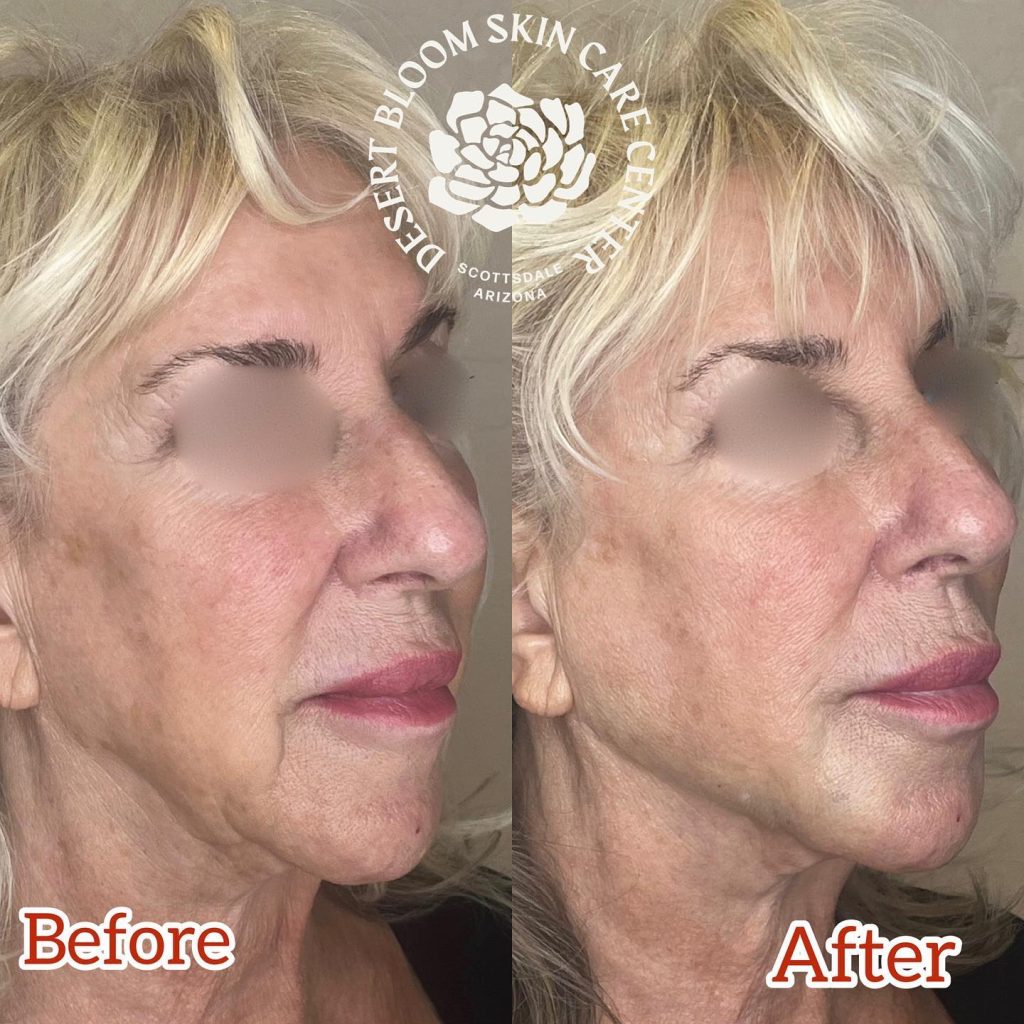
PDO Thread Lift in Scottsdale, AZ 85260
Cost$160 and up
Procedure
time15 minutes and up
Recovery time5–7 days
Book now
When You First Notice the Softening
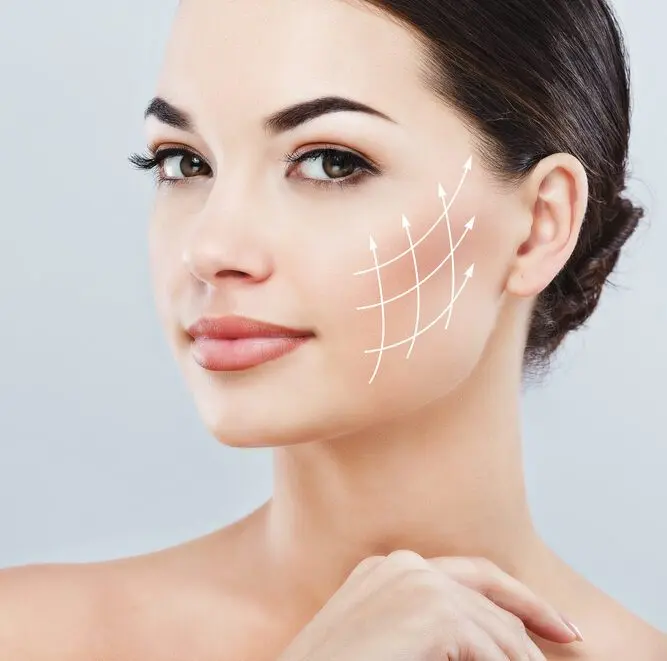
You noticed it recently — on a video call, or catching your reflection at a restaurant. Your jawline looks softer than it did a couple of years ago. The skin around your mouth sits differently. A PDO thread lift is a minimally invasive facial rejuvenation procedure that addresses visible signs of aging — mild-to-moderate sagging skin in the face and jawline — without surgical procedures and without weeks of recovery.
This page covers what a PDO thread lift in Scottsdale involves at Desert Bloom: candidacy, procedure, recovery, cost, and what PDO threads will not do. For the science of the material, the polydioxanone page covers that separately.
At a Glance
- Procedure time: 30–60 minutes under local anesthesia
- Minimal downtime: Most patients return to desk work in 24–48 hours; plan 7–14 days before a visible event
- Facial rejuvenation timeline: Immediate lift, with collagen production driving natural-looking results over 1–3 months
- Duration: Effects typically last 12–18 months; PDO threads dissolve over 4–6 months
- Price range at Desert Bloom: Starts at $1,180 for the foundational face thread lift; full PDO non-surgical facelift $2,500
- Reviewer: Dr. Natalya Borakowski, NMD — 17 years of experience in Scottsdale aesthetic medicine, IMCAS Paris 2025 presenter on thread technique
PDO thread lifting is one of several thread-based treatments at Desert Bloom, including neck thread lift, thread brow lift, and PDO nose threading. For a broader PDO threads overview, see our category page.
Common Questions Before Booking
These are the questions most patients need answered before deciding whether a consultation makes sense.
How much does a PDO thread lift cost in Scottsdale?
$1,180 base for a single-zone face thread lift; $2,500 for the multi-zone non-surgical facelift. Each patient receives a written quote at consultation.
How long does face threading last?
PDO threads dissolve in 4–6 months; the collagen production they trigger sustains results for 12–18 months. Longevity varies with skin quality and whether you return for maintenance.
Is a PDO thread lift worth the cost?
Worth depends on your goal. PDO threads offer subtle structural support with minimal downtime for 12–18 months. If you want surgical-level change, surgery may be the more appropriate investment. If you want natural-looking improvement without general anesthesia, surgical incisions, or a facelift recovery timeline, threads can be the right value at this stage of aging.
Will I look natural?
Natural-looking results depend on candidacy and technique. A good candidate — early-to-moderate descent, good skin quality, realistic expectations — gets subtle support that reads as “you, more rested.” The wrong candidate is more likely to develop visible irregularities, disappointment, or issues that require clinical management.
Is it painful?
Local anesthesia numbs the entry sites. Most patients describe pressure or tugging, not pain. Mild soreness for 2–3 days is normal.
How is it different from a facelift?
Different stages of aging. A traditional facelift surgically repositions deeper tissues and removes redundant skin; PDO threads reposition soft tissue without surgery and typically last 12–18 months.
What Is a PDO Thread Lift?
A PDO thread lift uses dissolvable polydioxanone sutures placed beneath the skin to mechanically lift soft tissue and trigger a collagen response over the following weeks. Polydioxanone has a decades-long surgical safety record outside aesthetics. → Read the full science of PDO threads
How PDO Threads Stimulate Collagen Production
PDO threads do not work by mechanical pull alone. They dissolve over about six months through hydrolysis, but while present they activate the body’s natural healing response, which encourages new collagen production around each thread. That collagen does not vanish when the thread dissolves, though density declines over 12–18 months. Improvements often continue through the first few months. The collagen response varies between individuals, and published safety data remains stronger in observational studies than in large controlled trials.
Types of PDO Threads: Smooth, Screw, and Barbed
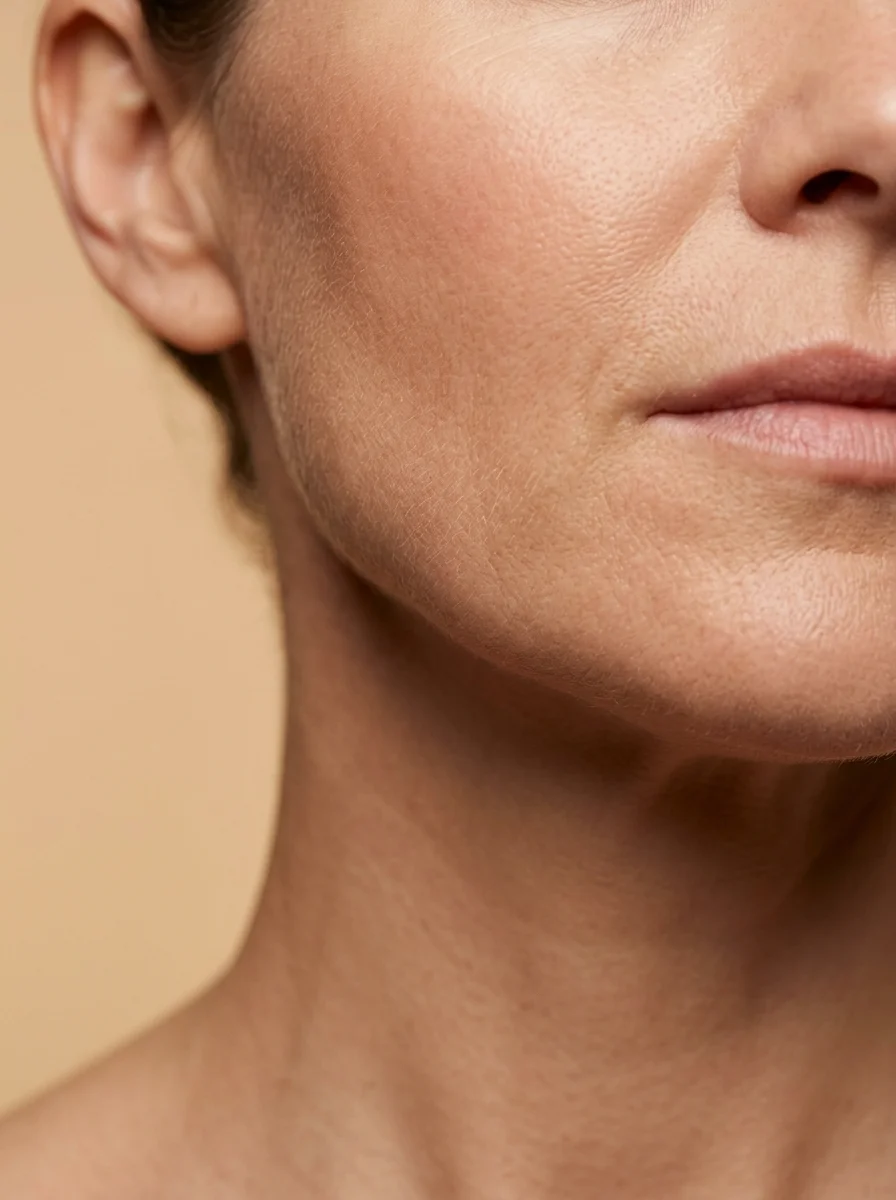
No single PDO thread lifts, volumizes, tightens, and improves texture equally — different thread types exist because different problems require different tools. For the technical breakdown of each subtype, see our deeper breakdown of thread types.
At Desert Bloom, Dr. Borakowski selects the type — or combination of types — based on anatomy, skin quality, and the zones being treated. Facial aging happens in multiple layers; many individuals benefit from a combination of PDO threads across zones for full-face contouring.
| Smooth (Mono) | Screw (Twist) | Barbed (Cog) | |
|---|---|---|---|
| Primary Use | Collagen stimulation | Localized support and subtle volumization | Mechanical lifting |
| Best For | Fine lines, wrinkles, neck skin, overall skin rejuvenation | Nasolabial folds, marionette lines, sunken temples | Jawline definition, jowls, brow lift |
| Overview | Creates a collagen mesh under the surface | Greater surface area produces concentrated collagen response | Tiny cogs anchor into tissue and physically reposition it |
| Duration | 6–12 months | 9–12 months | 12–18 months |
1 / 3
→ swipe to compare
PDO Thread Lift vs. Surgical Facelift
A PDO thread lift is not a facelift, and it is not a shortcut to facelift-level correction. A traditional facelift addresses deeper structural descent, removes excess skin, and requires general anesthesia with weeks of recovery. PDO threads work best in patients with mild to moderate skin laxity who still have tissue integrity — for a minimally invasive treatment that produces natural-looking results.
A thread lift suits the patient who says: “I look a little heavier, softer, more tired than I used to.” A traditional facelift suits the patient with significant loose skin, heavy jowling, and deeper neck changes wanting a more dramatic correction. Different stages of aging.
Who Is a Good Candidate for PDO Threads?
The best results do not happen because threads are good. They happen because the right patient receives the right treatment at the right time. These are the same questions Dr. Borakowski uses at the consultation:
- You notice early jowl formation or a less defined jawline
- Nasolabial folds or marionette lines have deepened over the past year or two
- Your skin still has some elasticity — it responds when gently pressed
- You prefer non-surgical treatments with shorter recovery time
- You are a non-smoker in generally good health
- You have realistic expectations about what a minimally invasive procedure can achieve
When PDO Threads Are Not the Right Choice
We do turn patients away from threads. That is not a weakness in the practice. It is part of practicing ethically.
PDO threads are usually not the right choice for patients with:
• Significant skin redundancy where facelift surgery would produce a meaningfully better outcome
• Active skin infections or inflammatory conditions in the treatment area
• Pregnancy or breastfeeding
• Bleeding disorders or current use of blood thinning medications
• Permanent fillers in the planned treatment area
• Very thin skin where threads might become visible beneath the surface
Sometimes the better treatment option is RF skin tightening. Sometimes it is dermal fillers. Sometimes it is a referral to a trusted surgical colleague. Sometimes it is no treatment at all.
PDO threads are usually not the right choice for patients with:
• Significant skin redundancy where facelift surgery would produce a meaningfully better outcome
• Active skin infections or inflammatory conditions in the treatment area
• Pregnancy or breastfeeding
• Bleeding disorders or current use of blood thinning medications
• Permanent fillers in the planned treatment area
• Very thin skin where threads might become visible beneath the surface
Sometimes the better treatment option is RF skin tightening. Sometimes it is dermal fillers. Sometimes it is a referral to a trusted surgical colleague. Sometimes it is no treatment at all.
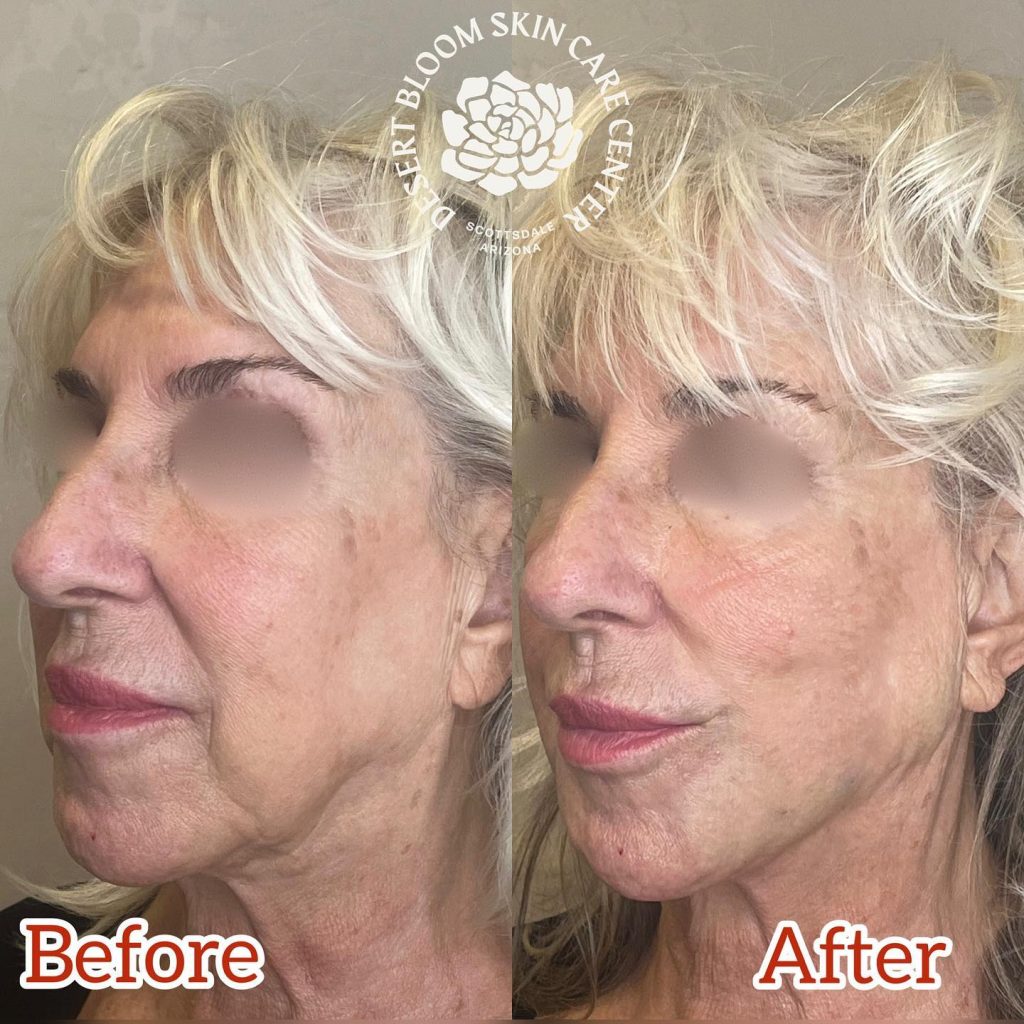
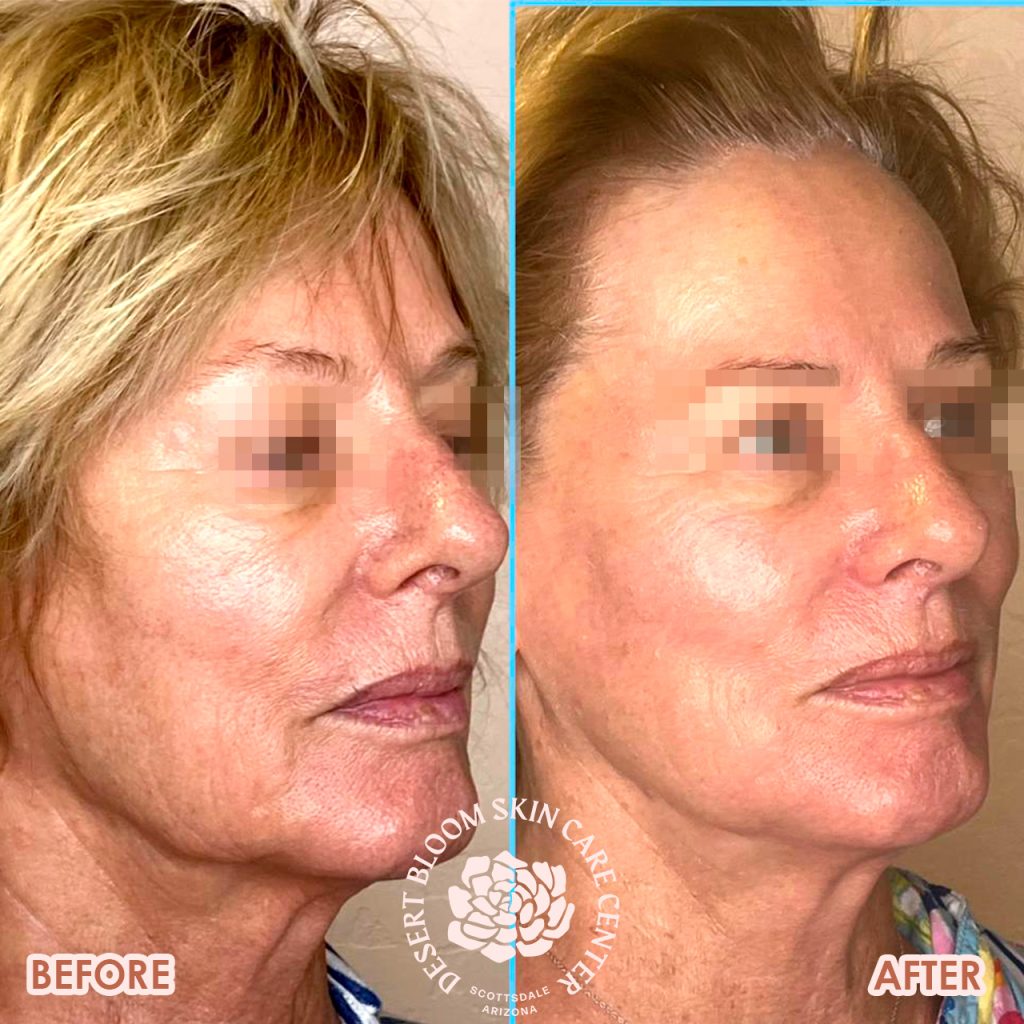
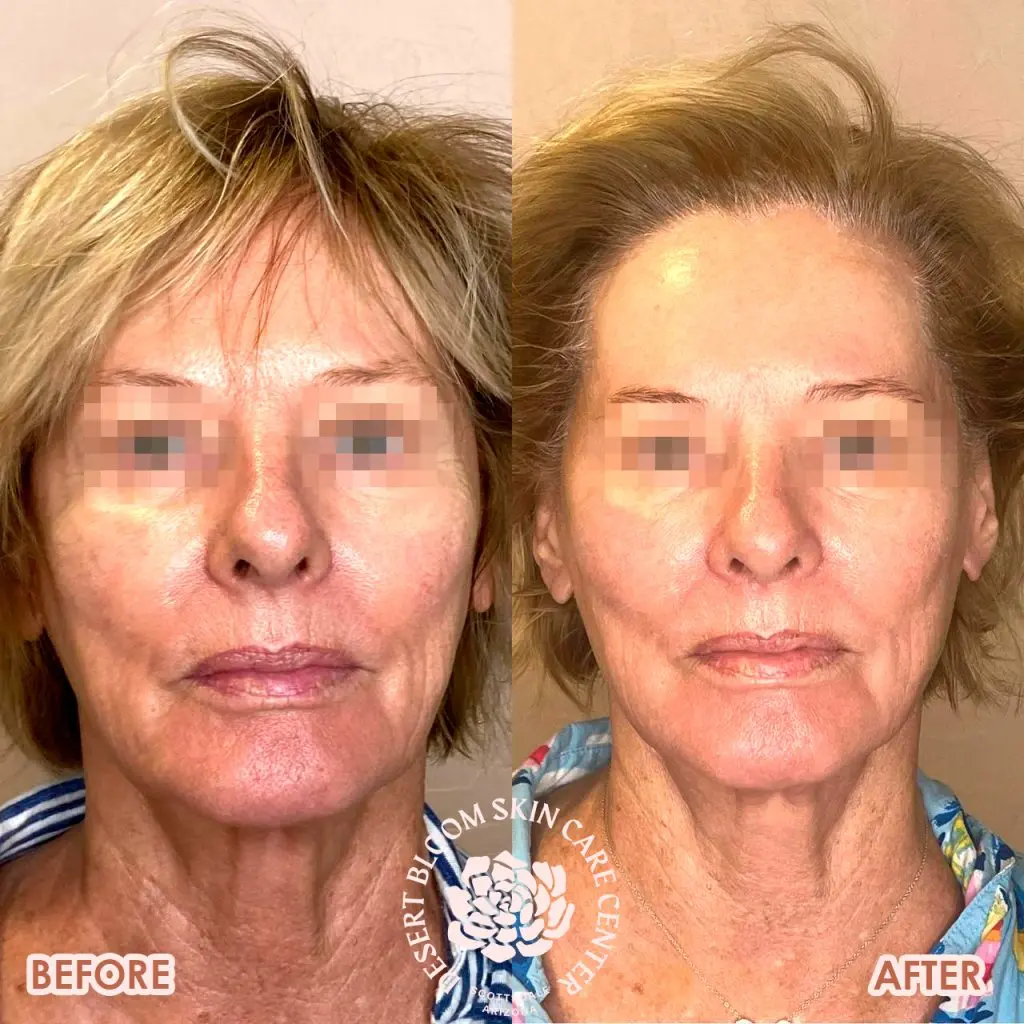
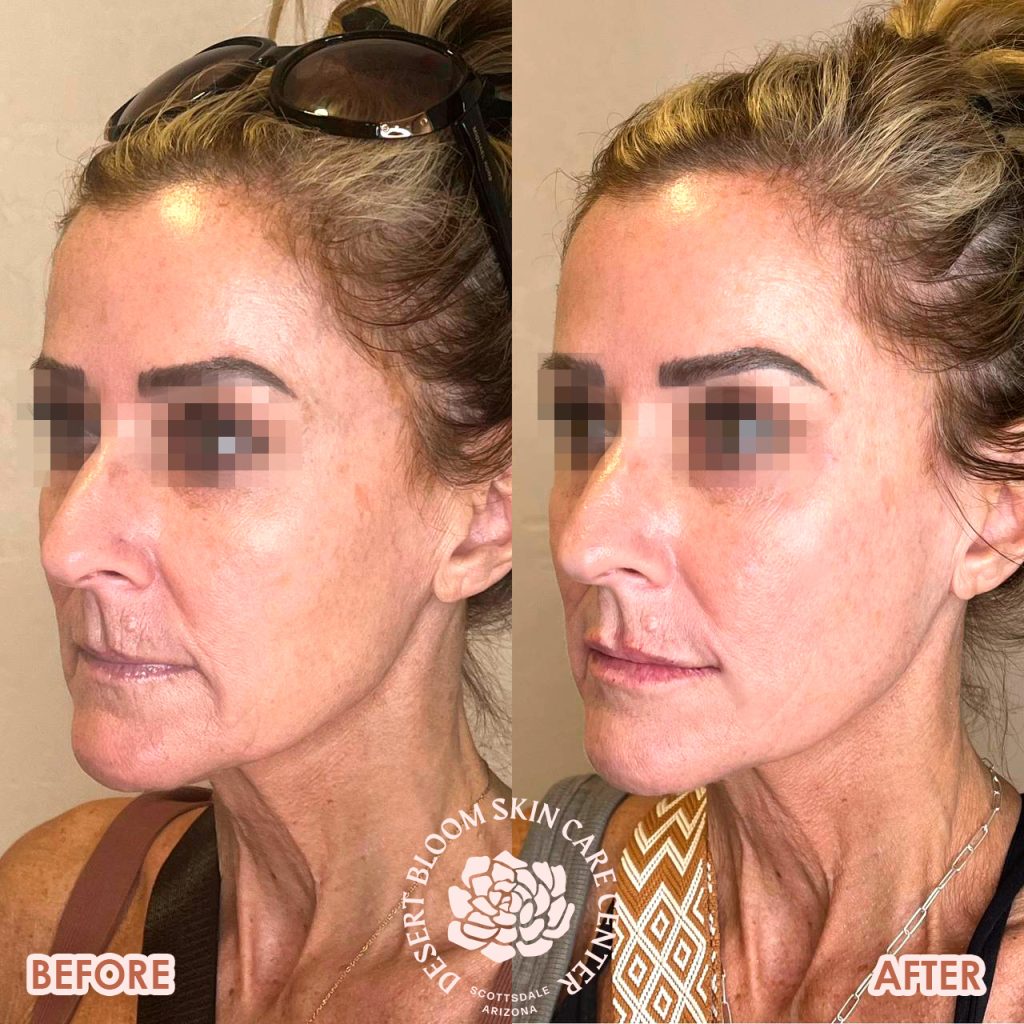
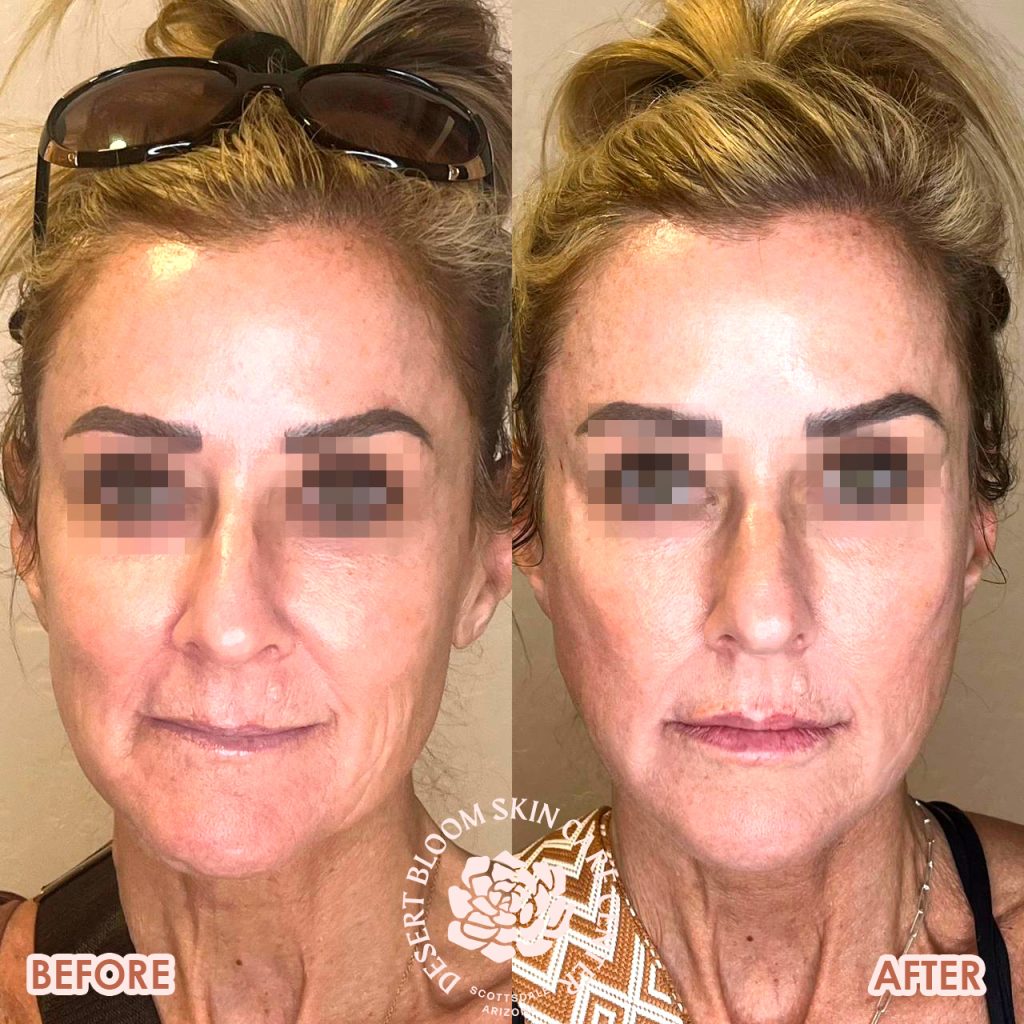
Before & After Gallery
What PDO Threads Can — and Cannot — Do
Realistic expectations matter as much as technical skill. The PDO threads work when the goal matches what the procedure can actually deliver.
What PDO threads can do: Improve mild to moderate facial laxity. Sharpen the jawline. Soften early jowls. Enhance support across the brow, lower face, midface, and cheeks. Stimulate collagen production and refine skin quality. The result should read as refreshed and better supported — not obvious, pulled, or ‘done.’

What a PDO Thread Lift Won’t Do
This is where Desert Bloom diverges from medspa marketing. We name the limits before treatment so you can decide with full information.
- Won’t remove excess skin. PDO threads reposition soft tissue. They do not excise redundant skin. Only surgery does that.
- Won’t substitute for a facelift in significant laxity. If your skin has lost most of its elasticity and your jowls are heavy, threads disappoint. The right answer is a referral, not a procedure.
- Won’t add volume to deflated areas. Volume loss is a filler problem. Threads support what is there; they do not create what is missing.
- Won’t last as long as surgery. 12–18 months versus 10+ years. If you measure value purely by duration, surgery wins. If you measure it by recovery time and reversibility, PDO threads do.
- Won’t fix problems that are not soft-tissue descent. Skin quality, pigmentation, and dynamic wrinkles need different tools — peels, laser, neurotoxin. PDO threads will not address those no matter how well placed.
The best PDO thread lift results are subtle. You look more rested. More defined. A little fresher. Not different. Not obvious. Not “done.”
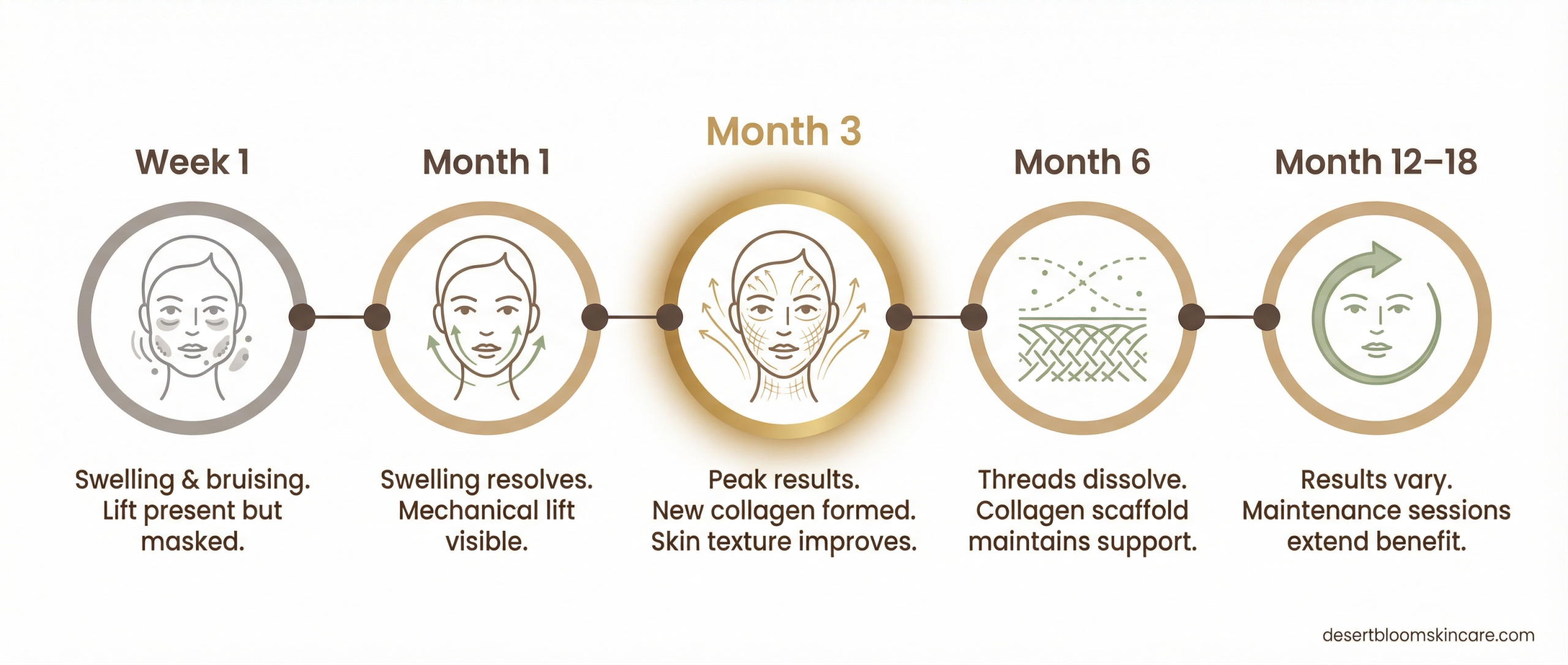
Realistic Results at 1, 3, 6, and 12 Months
PDO thread lift results evolve. Knowing what to expect at each stage helps you judge your outcome fairly. For a real example, see a 6-month case study.
Satisfaction can be lower at six months than in the first weeks — PDO threads are temporary by design, and some softening is normal. Long lasting improvements depend on collagen scaffold quality, not on the thread itself.
Week 1Initial Recovery
The lift is present but partially masked by swelling. Bruising, tenderness, and a pulling sensation are common and expected.
Month 1Lift Becomes Visible
Most swelling resolves. The mechanical lift becomes easier to see. Collagen stimulation has begun but is not yet apparent.
Month 3Peak Results
This is when most patients feel they are seeing the full benefit. The threads have settled, the lift looks natural, and the collagen response shows in skin texture and firmness.
Month 6Collagen Scaffold
Threads are dissolving. The collagen scaffold they helped create maintains structural support. Some patients notice gradual softening — this is normal.
Months 12–18Long-Term Maintenance
Results vary by individual. Many patients maintain visible improvement. Maintenance treatments can extend the benefit — at Desert Bloom we typically recommend reassessment approximately every 12 months.
Not Sure If a PDO Thread Lift Fits Your Goals?
If you are weighing PDO threads against fillers, laser tightening, or surgery — the next step is understanding what your anatomy can realistically respond to. A consultation with Dr. Borakowski clarifies what PDO threads can do for your specific face, what they cannot, and whether a different approach would serve you better.
Schedule a PDO Thread Lift Consultation
Treatment Areas for PDO Threads
Most commonly treated areas: lower face, jawline, midface and cheeks, brow, and neck. Many patients combine two or three areas for balanced facial contouring.
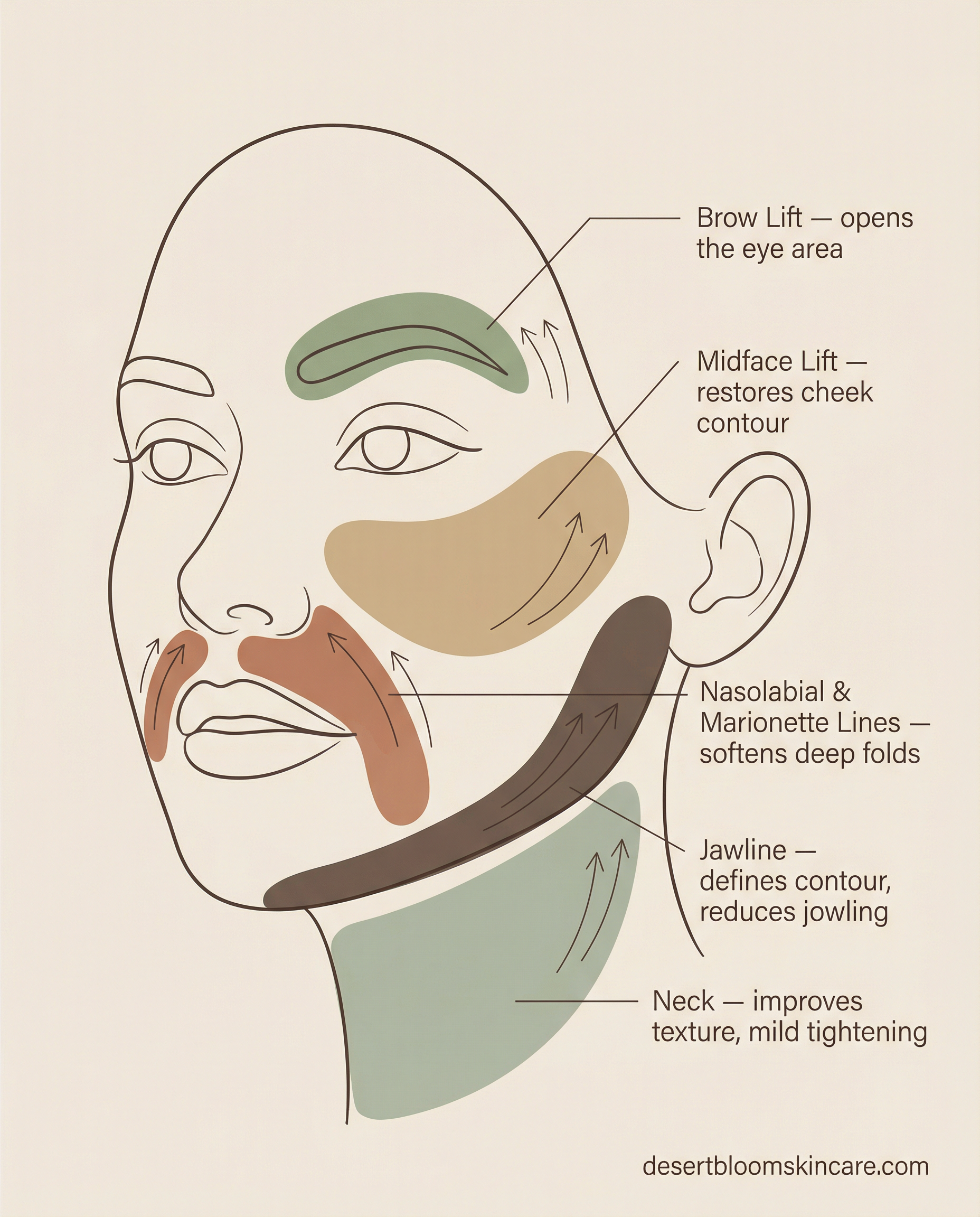
Face: jowls, nasolabial folds, marionette lines. Barbed PDO threads along the jawline address early jowl formation. Screw threads around nasolabial folds and marionette lines add collagen stimulation and subtle volumization where appropriate.
Brow. A carefully positioned thread brow lift can subtly open the eye area. The margin between natural elevation and over-correction is narrow.
Neck. Neck and jawline laxity have their own anatomy and technique. See our dedicated Neck Thread Lift page for protocol, candidacy, and pricing.
Nose.PDO nose threads can address mild asymmetry or a drooping tip without surgery, though candidacy is more selective than for facial threads.
The PDO Thread Lift Procedure at Desert Bloom
Every treatment at Desert Bloom starts with assessment. Not every individual asking for PDO threads should get them.
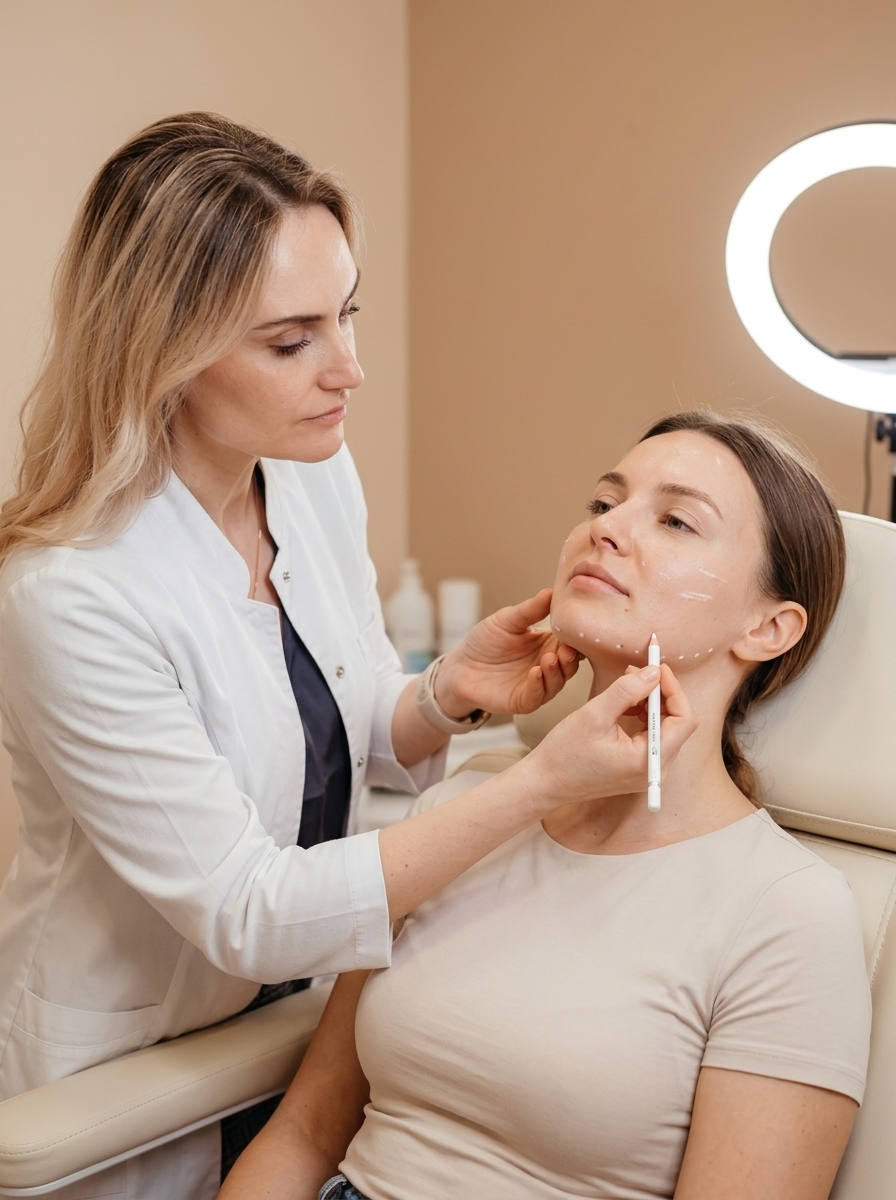
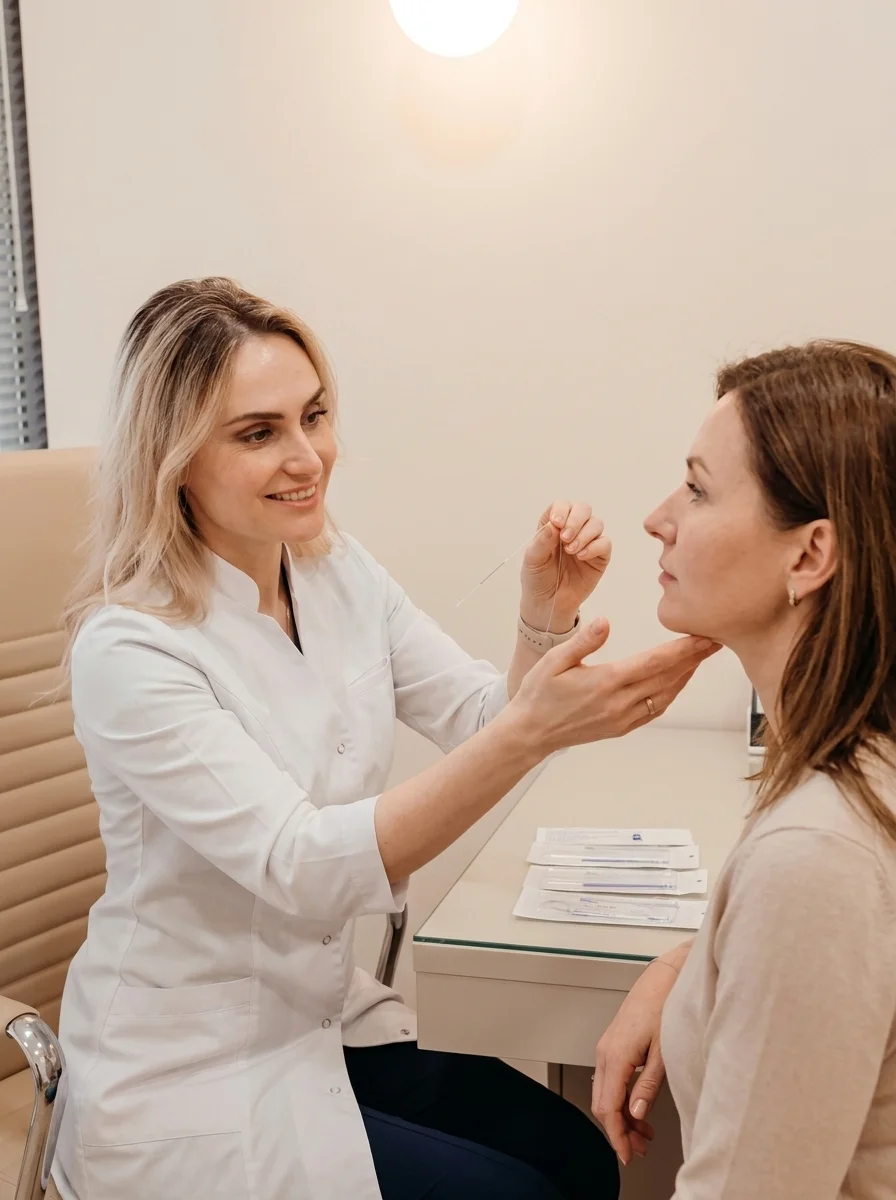
Most procedures take 30 to 60 minutes; you go home the same day. No general anesthesia, no overnight stay. Dr. Borakowski performs the procedure in sequence: assessment and marking, topical numbing plus local anesthesia, thread insertion through a cannula or fine needle, controlled tension and trimming, and symmetry review before you leave.
Placement Depth: Why It Matters
Most thread-related complications trace back to one technical question — at what depth was the thread inserted? The target plane for many facial lifting PDO threads is the deep subcutaneous / supra-SMAS plane — superficial to the SMAS and deep enough to avoid the dermis. In practical terms, the thread should not sit so superficially that it can be seen or felt from the surface, and not so deep that it misses the tissue plane it is meant to support.
When threads sit too superficially — closer to the dermis — the patient feels them, sees them, and may develop dimpling and asymmetry that bring people in for second opinions. When threads sit too deep, they fail to lift because they pass through the tissue plane they were meant to reposition. Placement depth is not a marketing detail; it is the procedure.
PDO Thread Lift in Action
Watch Dr. Borakowski perform a PDO thread lift. The video shows actual technique — from thread insertion to final adjustment — in a real clinical setting at Desert Bloom.

Recovery, Downtime, and Aftercare
Recovery is real — plan accordingly. PDO threads are minimally invasive, but following the post-procedure instructions matters for safety and final outcome.
Days 1–3: Mild swelling, bruising, and tenderness are common. You may feel a pulling sensation. Sleep on your back with your head slightly elevated. Avoid excessive facial movements and do not touch or massage the treated area. The swelling or bruising you see is part of the body’s normal response.
Days 4–7: Most swelling subsides. Some patients notice subtle asymmetry or temporary skin dimpling — this resolves as PDO threads settle into their final position. Light walking and gentle activities are fine; avoid heavy lifting.
Weeks 2–4: Most patients feel comfortable in social and professional settings. Avoid strenuous activities for at least seven days. No dental work for two weeks. Avoid sleeping face-down for three to four weeks. Aftercare instructions are reviewed at follow-up.

Most patients return to desk work within 24–48 hours, though visible healing may take longer. The collagen-driven skin tightening effect builds gradually over the following weeks. If you have a visible event, plan for 7–14 days before it.
What Research Says: Pooled Complication Data
Industry pooled data gives a baseline for the safety conversation at consultation. A 2021 meta-analysis (Niu et al., PMID 33821308) pooled outcomes across 26 thread-lift studies and reported these weighted side effects and complication rates:
- Swelling: ~35%
- Skin dimpling: ~10%
- Paresthesia (temporary altered sensation): ~6%
- Visible threads at the surface: ~4%
- Infection: ~2%
- Thread extrusion: ~2%
These are pooled industry numbers across many practitioner groups — not Desert Bloom’s outcomes. We share them because patients deserve the realistic range before treatment, not after. Most events are minor and self-limited; a small minority require revision. For a full clinical breakdown, see our guide on thread lift complications.
Contact us immediately if:
You experience persistent or worsening pain after 72 hours, hot or draining insertion points, or a visible ridge or protrusion under the skin. Infection and thread extrusion are uncommon but documented complications; pooled literature estimates place each around 2%. These require prompt clinical assessment.
Patient Case Studies
Every face is different, and so is every result. Our case studies show what PDO thread lifts look like in practice. The most clinically meaningful comparison is at the six-month mark — when threads have largely dissolved and the collagen scaffold is visible. Photos taken the week of the procedure show swelling and immediate lift, not the final outcome.
Before & After: Real Patient Results
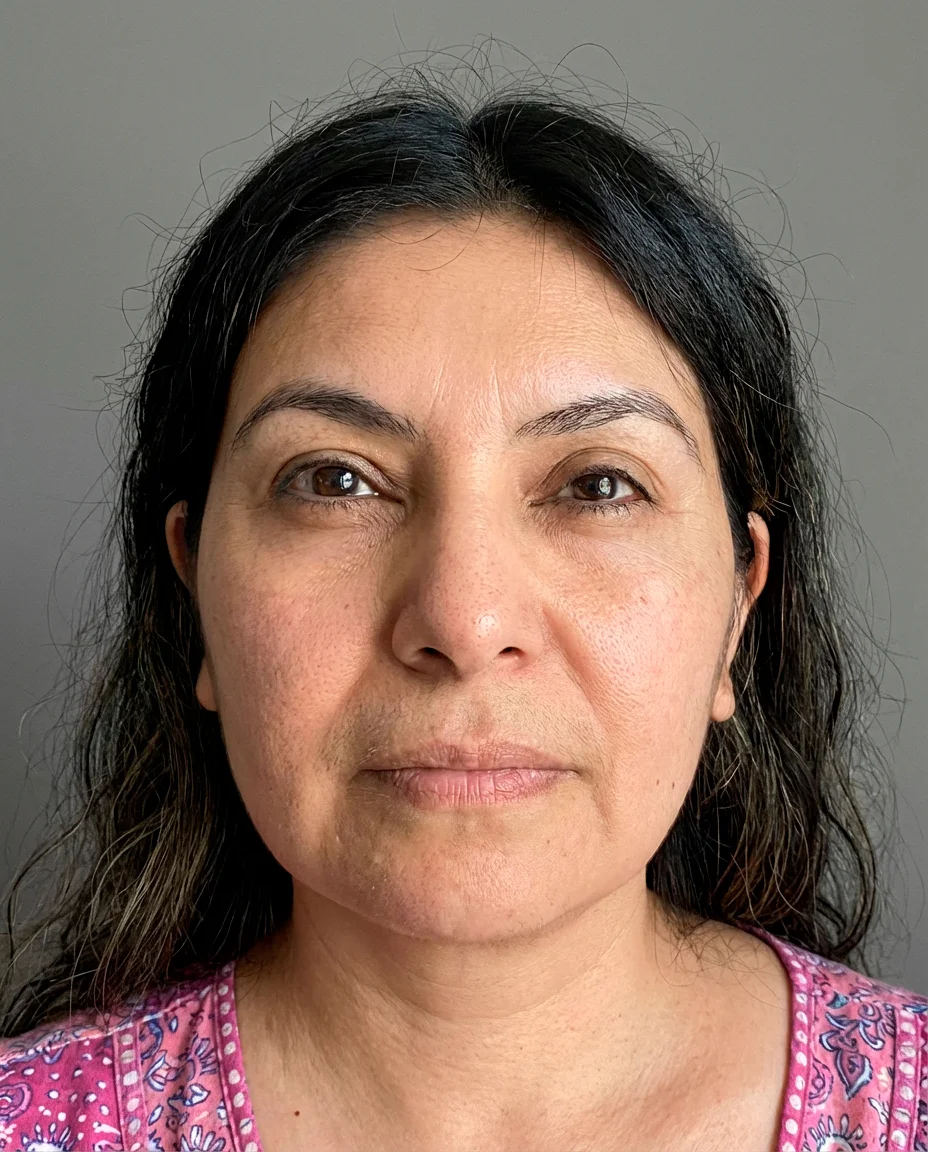 Jawline Contouring
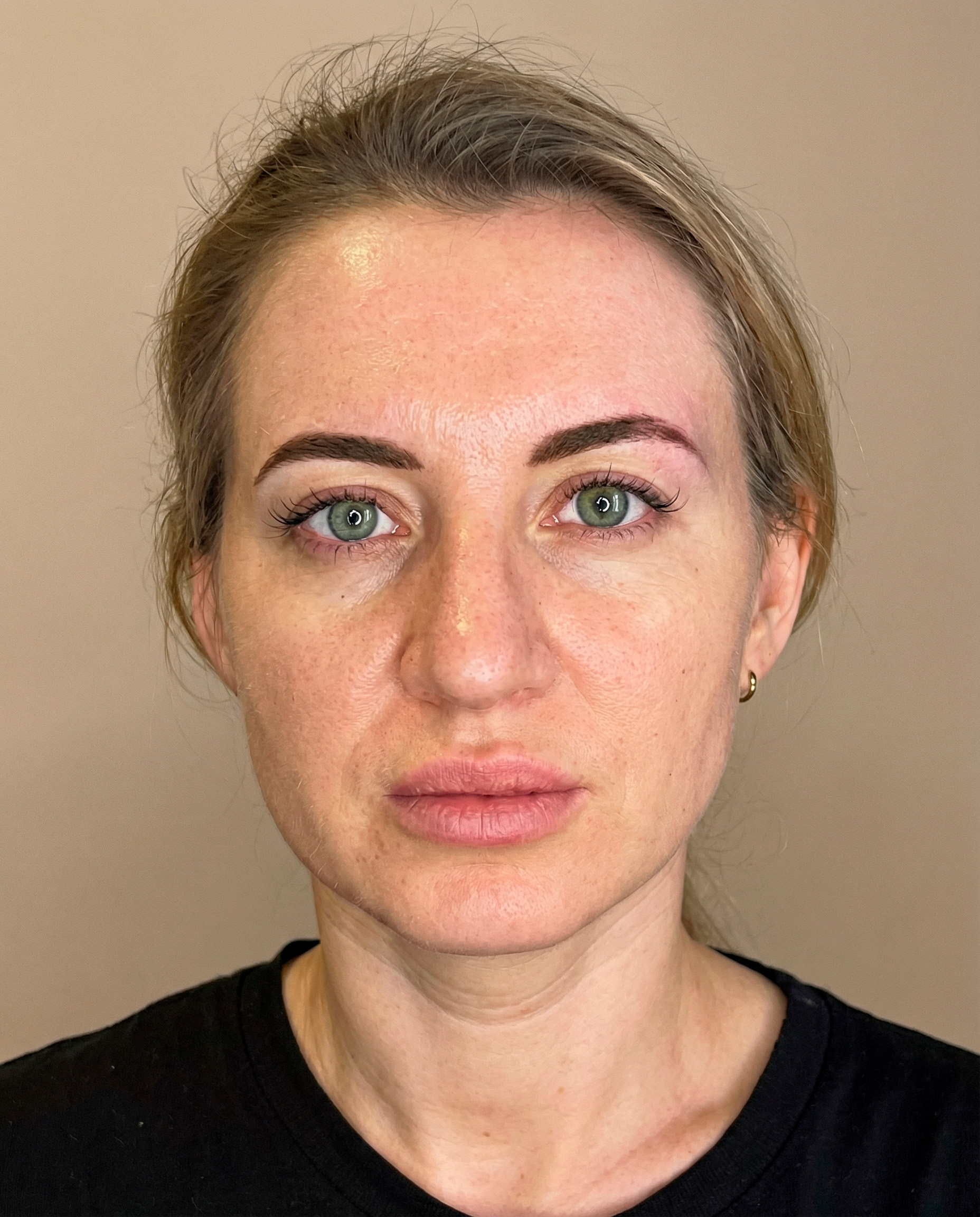 Facial Fatigue Recovery
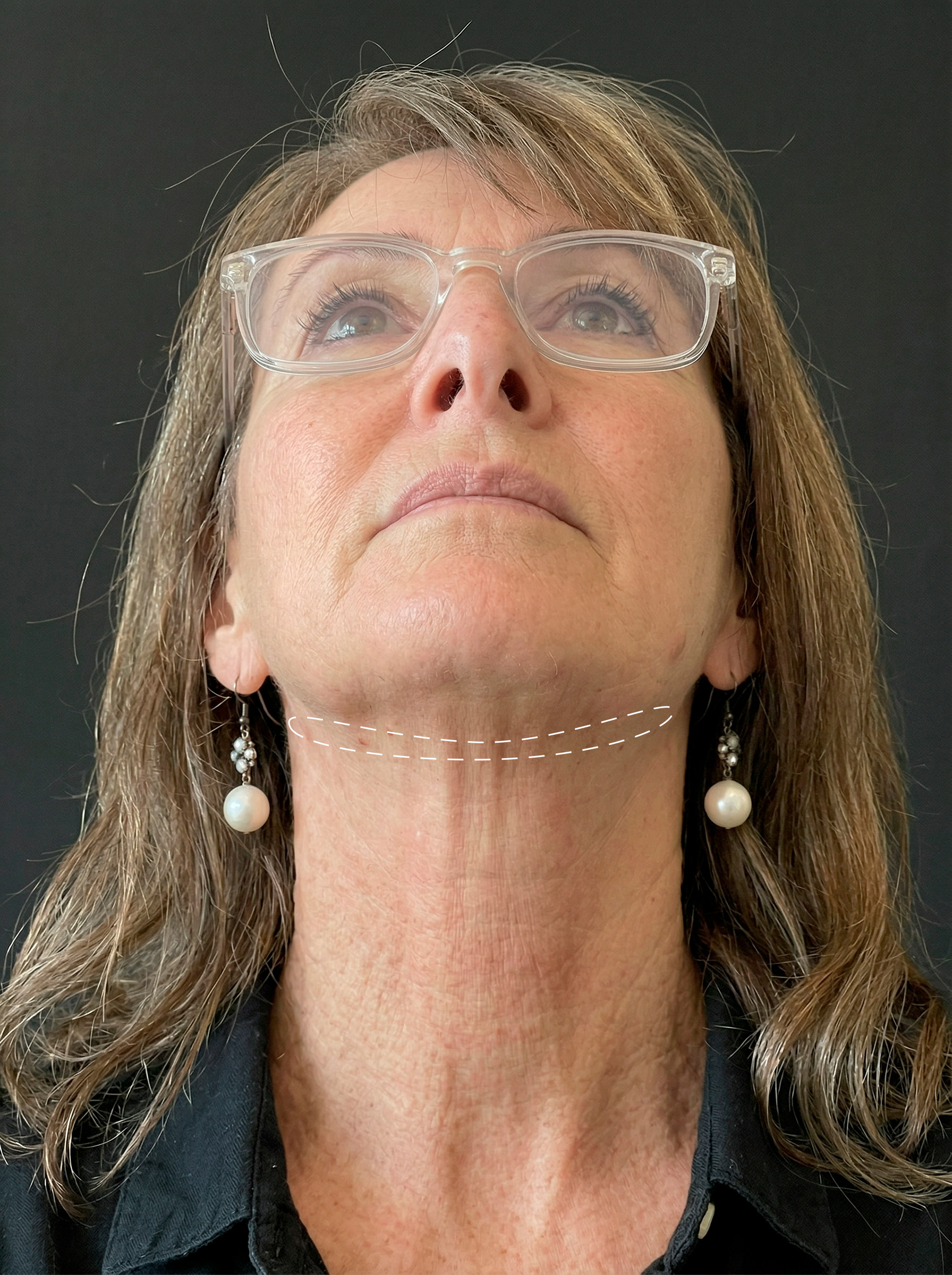 Neck Rejuvenation
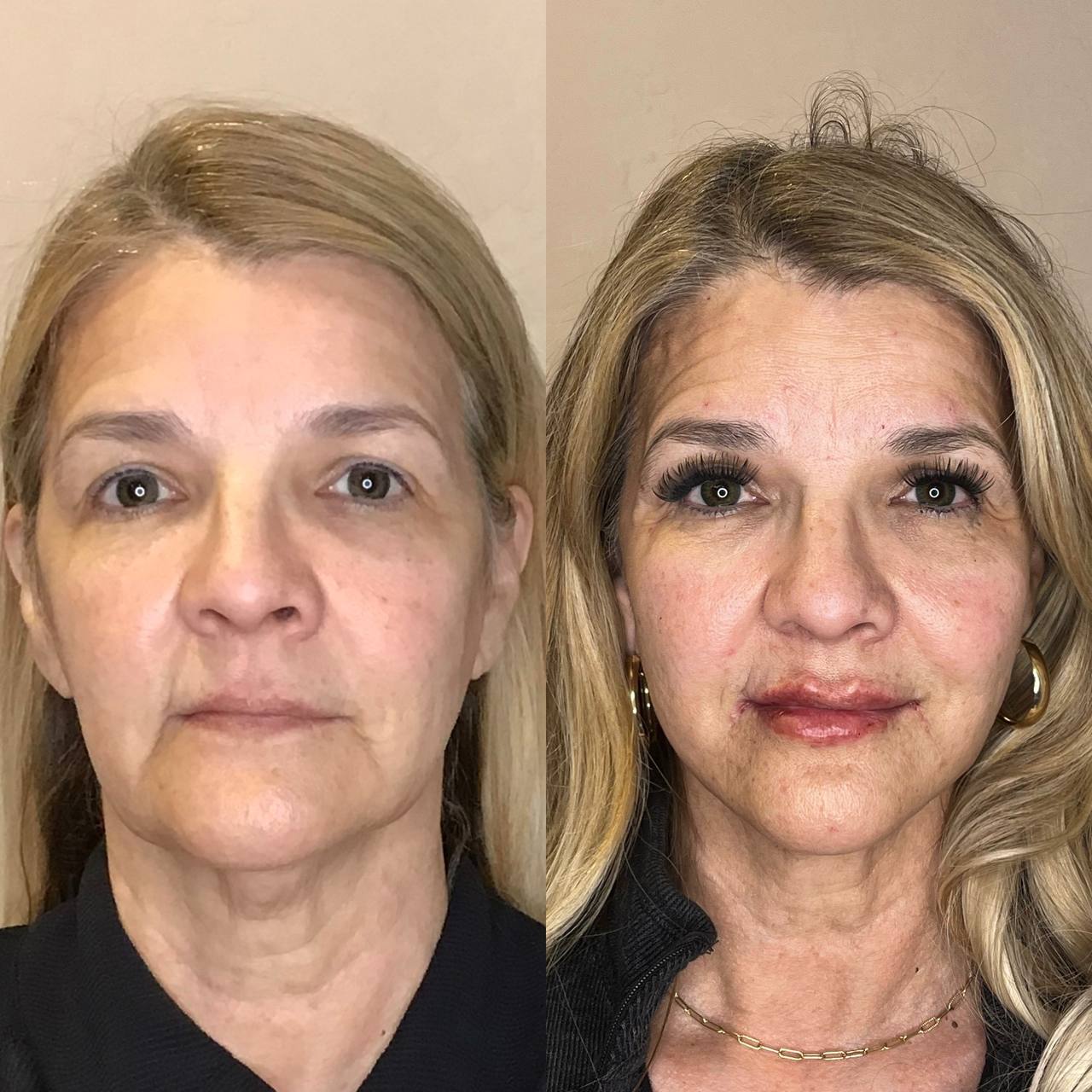 Face & Neck Lift with Lip Filler
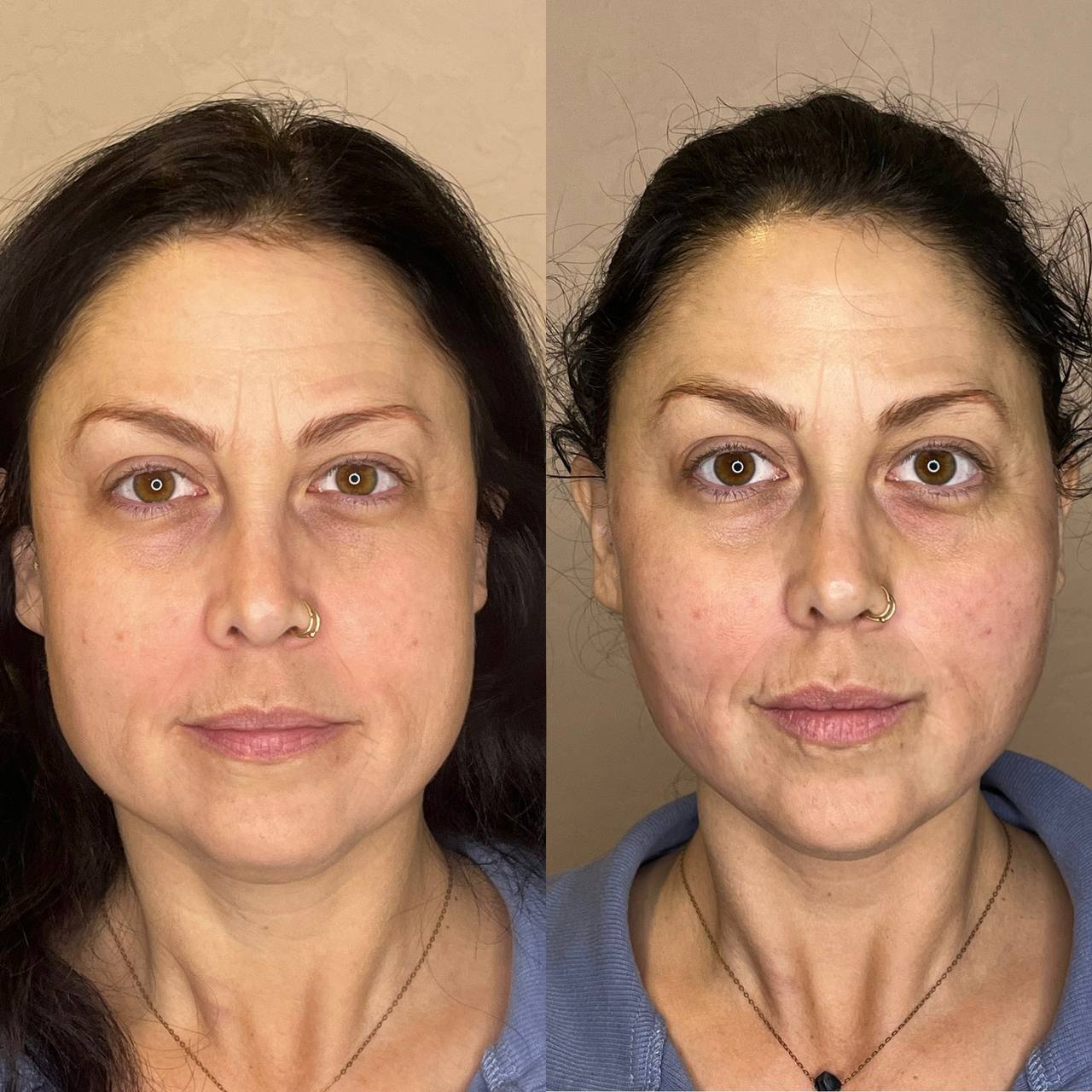 PDO Thread Lift Face
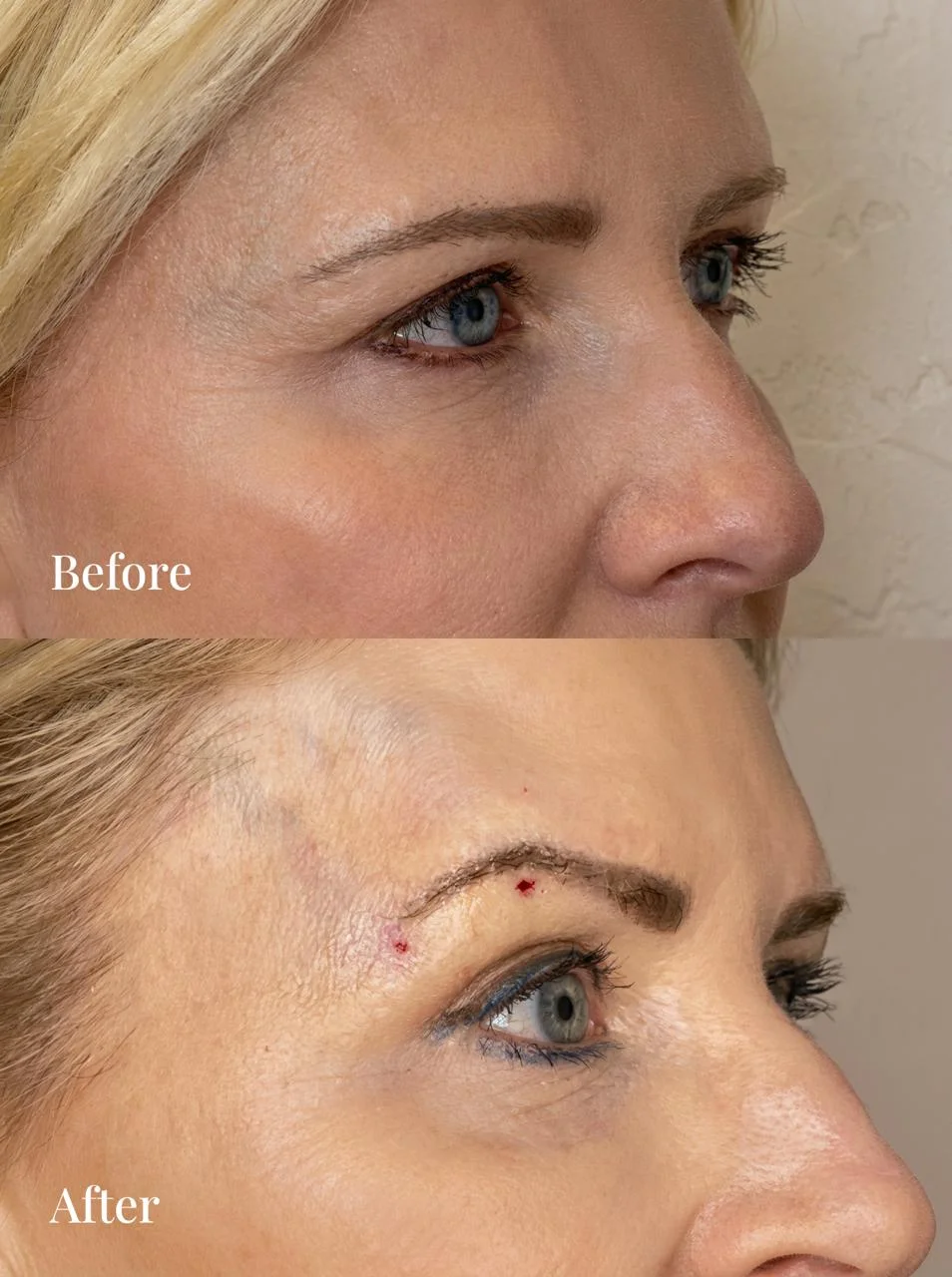 Brow Repositioning
How Much Does a PDO Thread Lift Cost in Scottsdale?
At Desert Bloom, PDO thread lifting begins at $1,180 for the foundational face thread lift. Zone-specific procedures — Thread Brow Lift, Neck Thread Lift, and PDO Nose Thread Lift — are priced separately on their dedicated pages. The multi-zone Non-Surgical Facelift — combining PDO threads across the lower face and midface for full facial rejuvenation — is $2,500. Every patient receives a written quote at consultation based on anatomy and the protocol Dr. Borakowski recommends.
The same patient can be quoted very different numbers at different clinics depending on how the plan is built. Below: what drives the cost, what Desert Bloom charges, and what the price includes — so the estimate you leave with is one you can compare.
What Drives the Price
Six variables drive the cost of any PDO threading session:
- Severity of descent. Mild jowl softening and early sagging skin need fewer PDO threads than moderate descent. A heavier face requires more material.
- Number of zones treated. A jawline lift is one zone; lower-face plus neck plus brow is three. Each zone adds threads, time, and cost.
- Number of PDO threads per zone. Anatomy varies. Two people with the “same” concern can require different counts because tissue density and bone structure differ.
- Thread material. PDO is the most common and least expensive. PLLA and PCL absorbable threads cost more per unit; the collagen response is more sustained.
- Anesthesia approach. Local anesthesia at entry points is standard and included. Extensive nerve blocks or pre-medication, when clinically indicated, add to the total.
- Follow-up included. A complimentary post-procedure check is standard. Optional touch-ups at 12 months are priced separately.
PDO Thread Lift Pricing at Desert Bloom
Current published price points. Starting estimates, not binding quotes — your final number depends on the plan Dr. Borakowski designs at consultation.
| Treatment | Starting price |
|---|---|
| PDO Thread Lift (foundational face) | $1,180 |
| Non-Surgical Rhinoplasty (PDO nose thread lift) | $1,250 and up |
| Thread Brow Lift | $1,800 |
| Neck Thread Lift | $1,800 and up |
| Non-Surgical Facelift (full multi-zone PDO) | $2,500 |
1 / 1
→ swipe to compare
What the Price Includes
- The consultation itself (complimentary; no obligation to book)
- The procedure and all materials
- Local anesthesia at entry points
- A post-procedure check to assess healing and symmetry
- No facility fees or hidden add-ons
What the Price Does Not Include
- An optional touch-up session at the 12-month mark
- Combination plans with dermal fillers or RF microneedling, priced separately
- Travel, lodging, or time off work for out-of-town patients
Cost Framing
A PDO thread lift in Scottsdale is meaningful money but not facelift money. Some context:
- Surgical facelift: often several times higher than thread lifting, depending on surgeon, anesthesia, facility, and whether neck work is included.
- Annual dermal filler maintenance: $1,500–$3,000 in our market depending on syringes and product. Filler restores volume but does not lift.
- Doing nothing: No cost, no risk, no result. For some patients early in the timeline, this is a clinically reasonable choice.
If your concern is soft-tissue descent at the early-to-moderate stage and you want subtle facial rejuvenation with minimal downtime, the thread lift price is in line with the value. If your concern is significant laxity, PDO threads will feel expensive for the outcome they produce.
Financing
Financing is available with Affirm, Cherry, and Care Credit. The monthly payment will vary by purchase amount and customer credit rating.
Combination Treatments
PDO threads address tissue position; fillers address volume; RF skin tightening and lasers address surface quality. Dr. Borakowski combines these aesthetic treatments in a staged plan rather than choosing one in isolation. Sequencing matters: PDO threads go first; filler follows at a separate appointment to avoid displacement. RF microneedling is scheduled several weeks apart from thread work, while Botox or Dysport for dynamic wrinkles can run alongside threads with appropriate spacing.
PDO Threads + RF Skin Tightening
Threads lift and reposition tissue; radiofrequency stimulates deeper collagen remodeling for enhanced skin tightening.
PDO Threads + Dermal Fillers & Botox
Threads address laxity; dermal fillers restore lost volume in the midface and cheeks while neuromodulators soften dynamic wrinkles. The choice of dermal filler — hyaluronic acid versus biostimulatory — depends on volume deficit and timeline. These aesthetic treatments complement each other when sequenced thoughtfully.
Learn more →PDO Threads + Sculptra
A staged option for candidates who need both tissue repositioning and longer-term biostimulatory support.
Learn more →How to Choose a Provider for PDO Thread Lift
The single biggest factor in any PDO thread lift outcome is the practitioner planning the vectors and placing the cannula. Devices and PDO threads are commodities; judgment, experience, and technique are not. These are questions worth asking any provider you are considering — to ensure you are working with a qualified practitioner.
Questions to Ask Any Thread Lift Provider
“What anatomical plane do you place the threads in?”
The expected answer references the deep subcutaneous / supra-SMAS plane — superficial to the SMAS, deep enough to avoid the dermis. A practitioner who cannot answer this clearly, or answers in marketing language, is a signal to look further.
“How do you select thread type for my anatomy?”
The right answer is patient-specific: thread choice depends on skin quality, descent pattern, zone, and desired result. A provider who applies the same protocol to every patient is not selecting; they are dispensing.
“What happens if I am not a good candidate?”
The right answer: “We tell you and discuss alternatives or watchful waiting.” The wrong answer: “We can usually find a way to do something.” PDO threads in the wrong patient produce avoidable complications and predictable disappointment.
“Who performs the procedure, and what is their training in thread complications?”
Thread lifting is a medical procedure. Ask whether the practitioner is licensed, how they were trained, and what their protocol is for visible threads, persistent dimpling, infection, or extrusion. A provider without a clear complication-management answer has not seen enough cases to develop one.
Red Flags in a Provider
- Pressure to book before your anatomy, alternatives, and risks have been reviewed
- A quote before a clinical exam
- No discussion of what could go wrong or who is not a good candidate
- A generic protocol applied without regard to individual anatomy
- Inability to explain placement plane or technique in clinical terms
- Marketing that uses words like “facelift-level result in a short appointment” or “guaranteed lift”
Why Training Matters Here
PDO thread lifting is technique-dependent. The same PDO threads in different hands produce different results. Dr. Borakowski trained with Dr. Murat Tsintsadze in Tbilisi and completed cadaver-based facial anatomy training. She presented PDO thread techniques at the IMCAS World Congress in Paris in January 2025. The training matters because the supra-SMAS plane is a centimeter wide; the difference between a clean result and a visible thread is a millimeter of depth and a correct vector of pull. Experience, not marketing, closes that gap.
For full provider background, see Dr. Natalya Borakowski, NMD.
Why Scottsdale Patients Choose Desert Bloom
Candidacy is taken seriously here. Nobody books treatment at the first visit. The goal: help you look more supported and more like yourself — a youthful appearance that does not announce itself. Patients from Phoenix and the greater Phoenix metro regularly travel to Desert Bloom in Scottsdale to work with Dr. Borakowski.

Medically reviewed byDr. Natalya Borakowski, NMDFounder, Desert Bloom Skincare
“I believe in an individualized approach, because there is no single treatment that works for every patient, even when the concern looks similar on the surface.”
Book Your PDO Thread Lift Assessment in Scottsdale
Before any booking, Dr. Borakowski evaluates your skin, discusses your goals, and gives an honest recommendation — PDO threads, an alternative aesthetic treatment, or a combination plan.
Complimentary assessment. No same-day pressure. A conversation about what is realistic for your face.
Book PDO Thread Consultation
Call (480) 567-8180
Frequently asked questions
Are PDO thread lifts safe?
In appropriately selected patients and when performed by a trained medical provider, PDO thread lifting is generally well tolerated. Published complication data show that most reported events are minor and self-limited, but swelling, dimpling, altered sensation, visible threads, infection, and extrusion are documented risks. The dominant risk factor is provider technique, particularly placement depth — which is why provider selection matters more than thread brand.Will I have visible scars or marks?
No planned incisions; small entry points usually fade within days. You may see pinpoint marks briefly during normal healing.Can the threads be removed if I do not like the result?
PDO threads dissolve on their own over 4–6 months. Threads placed at the correct depth are not designed to be simply pulled out, but localized issues can often be evaluated and managed by a qualified medical provider experienced in thread complications. Reversibility is part of the appeal of threads compared with surgery.What is the difference between PDO and PLLA threads?
PDO dissolves over 4–6 months; PLLA over 12–24 months. PLLA tends to drive a more sustained collagen response and is used when longer-lasting biostimulation is the priority. PDO is widely used for facial thread lifting; candidacy and technique matter more than material alone.Do you do thread lifts on darker skin types?
Yes. PDO thread lifting does not target melanin and is generally safe across Fitzpatrick types. The procedure-related risks (placement, candidacy, technique) are the same regardless of skin tone.References
- “Complications of Thread Lift About Face: A Systematic Review and Meta-Analysis.” Aesthetic Plastic Surgery. 2021. DOI(PMID 33821308)
- “510(k) Premarket Notification database — PDO suture device clearances for soft tissue approximation.” FDA. (https://www.accessdata.fda.gov/scripts/cdrh/cfdocs/cfPMN/pmn.cfm)
- “Thread Lift: Classification, Technique, and How to Approach to the Patient.” International Journal of Medical, Health, Biomedical, Bioengineering and Pharmaceutical Engineering (WASET). DOI
Certain PDO suture and thread systems are FDA-cleared for soft tissue approximation. Their use in aesthetic thread lifting depends on the specific device, indication, anatomy, and clinical judgment. Individual results may vary. A consultation is required to determine suitability for any procedure. All before-and-after images feature actual patients who have provided written consent. All procedures performed or supervised by licensed medical professionals.
Content reviewed by Dr. Natalya Borakowski, NMD, Founder, Desert Bloom Skincare, Scottsdale AZ. Last updated: May 2026.
PDO Thread Lift price
- Crows feet$55030 minutes
- Dark circles and eye bags$600 – $90045 minutes
- Chest wrinkles$450 – $80045 minutes
- Forehead severe to moderate wrinkles$45030 minutes
- Glabellar (between brows) lines$16015 minutes
- Hand Rejuvenation$50030 minutes
- Lip enhancement$160 – $40015 minutes
- Malar crease correction$590 – $1180
- Marionette lines$480
- Nasolabial folds$455 – $800
- Smoker lines$195
- Sunken temples$700
What Our Clients Say
 2 months ago
⭐⭐⭐⭐⭐ I had a great experience at this place. The doctor Natalya was incredibly knowledgeable, honest, and informative, taking the time to answer all of my questions and provide thoughtful recommendations. I never felt pressured into any treatment and truly appreciated the transparency and professionalism. I was also pleasantly surprised that they didn’t charge me for the consultation despite spending so much time with me. The reception (seems like he is the owner) was equally welcoming, professional, and knowledgeable. It’s rare to find a team that genuinely prioritizes patient care and education. I left feeling confident and well-informed, and I will definitely be returning for future treatments. Appreciated and highly recommend!
 5 months ago
I received a PDO nose lift with Natalya. She creates incredibly comfortable environment and is thorough throughout the process. She was available to answer questions through my healing process as they came up. Very happy with my results! I especially love that she is honest and does not try to oversell or push treatments if you don’t need them!
 6 months ago
I have gone to Natalya for years. She does an amazing job! I completely trust her opinion and technique. She and her husband always make me feel welcome and relaxed during my visits. I highly recommend to anyone looking for an honest and approachable place to get a glow up.
 5 months ago
They're amazing! They are Incredibly kind and accommodating and have the best prices. They really seem to care about their clients and making them feel valued. Dr. Natalya is also so knowledgeable and really took the time to talk through everything. Thank you Dr. Natalya and Brian--you have a happy customer.
 5 months ago
There won't be enough space to capture the Goodness that is Dr. Natalya. In 20 years of receiving beauty treatments I have finally found the most competent, knowledgeable, skilled, and kind female practitioner who focuses on what is right and not what is wrong. Plus all of her unique and beautiful surprises, such as her UniquelyYou platform, podcast, etc. to help people love their insides as much as their outsides! The whole office is a retreat and everything they offer is so thoughtful and filled with care. Her husband is so considerate and helpful too, and what a joy to witness such a supportive relationship! What a blessing for us all! Thank you!
Consultation in skin care clinic
Desert Bloom Skincare Center offers personalized skincare consultation to help you achieve a flawless and radiant complexion. Book your appointment today and let our expert team of skincare professionals address your specific concerns and help you reach your skincare goals.
Similar treatments

Visit Our Scottsdale Aesthetic Center
Address
10752 N 89th Place, Suite 122B,Scottsdale, AZ 85260.
Phone:(480) 567-8180
E-mail:info@desertbloomskincare.com
Get Directions →Location & Directions
Desert Bloom Skincare is conveniently located in the Shea Corridor of North Scottsdale, within Edwards Professional Park I — minutes from HonorHealth Scottsdale Shea Medical Center and the Mayo Clinic Scottsdale Campus.
From the North / South:
Take Loop 101 (Pima Freeway) and exit at E Shea Blvd. We are located just East of
the freeway.
From Paradise Valley:
Head East on E Shea Blvd toward North 90th Street.
Parking:
Ample free parking is available directly in front of Suite 122B.
Areas We Serve
We proudly provide expert non-surgical rhinoplasty and PDO thread lifts to patients across the Southwest:
- ScottsdaleNorth Scottsdale · McCormick Ranch · Gainey Ranch
- Paradise Valley
- PhoenixArcadia · Biltmore · North Phoenix
- Fountain Hills
- Cave Creek & Carefree