Surgical vs. Non-Surgical | Which One is Right for You?


Are you considering a cosmetic procedure to enhance your appearance but unsure which type is right for you? The world of cosmetic procedures can be overwhelming, with a vast array of options available. In this article, we will break down the differences between surgical and non surgical cosmetic procedures, weigh the pros and cons of each, and discuss the recovery time involved for both types. We will also explore the scope of each option so that you can make an informed decision about what will work best for you. Finally, we will provide you with some factors to consider when choosing between surgical and non-surgical procedures to help you make an informed decision.
Overview
These aren’t competing options. They serve different anatomical realities — and the question “surgical or non-surgical?” only becomes answerable once we understand what’s actually happening in your face. Volume loss looks different from skin laxity. Structural bone remodeling is different from surface texture change. Treating the right layer with the wrong tool doesn’t fail because the tool is bad. It fails because the anatomy didn’t ask for it.
At Desert Bloom, we do not perform surgery. That’s a deliberate scope choice, not a limitation — and being honest about that scope is part of how we serve you. What we do offer covers the full range of non-surgical aesthetics: injectables and fillers, biostimulators, threads, energy devices, lasers, and skin health protocols. When surgery is the right answer, we will tell you, and we’ll help you find the right surgeon who fits your goals. Trust requires that kind of honesty.
At a Glance: Two Paths
- Non-surgical (offered here)
- Botox/Dysport, fillers (Restylane, RHA, Radiesse, Sculptra, Bellafill), PDO & PLLA threads, RF microneedling, CO₂/Erbium/photofacial, HydraFacial & peels
- Surgical (refer-out)
- Facelift, blepharoplasty, rhinoplasty, neck lift — referred to a board-certified plastic surgeon
- Non-surgical is right when
- Mild–moderate laxity, volume loss, minimal downtime preferred
- Surgery is right when
- Excess skin, structural shift, advanced laxity
What Non-Surgical Treatments Actually Do
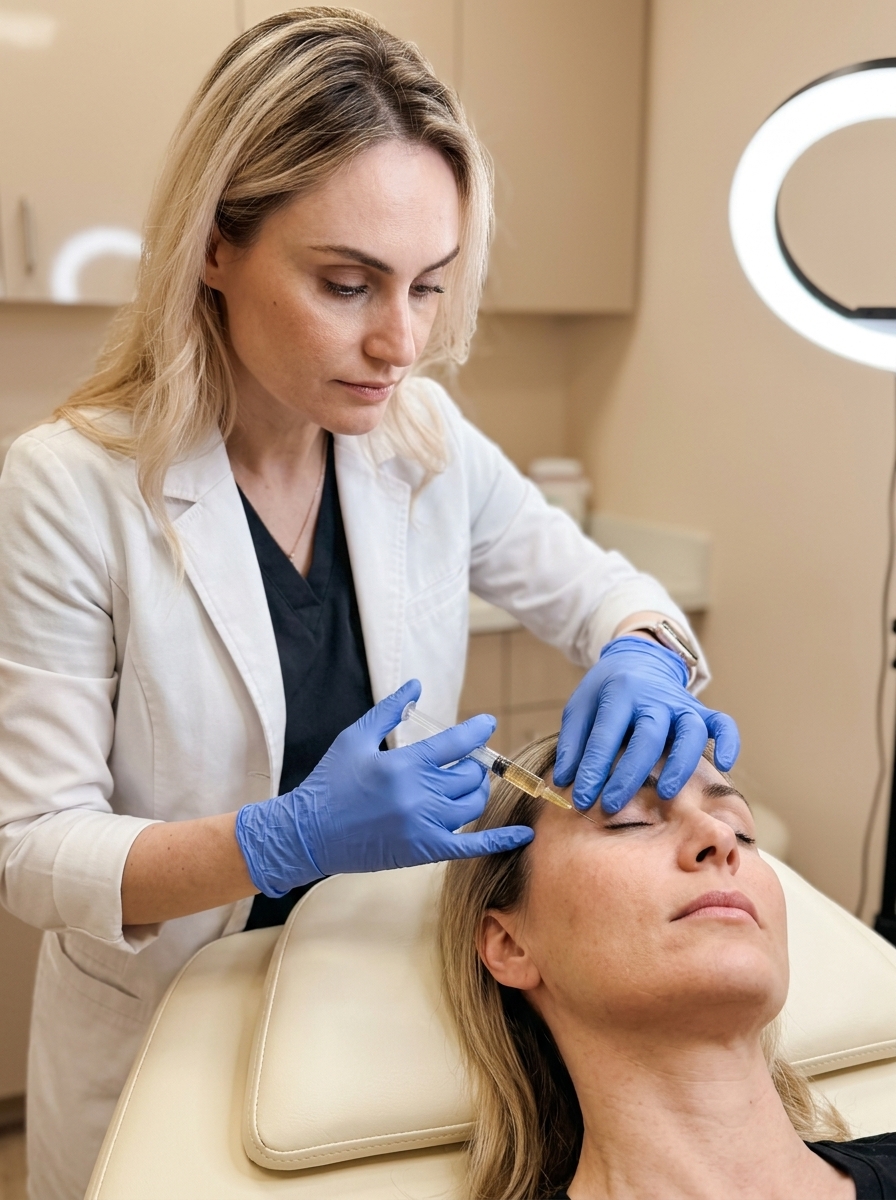
Non-surgical aesthetics work by addressing the specific layers where early-to-moderate change happens: volume depletion in fat pads and bone, collagen degradation in the dermis, dynamic muscle activity driving expression lines, and surface-level texture and tone. Each modality targets a different mechanism. Botox and Dysport quiet overactive muscles. Fillers like Restylane, RHA, Radiesse, and Sculptra restore or stimulate volume. PDO and PLLA threads reposition tissue and trigger a controlled healing response. CO₂ resurfacing is ablative — it removes the surface layer of skin to trigger a controlled wound-healing response that rebuilds collagen from the dermis up.
What non-surgical treatments cannot do is remove tissue. They can lift, stimulate, fill, resurface, and remodel — but if there is significant excess skin or structural bone loss that has changed the fundamental scaffold of the face, the solution sits in a different category. This is not a failure of the tools. It’s anatomy. Knowing which layer needs attention — and which tool speaks to that layer — is what separates a good outcome from a frustrating one.
When Surgery Is the Honest Answer

Surgery becomes the right conversation when the anatomy has shifted beyond what non-surgical tools can address — not because non-surgical has failed, but because the problem is structural. A significant amount of redundant skin on the neck or lower face, advanced ptosis of the eyelid (drooping that blocks vision or creates significant heaviness), or a deep anatomical change in mid-face structure may require excision or repositioning that only an operating room can provide. In these cases, adding more filler or threads doesn’t resolve the issue — it can sometimes obscure it, or create an unnatural heaviness.
I’m direct about this in consultations. If what you’re describing sounds like something a facelift, blepharoplasty, rhinoplasty, or neck lift would address more definitively, I’ll say so. That referral to a surgical specialist is part of the care — not an admission that we can’t help. In many cases, the right sequence is surgery first to correct structure, then non-surgical maintenance to preserve and enhance the result. The two approaches work together more often than they compete.
Recovery, Cost, and Risk

Recovery looks very different between these paths. Non-surgical procedures typically involve hours to a few days of social downtime — bruising from injections, mild swelling after threads. Ablative CO₂ laser is the exception: expect 5–10 days of meaningful downtime, with redness lasting weeks afterward. Life continues. Surgical procedures carry weeks of recovery: swelling, restricted activity, general anesthesia risks, and a longer window before final results are visible. Neither path is wrong — but the recovery commitment matters for how you plan your life, and nobody should minimize it in either direction.
Cost comparisons are genuinely complicated. Non-surgical treatments are often lower upfront — a filler session, a Botox appointment, a laser treatment. But these results are not permanent. Botox lasts three to four months. Filler longevity ranges from 6 months for some HA products to 5+ years for Bellafill, depending on type and placement. Threads provide lift for twelve to eighteen months. Over a decade, a committed maintenance plan may approach or exceed the one-time cost of surgery. Neither path is inherently more economical. The right comparison isn’t cost in isolation — it’s cost relative to what the treatment can actually deliver for your anatomy and timeline.
| Factor | Non-Surgical | Surgical |
|---|---|---|
| Mechanism | Stimulate, fill, remodel, resurface — no tissue removal | Excise, reposition, or structurally correct tissue |
| Best for | Mild–moderate laxity, volume loss, texture, early structural change | Excess skin, advanced laxity, structural bone/soft tissue shift |
| Recovery | Hours to a few days; most return to routine quickly | 2–6 weeks; restricted activity, general anesthesia involved |
| Longevity | 3 months (Botox) to 5+ years (Bellafill); ongoing maintenance | Often 5–15 years; not permanent but long-lasting structural correction |
| Cost | Lower upfront; can accumulate over years of maintenance | Higher upfront; potentially more cost-effective long-term for correct anatomy |
| Risks | Bruising, swelling, asymmetry, migration, rare vascular complications | Anesthesia risks, scarring, nerve injury, longer healing, revision surgery |
| Reversibility | Restylane/RHA fillers dissolvable with hyaluronidase; Botox wears off; biostimulators/threads not reversible | Not reversible — permanence requires careful candidacy assessment |
| Available at DB | Yes — full range | No — refer to board-certified plastic surgeon |
Non-Surgical
- Mechanism
- Stimulate, fill, remodel, resurface — no tissue removal
- Best for
- Mild–moderate laxity, volume loss, texture, early structural change
- Recovery
- Hours to a few days; most return to routine quickly
- Longevity
- 3 months (Botox) to 5+ years (Bellafill); ongoing maintenance
- Cost
- Lower upfront; can accumulate over years of maintenance
- Risks
- Bruising, swelling, asymmetry, migration, rare vascular complications
- Reversibility
- Restylane/RHA fillers dissolvable with hyaluronidase; Botox wears off; biostimulators/threads not reversible
- Available at DB
- Yes — full range
Surgical
- Mechanism
- Excise, reposition, or structurally correct tissue
- Best for
- Excess skin, advanced laxity, structural bone/soft tissue shift
- Recovery
- 2–6 weeks; restricted activity, general anesthesia involved
- Longevity
- Often 5–15 years; not permanent but long-lasting structural correction
- Cost
- Higher upfront; potentially more cost-effective long-term for correct anatomy
- Risks
- Anesthesia risks, scarring, nerve injury, longer healing, revision surgery
- Reversibility
- Not reversible — permanence requires careful candidacy assessment
- Available at DB
- No — refer to board-certified plastic surgeon
How We Think About Candidacy at Desert Bloom
The consultation is where this question actually gets answered — not by reading a list of treatments, but by examining your structure, listening to what’s bothering you, and being honest about what each path can realistically deliver. The best candidates for non-surgical care are typically noticing change that’s meaningful to them but hasn’t yet crossed into structural territory that only surgery addresses. That window is wide. Most people in their late thirties through mid-fifties are well within it.
The best candidates for surgery, in our experience, are those who have already tried quality non-surgical care and found it insufficient — or those where what’s actually present shows a degree of change that would make non-surgical treatment either ineffective or require such volume that it would look unnatural. A good consultation doesn’t always end with a procedure. Sometimes it ends with clarity: “what you need is a surgeon, and here’s who I’d send my own family to.” That clarity is part of the care.
Frequently Asked Questions
Can non-surgical treatments replace a facelift?
Will I eventually need surgery even if I start with non-surgical?
Why doesn’t Desert Bloom perform surgery?
Is non-surgical always cheaper than surgery?
What are the biggest risks I should know about?
Can I combine non-surgical treatments with surgery?
How do I know which path is right for me?
If You’re Not Sure, That’s a Good Place to Start
Most people who come in asking “surgical or non-surgical?” don’t need a sales pitch for either side. They need an honest assessment of their anatomy and a straight answer about what will actually help. That’s what we offer. If the answer is non-surgical, we’ll show you exactly what that looks like and what to expect. If the answer is surgery, we’ll tell you directly — and help you find the right person. Either way, you leave with clarity.
Clarity is the first step — and sometimes the most valuable thing we offer.
“The most important thing I can do in a consultation is tell the truth about what’s actually present — even when that means referring someone elsewhere. A facelift candidate who gets filler instead doesn’t get a result. They get a delay. I’d rather be the person who gave them clarity.”
Keep exploring
Explore Specific Treatments
If you already have a sense of where your concern sits, start with the relevant treatment page.
Volume loss & contour
→Dermal Fillers — Restore or stimulate volume with HA, Radiesse, Sculptra, or Bellafill.
Mild laxity & sagging
→PDO Thread Lift — Reposition tissue and trigger a controlled healing response without surgery.
Crepey skin & texture
→RF Microneedling — Stimulate collagen at depth to firm and refine surface quality.
Sun damage & deep lines
→CO₂ Laser Resurfacing — Ablative resurfacing that rebuilds collagen from the dermis up.
Choosing a provider
→Find the Right Injector — How to vet an injector for training, safety protocols, and honest scope.
Realistic thread expectations
→When Thread Lifts Go Wrong — What can go wrong with thread lifts and how to set expectations.
Individual results vary. Content is educational and does not constitute medical advice. Desert Bloom Skincare does not perform surgery and refers surgical candidates to board-certified plastic surgeons. Clinical content reviewed by Dr. Natalya Borakowski, NMD. Last updated April 2026.