What Are PDO Threads? The Complete Science and FDA Guide for Patients
Polydioxanone (PDO) threads are dissolvable surgical sutures inserted under the skin to mechanically lift tissue and trigger collagen production. But they are FDA-cleared, not FDA-approved — a distinction most medspa marketing gets wrong. Here is the science, the three thread types, and the FDA facts.
Article's contents
- What Does “PDO” Stand For? The Polymer Behind the Procedure
- FDA Status: What “Cleared” Actually Means for PDO Threads
- How PDO Threads Work: The Two-Phase Mechanism
- Phase 1: Mechanical Scaffolding (Day 1)
- Phase 2: Biological Response (Months 1–6)
- Result Timeline
- Three Main Types of PDO Threads
- Mono Threads (Smooth Monofilament)
- Screw Threads (Twisted Filament)
- Cog/Barbed Threads (Lifting Threads)
- PDO vs. PLLA vs. PCL: What’s the Actual Difference?
- What Areas Can PDO Threads Address?
- What the Research Says: Clinical Evidence for PDO Threads
- How Long Do PDO Thread Results Last?
- Are PDO Threads Safe? What to Know About Risks
- PDO Threads vs. Surgical Facelift: The Real Comparison
- Frequently asked questions
- Explore Your Treatment Options
- References
PDO threads are dissolvable surgical sutures inserted under the skin to produce two effects: an immediate mechanical lift and a biological response that stimulates collagen production. They are not a facelift. They are not permanent. And they are FDA-cleared — not FDA-approved, a distinction most medspa websites get wrong, and one that matters clinically more than most patient-facing marketing explains.
This article covers the polymer chemistry behind PDO, how collagen induction works, the difference between thread types, what research confirms (and what it doesn’t), and what the FDA regulatory record actually says. For what the procedure itself looks like — candidacy, protocol, and recovery — the PDO thread lift procedure page covers that territory.
What Does “PDO” Stand For? The Polymer Behind the Procedure
PDO stands for polydioxanone — a synthetic, biocompatible polyester used in surgical sutures since the 1980s. Cardiac, orthopedic, and pediatric surgeons have relied on polydioxanone to close wounds for decades. This is not a novel material; it is a well-characterized one.
In the body, PDO breaks down through hydrolytic degradation — water molecules cleave the polymer’s ester bonds. The end products are carbon dioxide and water. The degradation byproducts are generally considered biocompatible and are cleared through normal metabolic processes. Absorption takes 6 to 9 months, depending on thread diameter and local tissue environment.
FDA Status: What “Cleared” Actually Means for PDO Threads
Here is where most content — and most medspa websites — get it wrong.
PDO threads used in aesthetics are often described online as “FDA-approved,” but that wording is usually inaccurate. Specific PDO suture devices may be FDA-cleared through the 510(k) pathway as absorbable surgical sutures for soft tissue approximation. That clearance does not automatically mean the device is FDA-approved — or FDA-cleared — for cosmetic facial lifting, tightening, or volume claims.
The regulatory distinction:
- FDA clearance (510(k)) means the device is substantially equivalent to a predicate device already on the market. It confirms safety equivalence for the cleared indication. It is not a review of efficacy for a different purpose.
- FDA approval requires clinical trial data proving the device works for the specific use claimed.
One verified cleared device is PDS Barbed Suture, PDO MAXX Threads (510(k) K190245), with an FDA substantial equivalence decision letter dated June 4, 2019. The FDA summary for K190245 specifically states the device is indicated for soft tissue approximation where absorbable sutures are appropriate — and is not intended for lifting and supporting tissues.
In fact, some FDA-cleared PDO suture devices are cleared for soft tissue approximation only, not for lifting or supporting tissue. This is why Desert Bloom treats FDA language carefully: clearance status depends on the specific device and its cleared indication, and aesthetic thread lifting may involve off-label clinical use. When a clinic states their threads are “FDA approved for lifting,” that claim is not supported by the cleared indication on record.
The key point for patients: FDA clearance for a specific PDO suture device should be read according to its cleared indication. It should not be translated into “FDA-approved for cosmetic lifting” unless that exact use is supported by the device’s FDA record.
How PDO Threads Work: The Two-Phase Mechanism
Understanding PDO threads means understanding that the treatment does two separate things, on two separate timelines.
Phase 1: Mechanical Scaffolding (Day 1)
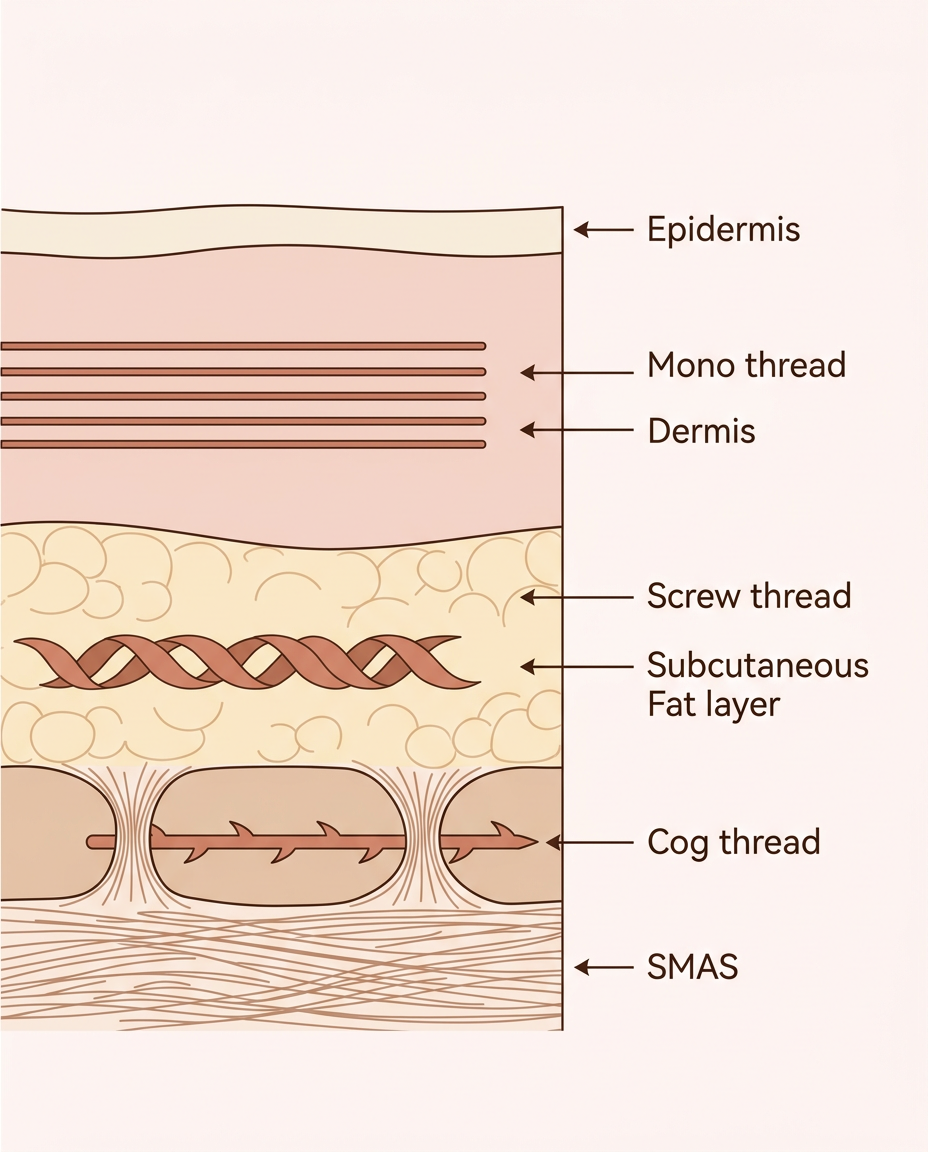
When barbed or cog threads are inserted, the directional barbs catch and anchor subcutaneous tissue. The practitioner then gently pulls the suture to reposition that tissue. The result is often an immediate visible repositioning effect, though the degree varies by anatomy, thread type, and placement technique. Mono and screw threads lack barbs and cannot do this — they are placed in a grid or mesh pattern to create a collagen scaffold across the treatment zone, not to reposition tissue.
Phase 2: Biological Response (Months 1–6)
Thread insertion creates a controlled micro-injury in the dermis. The immune system identifies the foreign material and initiates repair signaling. Fibroblast cells migrate to the insertion site and begin producing Type I collagen (structural) and Type III collagen (regenerative). Animal-model studies (pig: Su et al. 2024) demonstrate that PDO thread implantation produces measurable collagen response, with thread integrity detectable up to approximately 24 weeks, accompanied by mild local inflammation. New capillaries also form in the treated area (neovascularization), improving local tissue nutrition.
Note: The collagen induction evidence cited here comes from animal models, not human RCTs. Extrapolating these findings directly to human facial outcomes requires clinical context.
Result Timeline
Mechanical lift effect from barbed/cog threads. Mono/screw threads show no immediate change.
Fibroblast activity peaks; tissue tightening builds gradually as new collagen forms around the threads.
Combined effect of lift + collagen response reaches its visible peak in most patients.
PDO threads fully dissolve through hydrolysis. The collagen scaffold they triggered remains.
Stimulated collagen continues to support firmness; natural aging gradually continues.
The implication: the best-looking results often appear after the threads themselves are gone. Patients who judge outcome at week two are evaluating through bruising, swelling, and incomplete collagen response.
Three Main Types of PDO Threads
Not all PDO threads are the same shape or serve the same purpose. The thread type determines both the technique and the outcome.
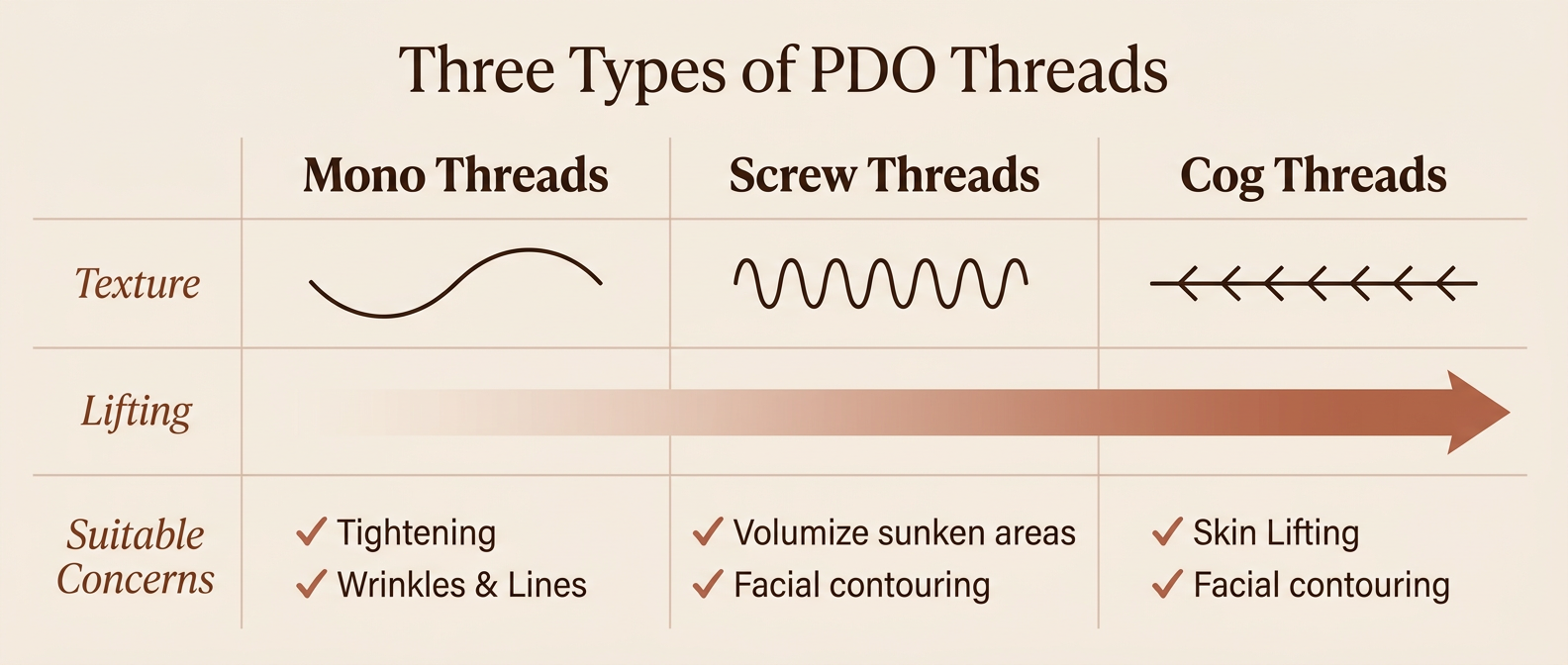
For a full clinical breakdown of subtypes and placement protocols, see our types of PDO threads guide. The overview here covers the three primary categories.
Mono Threads (Smooth Monofilament)
Mono threads are smooth, single-strand filaments with no barbs. They cannot lift — they have nothing to anchor tissue with. Instead, they are placed in a grid or mesh pattern across the dermis. Their function is collagen induction across a broad area: improved skin texture, reduced pore appearance, and mild generalized tightening.
Mono threads are commonly used on the neck, décolletage, and facial areas where texture is the concern rather than position. They also complement barbed threads by adding diffuse collagen stimulation where lifting threads cannot reach.
Screw Threads (Twisted Filament)
Screw threads intertwine one or two mono threads around each other in a helical pattern. This increases the surface area in contact with the dermis, which amplifies the collagen stimulus compared to a single smooth thread. The helical structure also creates mild volumizing effect in hollow or deflated areas — useful in the temples or under the eyes where tissue has thinned.
Cog/Barbed Threads (Lifting Threads)
Cog threads have barbs — small, angled projections cut or molded into the filament. These barbs face in one or two directions. When inserted and pulled, they catch the fibrous septa in the subcutaneous fat and physically reposition tissue upward or posteriorly.
This is where lifting happens. Cog threads address jowl reduction, cheek lifting, brow elevation, and jawline definition. Press cog threads — a variant with barbs angled at 90 degrees from the filament — provide stronger anchor force in denser, more fibrous tissue.
PDO vs. PLLA vs. PCL: What’s the Actual Difference?
Three biodegradable thread materials are used in aesthetic practice. They share the same general mechanism but differ in absorption time, collagen stimulus strength, and cost.
| Material | Absorption | Collagen Stimulus | Lifting | Notes |
|---|---|---|---|---|
| PDO | 6–9 months | Moderate | Good | Most established; widest evidence base |
| PLLA | ~12 months | High (volumizing) | Moderate | Same polymer as Sculptra; builds gradual volume |
| PCL | 18–24 months | Longer absorption; evidence developing | Good | Newest on market |
PDO carries the longest track record and broadest evidence base. Most widely available; typically lowest cost. Desert Bloom uses PDO as its primary thread offering.
PLLA (poly-L-lactic acid — the same polymer as Sculptra) degrades in approximately 12 months and produces a strong volumizing collagen response. Useful when deflation is the primary concern rather than laxity.
PCL (polycaprolactone) is the newest option. Slower degradation means a longer potential stimulus period. Some clinicians consider PCL a longer-stimulus material because it degrades more slowly, but head-to-head clinical evidence comparing predictable aesthetic outcomes across PDO, PLLA, and PCL remains limited. Early animal-model evidence (Soen et al. 2025, rat model) found higher collagen density with PCL than PDO or PLLA — however, this is a rat study with UVB-exposed aging model, not human RCT data, and should not be extrapolated to clinical outcomes.
The choice between materials is a clinical decision, not a patient preference — it depends on which tissue problem is being addressed and at what stage of aging.
What Areas Can PDO Threads Address?
PDO threads may be used in facial and neck areas where tissue support, texture, or mild-to-moderate laxity is the concern. The exact treatment path depends on whether the concern is brow position, midface descent, jawline softening, neck laxity, or broader collagen support within a treatment area.
For treatment-specific information — what happens at your appointment, which thread type is selected for which zone, and what to expect during recovery — start with the PDO threads hub.
What the Research Says: Clinical Evidence for PDO Threads
The evidence base for PDO threads is real but uneven. Collagen induction is better established than long-term lifting outcomes.
Animal-model studies provide the most direct mechanistic evidence. Su et al. (2024) examined PDO thread implantation in a pig model (subcutaneous fat) at intervals of 1, 4, 12, 24, and 48 weeks. The study documented collagen production at insertion sites, with thread integrity maintained to approximately 24 weeks and mild inflammatory response throughout. Ko et al. (2016) reported outcomes in a human pilot study of PDO scaffold placement for forehead wrinkle correction, showing measurable wrinkle reduction at follow-up — though as a pilot study, findings require replication in larger cohorts.
Histological studies generally show that PDO thread insertion triggers fibroblast activation and Type I and III collagen synthesis at insertion sites. Neovascularization is also observed. The degree and persistence of lifting, however, vary considerably across published studies. Patient-reported satisfaction consistently runs higher than blinded-evaluator assessments — a common pattern in non-surgical aesthetics. Standardized outcome protocols are still lacking.
Dr. Natalya Borakowski, NMD, the founder of Desert Bloom Skincare, frames the clinical reality directly: “Thread lifts do not replace surgical facelifts. Threads reposition soft tissue, primarily subcutaneous fat. They do not remove excess skin — a function that only surgery can accomplish.” Her broader clinical approach starts with anatomy before procedure selection: candidacy depends on whether tissue has descended, thinned, or lost elasticity — different structural problems require different thread types or different treatments entirely. (Dr. Borakowski’s full clinical background)
How Long Do PDO Thread Results Last?
Two questions often get conflated: how long do the threads last, and how long do the results last?
PDO threads dissolve through hydrolysis in 6 to 9 months. The collagen they stimulated does not disappear when the threads are gone. Published outcomes suggest results commonly persist into the 12 to 24-month range before retreatment becomes appropriate — though individual variation is significant.
Longevity depends on:
- Age and skin quality: Robust collagen synthesis capacity tends to hold results longer; heavily photo-damaged skin has impaired fibroblast function
- Lifestyle: Smoking impairs wound healing; heavy UV exposure degrades new collagen
- Thread type and technique: Placement depth, vector selection, and thread count all affect how long the outcome holds
For specific treatment planning and maintenance schedules, see the PDO thread lift procedure page.
Are PDO Threads Safe? What to Know About Risks
“Biocompatible” does not mean “without risk.”
Expected side effects (typically resolve within 5–14 days): bruising, swelling in the first 48–72 hours, temporary skin puckering along the thread path, tenderness at anchor points.
Less common complications: thread visibility or palpability in thin-skinned patients; infection — any percutaneous procedure carries this risk, sterile technique minimizes it; thread migration if placed too superficially; nerve proximity effects at incorrect insertion depth.
Complication rates vary widely by study, technique, thread type, and how complications are defined. A 2021 systematic review and meta-analysis (Niu et al.; pooled across 26 studies) found swelling to be the most commonly reported event (35%), followed by skin dimpling (10%), paresthesia (6%), thread visibility or palpability (4%), infection (2%), and thread extrusion (2%). Most reported complications were minor or self-limited, but serious complications can occur. The same meta-analysis noted that absorbable threads carry lower paresthesia and extrusion rates than non-absorbable sutures, and that patients over 50 tend to have higher rates of dimpling and infection.
For documented complication cases and resolution approaches, see the article on what can go wrong with thread lifts.
Active skin infection at the treatment site;
Strong history of keloid scarring;
Active autoimmune conditions affecting wound healing.
PDO Threads vs. Surgical Facelift: The Real Comparison
PDO threads and surgical facelifts are not competing options — they address different problems at different life stages.
A surgical facelift excises redundant skin, repositions the SMAS (the fibromuscular layer beneath the fat), and achieves structural changes lasting 10 or more years. It carries surgical risk and 2 to 4 weeks of social downtime. PDO threads are percutaneous sutures — they do not remove skin, do not operate on the SMAS, and produce less lifting force. Recovery is typically 3 to 7 days.
Where threads have value:
- Early to mid aging: Tissue descent without significant redundancy — improvement without surgery
- Pre-surgical period: Threads in the 40s can delay when surgery becomes the right intervention
- Post-surgical maintenance: After a facelift, threads can help extend results in subsequent years
What threads cannot do: replace surgery when it is genuinely indicated. Placing threads in a patient with significant skin excess typically produces short-lived, visually irregular outcomes.
Frequently asked questions
What does PDO stand for in PDO threads?
PDO stands for polydioxanone — a synthetic, biocompatible polyester used in surgical sutures since the 1980s. In aesthetic medicine, PDO filaments are inserted under the skin to mechanically lift tissue and trigger collagen production.How do PDO threads stimulate collagen?
Thread insertion creates a controlled micro-injury in the dermis. The body responds with a wound healing cascade: fibroblast cells migrate to the site and synthesize Type I collagen (structural) and Type III collagen (regenerative). Animal-model research (Su et al. 2024, pig model) documents this collagen response at PDO thread insertion sites. Collagen production often peaks after the threads have begun dissolving — which is why results typically improve over the months following treatment.How long do PDO thread results last?
Threads dissolve within 6 to 9 months. The collagen they stimulated maintains the tightening effect for approximately 12 to 24 months in many patients, though individual results vary. Longevity depends on age, skin quality, sun exposure, and lifestyle factors. For specific maintenance planning, see the PDO thread lift procedure page.Are PDO threads FDA approved?
No. PDO threads are FDA-cleared as medical devices for soft tissue approximation — not FDA-approved for cosmetic lifting or tightening. Clearance via the 510(k) pathway confirms safety equivalence to a predicate device for the cleared indication. The FDA summary for PDO MAXX (K190245), one verified cleared device, states it is indicated for soft tissue approximation and is not intended for lifting and supporting tissues. FDA clearance for a specific PDO suture device should be read according to its cleared indication — it should not be translated into FDA-approved for cosmetic lifting unless that exact use is supported by the device’s FDA record.What are the main types of PDO threads?
Three core types: (1) Mono threads — smooth, no barbs; used for skin texture and diffuse collagen induction. (2) Screw threads — twisted filaments; used for volumizing deflated areas. (3) Cog/barbed threads — directional barbs anchor into tissue to produce mechanical lifting of sagging skin. See the types of PDO threads guide for a full breakdown.Who is a good candidate for PDO threads?
Candidacy depends on which structural change is present — tissue descent, texture change, or volume loss — and requires clinical assessment. Threads are not appropriate for pregnant or breastfeeding patients, those with active skin infection at the treatment site, patients prone to keloid scarring, or those with active autoimmune conditions. For a candidacy discussion specific to your concerns, see the PDO threads hub.What is the difference between PDO, PLLA, and PCL threads?
All three are biodegradable materials that stimulate collagen through the same general mechanism but differ in absorption time and collagen response. PDO absorbs in 6 to 9 months — most established, broadest evidence base. PLLA (same polymer as Sculptra) absorbs in approximately 12 months with a strong volumizing collagen response. PCL has a longer absorption timeline (18–24 months); some clinicians consider it a longer-stimulus option, but head-to-head human clinical evidence remains limited. The choice between materials is a clinical decision based on the tissue problem being addressed.Explore Your Treatment Options
If this article addressed your foundational questions and you are now weighing whether PDO threads are appropriate for your concerns, the PDO threads hub → covers specific treatments, before-and-after considerations, and how Desert Bloom’s approach to thread selection differs from a standard medspa protocol.

“Thread lifts do not replace surgical facelifts. Threads reposition soft tissue, primarily subcutaneous fat. They do not remove excess skin — a function that only surgery can accomplish.”
References
- “Experimental investigation of biostimulatory effects after polydioxanone thread insertion in a pig model.” Journal of Cosmetic Dermatology. 2024. DOI(PMID: 37644781)
- “Multi-polydioxanone (PDO) scaffold for forehead wrinkle correction: A pilot study.” Journal of Cosmetic Laser Therapy. 2016. (PMID: 27223252; vol 18(7):405-408)
- “Enhancing dermal collagen density towards youthfulness: A comparative study of PCL, PLLA, and PDO thread implantation in aging rats model.” Various / PMC11756731. 2025. (Animal model — rat, UVB-exposed; not directly extrapolatable to human outcomes)
- “A Meta-Analysis and Systematic Review of the Incidences of Complications Following Facial Thread-Lifting.” Aesthetic Plastic Surgery. 2021. DOI(PMID: 33821308; 26 studies pooled)
- “510(k) Premarket Notification K190245 — PDS Barbed Suture, PDO MAXX Threads.” FDA accessdata. 2019. (https://www.accessdata.fda.gov/scripts/cdrh/cfdocs/cfpmn/pmn.cfm?id=K190245)
PDO thread lifting is performed off-label for aesthetic facial rejuvenation; PDO sutures are FDA-cleared for soft tissue approximation. Results vary by individual anatomy, skin quality, technique, and number of threads placed. Animal-model evidence cited in this article is not directly extrapolatable to human outcomes. Information on this page is educational and is not a substitute for clinical assessment.
Content medically reviewed by Dr. Natalya Borakowski, NMD. Last updated: May 2026.