PDO threads vs. dermal fillers: Which is the better option for you?


Considering a cosmetic procedure for skin enhancement? Discover the details, benefits, risks, and comparisons between PDO thread lifts and dermal fillers to determine the ideal treatment for your skin.
Threads or Fillers: The Wrong Question
Here is something I hear often: “Which is better — threads or fillers?” It is a reasonable question, but it is also the wrong frame. These are not competitors. They solve different biological problems. Asking which one wins is like asking whether scaffolding beats cement — the answer depends entirely on what the structure needs.
PDO threads address descended tissue: skin and fat that have shifted downward due to weakened ligaments and volume redistribution. Fillers address depleted volume: the structural loss in bone, fat, and soft tissue that leaves the face looking hollowed, flattened, or lined. One lifts. The other fills. For many patients, both things are happening simultaneously — and the treatment plan follows accordingly.
Threads vs. Fillers at a Glance
- Mechanism
- Threads lift descended tissue and trigger collagen. Fillers restore lost volume and smooth static creases.
- Best For
- Threads — jowling, lax jawline, brow descent. Fillers — hollow cheeks, deep nasolabial folds, under-eye troughs.
- Combinable?
- Often yes — lift plus volume together is a common and effective clinical plan.
- Related Reads
- PDO Thread Lift · Dermal Fillers · Restylane · Sculptra
Lift
What PDO Threads Actually Do
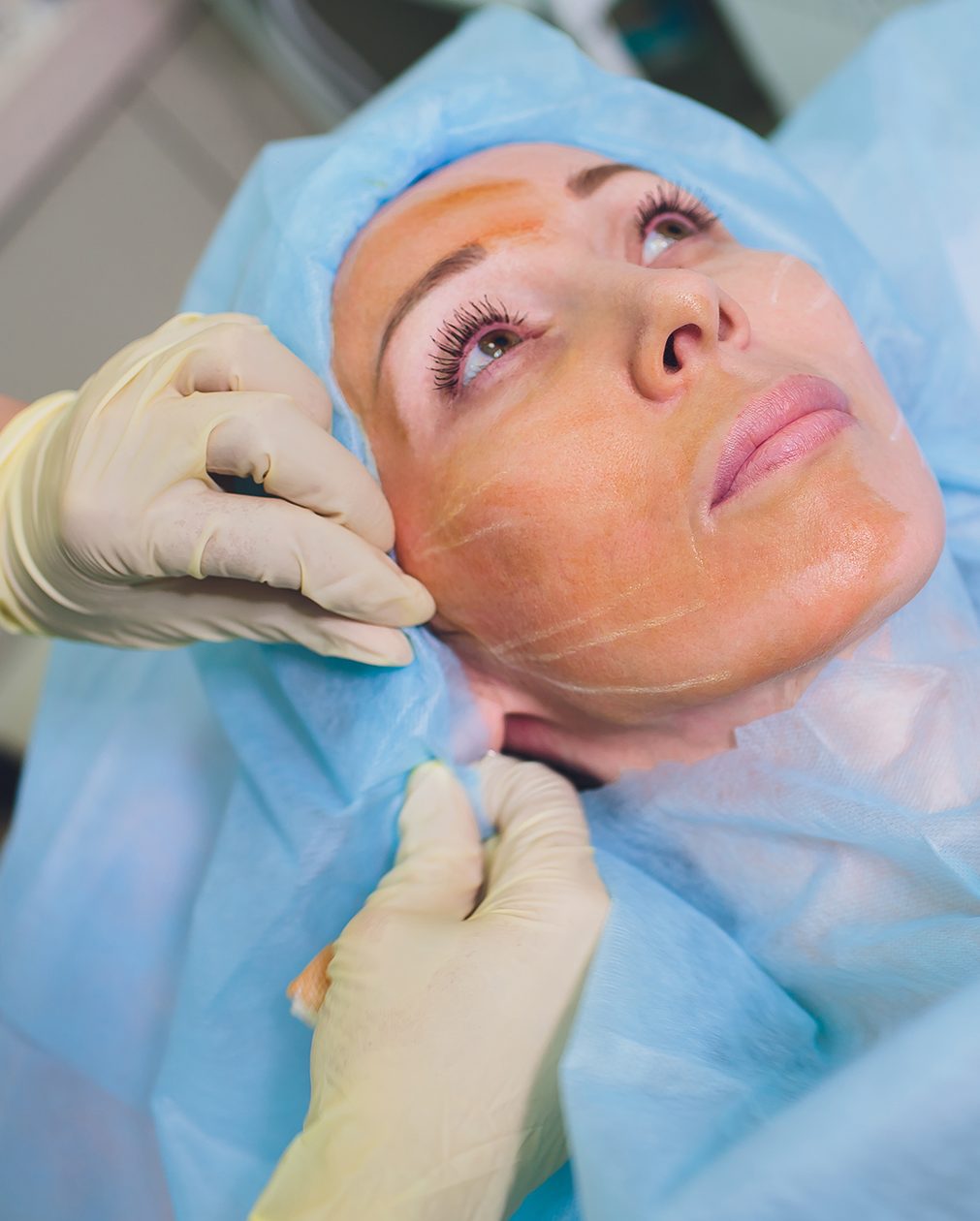
PDO (polydioxanone) threads are inserted beneath the skin along vectors that physically reposition descended tissue — typically along the jowl, jawline, midface, or brow. The mechanical lift is immediate. What follows is a slower, more durable process: as the threads dissolve over three to six months, they trigger a controlled inflammatory response that stimulates new collagen synthesis. The skin becomes denser, more supported from within.
This is why threads work best when laxity is the primary complaint — not volume loss. The ideal candidate has good underlying bone structure, moderate skin laxity, and tissue that has shifted rather than simply diminished. Threads reposition. They do not replace what is gone. If a patient has significant bone resorption or fat atrophy, threading over an empty scaffold produces limited results. I tell patients this directly during consultation — because false expectations are the fastest way to an unhappy outcome.
Volume
What Dermal Fillers Actually Do

Fillers address a different anatomical problem: the progressive loss of structural support that comes with time. Bone resorbs. Fat compartments deflate and shift. The result is hollowing under the eyes, flattening in the midcheek, deepening of the nasolabial folds, and loss of jawline definition — not because tissue has descended, but because what once held it in place has diminished. Fillers restore that support layer by layer.
At Desert Bloom, the HA fillers we work with are Restylane and RHA — both offering precise, reversible volumization with a range of rheologies suited to different anatomical zones. For structural rebuilding with longer-term biostimulation, Radiesse works through a calcium hydroxylapatite matrix. Sculptra (poly-L-lactic acid) encourages the body’s own collagen production over months — less immediate, but highly durable. Bellafill provides a semi-permanent option for patients who have found a result they want to maintain. Each of these has a specific clinical use case, and the right choice depends on the zone, the degree of loss, and the patient’s goals and timeline.
Anatomy
Zone by Zone: Where Each Applies

Most anatomical zones involve both problems at once — which is why assessment matters more than a treatment menu. That said, there are clinical tendencies worth understanding. Marionette lines deepen partly from volume loss in the prejowl area and partly from descent above. A filler-only approach may restore volume but leave the shadow of a jowl. Threads alone may lift the jowl but not address the hollow below. Nasolabial folds are primarily a volume story; cheek flattening is almost always volume-first, with threads in the mid-face helping when laxity is also present.
The jawline tells a more complex story. Early jowling responds well to thread vectors placed along the lower face. But when bone resorption along the mandible has caused the chin to narrow and the jawline to lose angular definition, this area needs volume first — filler along the mandible and chin projection gives the threads something solid to anchor to. Under the eyes is almost exclusively a filler zone: the tear trough and infraorbital hollow require careful volumization (typically with a soft HA filler placed deep), and thread insertion in this area carries risks that rarely justify the benefit.
The Comparison, Side by Side
| Criterion | PDO Threads | HA Filler (Restylane / RHA) | Biostimulator (Sculptra / Radiesse / Bellafill) |
|---|---|---|---|
| Primary mechanism | Physical tissue repositioning + collagen induction via PDO matrix | Hyaluronic acid volumization — reversible with hyaluronidase | Collagen stimulation (Sculptra/Radiesse) or semi-permanent scaffold (Bellafill) |
| Best anatomical use | Jowling, brow descent, lax jawline, midface descent | Hollow cheeks, tear trough, nasolabial depth, lip lines, chin | Diffuse volume loss, facial structure rebuilding, long-term correction |
| Duration | Lift: 12–18 months; collagen benefit 12–24 months | 6–18 months depending on product and zone | 18 months–5 years (product-dependent) |
| Onset of visible result | Immediate lift; collagen improvement builds over 3–6 months | Immediate; final result at 2–4 weeks as settling occurs | Gradual — 3–6 months for full effect (Sculptra/Radiesse); Bellafill near-immediate |
| Reversible? | No — threads dissolve but cannot be removed once placed | HA fillers: yes, with hyaluronidase | No — plan accordingly; patient selection is critical |
| Key limitation | Cannot replace lost volume; advanced laxity → surgical referral | Does not lift descended tissue; filler over a ptotic face can add bulk not support | Requires multiple sessions (Sculptra); not appropriate for acute volumization needs |
| Risk profile | Bruising, thread visibility, migration (rare); no vascular risk | Vascular occlusion risk (serious); requires injector skill and anatomy knowledge | Lower vascular risk than HA; nodule formation possible with Sculptra if technique poor |
PDO Threads
- Primary mechanism
- Physical tissue repositioning + collagen induction via PDO matrix
- Best anatomical use
- Jowling, brow descent, lax jawline, midface descent
- Duration
- Lift: 12–18 months; collagen benefit 12–24 months
- Onset of visible result
- Immediate lift; collagen improvement builds over 3–6 months
- Reversible?
- No — threads dissolve but cannot be removed once placed
- Key limitation
- Cannot replace lost volume; advanced laxity → surgical referral
- Risk profile
- Bruising, thread visibility, migration (rare); no vascular risk
HA Filler (Restylane / RHA)
- Primary mechanism
- Hyaluronic acid volumization — reversible with hyaluronidase
- Best anatomical use
- Hollow cheeks, tear trough, nasolabial depth, lip lines, chin
- Duration
- 6–18 months depending on product and zone
- Onset of visible result
- Immediate; final result at 2–4 weeks as settling occurs
- Reversible?
- HA fillers: yes, with hyaluronidase
- Key limitation
- Does not lift descended tissue; filler over a ptotic face can add bulk not support
- Risk profile
- Vascular occlusion risk (serious); requires injector skill and anatomy knowledge
Biostimulator (Sculptra / Radiesse / Bellafill)
- Primary mechanism
- Collagen stimulation (Sculptra/Radiesse) or semi-permanent scaffold (Bellafill)
- Best anatomical use
- Diffuse volume loss, facial structure rebuilding, long-term correction
- Duration
- 18 months–5 years (product-dependent)
- Onset of visible result
- Gradual — 3–6 months for full effect (Sculptra/Radiesse); Bellafill near-immediate
- Reversible?
- No — plan accordingly; patient selection is critical
- Key limitation
- Requires multiple sessions (Sculptra); not appropriate for acute volumization needs
- Risk profile
- Lower vascular risk than HA; nodule formation possible with Sculptra if technique poor
When Combining Both Is the Right Answer
For many patients in their mid-40s and beyond, the question is not threads or fillers — it is threads and fillers, sequenced in the right order. The general principle: address volume first — attempting to lift with threads when structural support is depleted is like tightening a tent over an empty frame. Restore the underlying support — cheek volume, jawline definition, chin projection — and the threads have something to anchor to. The lift is more precise, the result more balanced.
I’ll tell patients honestly — when I see a face that needs both, I say so. When one tool would do the job, I say that too.
Typical sequencing: filler placed at a first appointment, threads at a second appointment two to four weeks later once swelling has resolved and the structural outcome is visible. Some patients need only one of the two. Others benefit from both. The treatment plan follows the anatomy — not a package, not a trend, not a fixed protocol. A good consultation makes this clear from the start.
When Neither Is the Right Answer
This is the part most comparison articles skip, because it is not convenient to say: sometimes the right answer is neither. Significant skin laxity — true ptosis of the lower face, deep platysmal banding, skin that has lost its structural integrity — is a surgical problem. Threads can provide a modest improvement in mild-to-moderate cases, but they cannot replicate what a well-performed lower facelift achieves in terms of structural repositioning and longevity. Fillers in the context of severe laxity risk adding bulk where lift is needed, distorting facial proportions rather than restoring them.
I do refer patients to surgical colleagues. This is not a failure — it is part of practicing honestly. A patient who is a surgical candidate deserves to know that, not to be redirected toward a non-surgical option that will disappoint them. The goal is the right outcome for that face, not the right outcome for the treatment menu. When anatomy and goals align, the right plan becomes clear. Sometimes that plan includes a referral. See also: when threads go wrong — knowing the risk profile matters as much as knowing the benefit.
The Clinical Decision Flow
- 1
Assessment: what is actually happening?
Anatomical evaluation — bone structure, fat compartment volume, degree of skin laxity, tissue descent. This determines whether the complaint is primarily volume loss, descent, or both. No protocol before assessment.
- 2
Volume-first if a deficit is present
If mid-face hollowing, jawline bone resorption, or tear trough depression is present, address structural volume first (HA filler or biostimulator depending on degree and timeline preference).
- 3
Threading after the foundation is set
Once volume is restored and settled (typically 2–4 weeks), PDO thread vectors are placed to address residual tissue descent — jowl, brow, midface, or neck.
- 4
Review at 6–8 weeks
Assess collagen response, symmetry, and patient satisfaction. Touch-up filler or additional thread passes if needed. Set maintenance expectations honestly.
- 5
Surgical referral if indicated
If the degree of laxity exceeds what non-surgical tools can meaningfully address, refer to surgical consultation. Non-surgical options can be revisited post-surgery for maintenance.
Frequently Asked Questions
Can I have threads and fillers done at the same appointment?
Which lasts longer — threads or fillers?
Why do some patients need both?
I've heard fillers can make you look puffy over time. Is that true?
Is there an age where threads stop being appropriate?
What is the vascular risk with fillers, and how is it managed?
Where can I learn more about each treatment individually?
The Right Treatment Starts with the Right Question
Most patients come in asking which procedure is best. The question that actually matters is: what is my face doing, and why? Descent and deflation look different on careful assessment — and they respond to different tools. A consultation should answer that question honestly, even when the answer is “neither” or “both, in this order, for these reasons.” That clarity — offered without pressure, without a package, without a predetermined answer — is the starting point for a result that fits your face and your life. Compare the two options directly on our PDO Thread Lift and Dermal Fillers pages.
“The most useful thing I can do in a consultation is reframe the question. Not 'threads or fillers?' but 'what is this face actually doing — and what does it need?' The answer is almost always more specific, and more honest, than a protocol.”
This article is part of a broader resource on facial structure and non-surgical options at Desert Bloom Skincare. Additional reading: PDO Thread Lift, Dermal Fillers, Restylane, Sculptra, Radiesse, Bellafill, Thread Lift Complications, Patient Case Studies.
Individual results vary. Content reviewed by Dr. Natalya Borakowski, NMD. Last updated April 2026.