
Frown Lines
Frown lines, the vertical creases between your eyebrows, form from repeated muscle movement and can give your face a tense look even at rest. At Desert Bloom in Scottsdale, Dr. Borakowski treats frown lines with neuromodulators and collagen-rebuilding approaches matched to whether your lines are dynamic, static, or both.
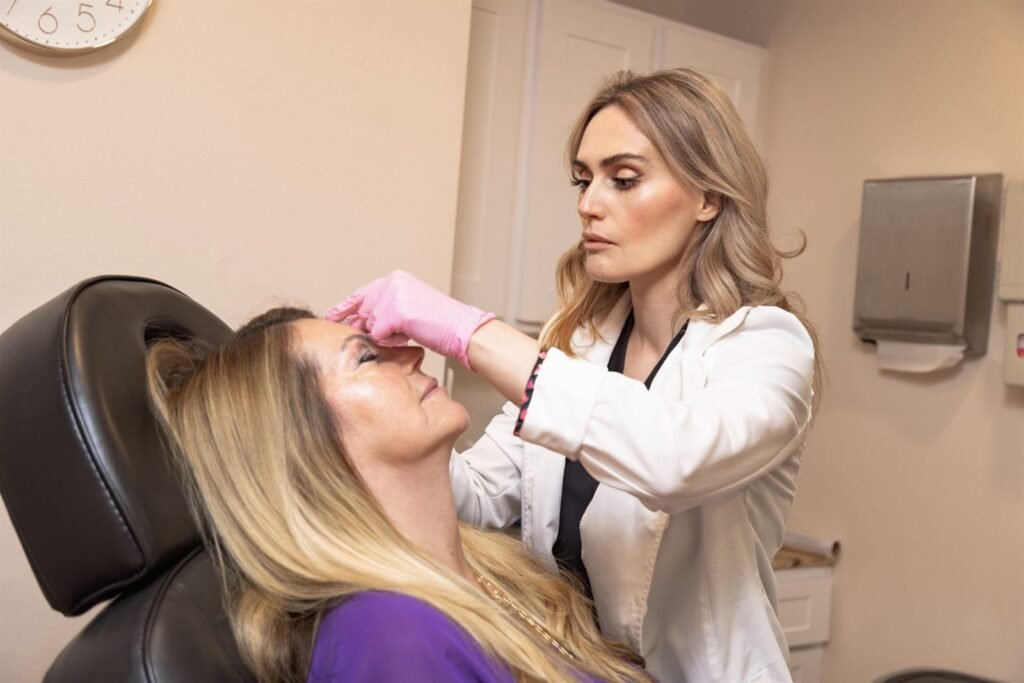
Those “11 Lines” Between Your Brows
Frown lines, the vertical lines that appear between your eyebrows, form from years of repeated facial expressions and the habitual pull of the corrugator and procerus muscles. You may know them as glabellar lines, worry lines, forehead furrows, or simply “the 11s.” Whatever the name, they can give your face a tense, tired, or angry look even when you feel perfectly relaxed. Most patients notice their 11 lines in photos long before they notice them in the mirror.
The most important distinction in any frown-line consultation is whether your 11s are still dynamic wrinkles (creases that appear in motion and fade at rest) or have become static lines etched into the skin itself. That single observation shapes the entire treatment plan. At Desert Bloom, Dr. Natalya Borakowski, NMD conducts a frown test at every glabellar consultation and builds each plan around what she actually sees, not a default answer.
Frown lines are part of the broader wrinkles family. Related sibling concerns: crow’s feet and forehead lines. All three route to our anti-aging treatments hub.
Not sure which treatment fits? Book a consultation and get a plan for your skin
At a Glance
Scope. Three neuromodulators (Botox, Dysport, Daxxify) cover dynamic 11s; For the static lines, the most affordable and effective method is collagen boosting PDO threads creating temporary skin supporting mesh, eliminating static wrinkles over the course of few months ($160). Pricing from ~$230 (Botox 20u) to $800 per session (RF microneedling). Dr. Borakowski tailors the plan to whether your glabellar lines are still in motion or have become permanent grooves.
Provider & candidacy. Dr. Natalya Borakowski, NMD oversees all injection and device planning. Neuromodulators and threads are appropriate for Fitzpatrick I–VI with no melanin-related risk. Pregnancy, breastfeeding, active skin infection at the glabellar site, and neuromuscular disorders are absolute contraindications to toxin. RF microneedling is safe across all skin tones with appropriate settings. A medical history review is part of every consultation.
Downtime & how to start. Neuromodulator procedures take a few minutes with zero social downtime; results settle at the two-week mark. PDO threads will have 2-5 days downtime as tenderness, temporary mild swelling and/ or bruising are expected. A 30-minute consultation is where Dr. Borakowski performs the frown test, maps your line depth and anatomy, and outlines which procedures apply to your situation. No commitment required on the day.
Dynamic vs. Static: The Frown Test
Knowing which stage your 11 lines are at is the single most useful thing to understand before a consultation, because the treatment path depends entirely on it. The frown test is simple: frown hard, then let your face relax completely. If the crease flattens and smooths out, it is a dynamic frown line. If it stays visible at rest, it is a static frown line or is becoming one.
Dynamic 11s
The vertical lines between your brows appear when frowning, squinting, or concentrating, but the skin smooths out at rest. The corrugator supercilii and procerus muscles are contracting and folding the overlying skin, but the collagen and elastin in the skin haven’t yet been permanently deformed. This is the stage most people are in during their late 20s and early 30s.
What helps: A neuromodulator (Botox, Dysport, or Daxxify) relaxes the corrugator and procerus pull so the skin stops being folded. Most plans start here and stay here for several years. Three to four months between appointments for Botox or Dysport; around six months for Daxxify.
First-line: Botox · Dysport · DaxxifyStatic 11s
The crease stays visible even when your face is fully at rest, and it has a textured or shadowed quality that suggests the fold has etched into the skin itself. Collagen and elastin fibers in the glabellar skin have been deformed by thousands of repeated expressions over many years. The crease is now a structural feature of the skin as well as a functional one.
What helps: A neuromodulator still addresses the muscle activity driving the crease deeper; PDO threads are inserted two weeks later, creating continues collagen stimulation, naturally filling in static lines with your own collagen over the course of few months. The neuromodulator base is almost always part of the plan because it removes the force that would otherwise deepen the line further.
Plan: Neuromodulator + PDO threadsFrown Line Treatments at Desert Bloom
Three neuromodulators address the same problem, muscle-driven glabellar movement, but they differ in diffusion profile and duration. The decision between them is made at consultation based on your line pattern, maintenance preference, and whether you are a first-time patient. RF microneedling and Restylane enter the plan only once dynamic treatment has been established and a static residual crease needs structural work.
Botox: First-Line Standard
Best for
First-time patients; dynamic 11s with standard glabellar anatomy; patients who prefer to fine-tune dosing before committing to a longer duration.
What makes it distinct
Onabotulinumtoxin-A was the first botulinum toxin FDA-approved specifically for glabellar lines (2002) and remains the most-studied. Standard glabellar dose is about 20 units at five injection sites. Duration: 3–4 months. Its tight diffusion profile makes it predictable for precise corrugator/procerus targeting.
Choose this if
This is your first time treating frown lines, or you want a conservative starting point to dial in dosing before committing to a longer-acting product.
Dysport: Broader Diffusion
Best for
Patients whose 11 pattern fans wider across the brow than a clean vertical pair; those with a history of good response to abobotulinumtoxin-A; patients who prefer slightly faster onset.
What makes it distinct
Abobotulinumtoxin-A spreads more broadly from each injection site than Botox, which is useful when the frown pattern is wider or asymmetric. Typical glabellar dose ~50 units (aboBoNT-A ≈ 2.5:1 conversion). Duration: 3–4 months, the same as Botox.
Choose this if
Your corrugator pull spreads wider than a standard “11” pattern, or your consultation history shows better results with this formulation.
Daxxify: Longer Duration
Best for
Established neurotoxin responders who want fewer annual appointments; patients comfortable with a ~6-month commitment rather than a 3–4 month cycle.
What makes it distinct
DaxibotulinumtoxinA-lanm uses a PEG-peptide stabilizer that extends effective duration to ~6 months for glabellar lines. Typical dose ~40 units. Not ideal for first-time treatment because a 6-month commitment is harder to adjust if dosing needs refinement.
Choose this if
You already know your frown lines respond well to neurotoxin and prefer two appointments per year instead of three or four.
For most patients, frown-line treatment stays in the neuromodulator lane for years. The two options below enter the plan when static lines have developed: when a crease remains visible at rest despite regular toxin, or when the skin surface itself has been structurally altered by the repeated folding. A microdroplet Restylane touch-up is also available for a residual static groove that sits in the skin after toxin; this is an off-label application for patients whose anatomy warrants it. Patients with a glabellar crease that is part of a broader photoaging picture may be candidates for CO2 laser resurfacing. That decision is made at consultation and routes to the wrinkles hub.
How to Choose Your Starting Point
The most common question at a frown-line consultation is which neuromodulator to start with, and whether any structural procedure is needed. These two tracks help orient the decision before you come in.
Dynamic Track: Neuromodulator First
Your 11 lines appear most in motion. Face smooths out at rest, or close to it.
Static + Combined Track: Layer In Structure
Your 11 lines stay visible at rest between toxin appointments, or have an etched, shadowed quality.
Compare All Frown Line Treatment Options
Use this table as a starting reference. Precise dosing, session counts, and cost are reviewed at consultation based on your anatomy and goals.
| Treatment | Best For | Mechanism | Fitzpatrick | Sessions | Downtime |
|---|---|---|---|---|---|
| Botox | Dynamic 11s (first-timers) | Relaxes corrugator + procerus | I–VI | 1 session, repeat every 3–4 mo | None |
| Dysport | Dynamic 11s (wider pattern) | Same as Botox, broader diffusion | I–VI | 1 session, repeat every 3–4 mo | None |
| Daxxify | Dynamic 11s (fewer visits) | Same mechanism, longer duration (~6 mo) | I–VI | 1 session, repeat every 5–6 mo | None |
| PDO threads | Static 11s (etched crease) | rebuild dermal collagen | I–VI (safe all tones) | 1 session 2 weeks after toxin, for old patients with deeper lines multiple sessions 6 months apart might be necessary | 2-5 days |
Safety, Skin Type, and Eligibility
All three neuromodulators carry no melanin-related risk and are appropriate for Fitzpatrick I–VI. RF microneedling is similarly safe across all skin tones with appropriate settings. The glabellar area warrants particular attention for any injectable procedure. Its proximity to the supratrochlear and supraorbital vessels and the ophthalmic artery means that provider technique and knowledge of vascular anatomy are essential for safe injections, including the rare microdroplet Restylane application. A complete medical history review is standard at every consultation.
Pregnancy or breastfeeding. All neuromodulator and RF microneedling procedures are deferred until after.
Active skin infection at the glabellar site. Injection into or near an infected area is contraindicated; skin must be clear before proceeding.
Neuromuscular disorders (e.g., myasthenia gravis, ALS). Botulinum toxin use requires specialist coordination or is contraindicated depending on severity and medication.
Heavy upper eyelid ptosis or significant brow ptosis. When drooping eyelids or descending brows are the primary concern, the answer is usually surgical: a brow lift or eyelid surgery consultation rather than toxin. Toxin can occasionally worsen ptosis if it diffuses into the levator palpebrae; Dr. Borakowski screens for this during the physical assessment.
The most effective way to slow frown line development between treatments is daily broad-spectrum sunscreen applied to the forehead and glabella. UV radiation is one of the leading external accelerators of collagen breakdown in the glabellar area. In Scottsdale’s sun, squinting against bright light is one of the most common reasons 11 lines appear prematurely. Polarized UV-blocking sunglasses reduce both sun damage and the habitual squinting that drives dynamic line formation. Topical retinoids (over-the-counter retinol or prescription tretinoin) are the best-studied option for maintaining collagen turnover in areas prone to repeated folding; consistent nightly use helps the skin retain some resilience between procedures and reduces the rate at which dynamic lines transition to static ones.
Lifestyle factors that appear unrelated to frown lines also contribute meaningfully: smoking reduces skin elastin and oxygen delivery, accelerating the structural damage that causes creases to etch. Chronic stress keeps the corrugators under higher baseline tension, which means more hours per day of involuntary furrowing. Adequate sleep and hydration support the skin’s nightly repair processes. For patients with strong corrugator activity who notice early frown lines forming in their late 20s, preventative low-dose toxin started conservatively is often the most effective long-term strategy. It stops the repeated fold before the collagen has been permanently deformed, instead of correcting established creases years later.
Questions
Frequently asked questions
At what age do frown lines usually start?
Most patients notice their first dynamic 11 lines between the late 20s and mid-30s. The crease appears in motion but fades completely at rest. Static frown lines that remain visible at rest typically develop in the mid-30s onward, and earlier for patients with significant sun exposure, fair skin, or particularly strong corrugator muscles. Starting preventative low-dose toxin in your late 20s or early 30s can meaningfully delay the transition from dynamic to static lines.
What is the difference between Botox, Dysport, and Daxxify for 11 lines?
All three are botulinum toxin products with FDA approval for glabellar lines. Botox (onabotulinumtoxin-A) is the most studied, with a tight diffusion profile, and it is the standard starting point for first-time patients. Dysport (abobotulinumtoxin-A) diffuses more broadly from each injection site, which can be useful when the frown pattern fans wider across the brow. Both Botox and Dysport last 3–4 months. Daxxify (daxibotulinumtoxinA-lanm) uses a PEG-peptide stabilizer that extends duration to approximately 6 months, which means two visits a year instead of three or four. Daxxify is not typically recommended for first-time treatment where conservative dosing adjustments are still being made.
How many units of Botox are needed for frown lines?
The standard glabellar dose is approximately 20 units of Botox, distributed across five injection sites: two medial corrugator points, two lateral corrugator points, and one procerus point. The equivalent Dysport dose is around 50 units (aboBoNT-A conversion ≈ 2.5:1). Daxxify is typically 40 units for glabellar treatment. Exact dosing varies with muscle strength; Dr. Borakowski starts conservative in first-time patients and adjusts at the two-week follow-up if needed.
Can dermal fillers treat frown lines?
This is a very risky method and rarely used as it contains a very high risk of vascular occlusion and blindness due to close proximity to supratrochlear and supraorbital arteries. Typically other collagen boosting treatments are used instead such as PDO threads, CO2 laser and RF microneedling.
Does RF microneedling hurt on the forehead?
The glabellar area is moderately sensitive, so Dr. Borakowski applies topical numbing for approximately 45 minutes before treatment. Most patients describe the sensation during the procedure as firm prickling with heat. It is uncomfortable but manageable. There is mild redness and tenderness for 24–48 hours afterward, similar to a mild sunburn. Significant pain during the procedure is uncommon.
Will I still be able to show expressions after treatment?
A properly dosed neuromodulator softens the 11 lines without freezing your appearance. You should still be able to communicate surprise, concentration, and concern with normal facial expressions. The goal is a smoother forehead at rest and reduced crease formation during movement, not a completely immobile face. Dr. Borakowski doses conservatively and adds units only if needed at the two-week follow-up. Patients who want a more natural appearance start with a lighter dose.
Is there a certified specialist I should see for frown lines?
For frown lines that are cosmetic concerns (dynamic or static glabellar lines without accompanying structural issues), an aesthetic medicine provider like Dr. Natalya Borakowski, NMD is the appropriate specialist. She has 18 years of experience in injectable and device-based treatments for the face. If you have concurrent eyelid or brow ptosis, Dr. Borakowski will assess it at your consultation and tell you directly which options suit you.
Ready to talk it through? Book a consultation and we will look at your goals, explain your options and give you a clear plan and price.