
Acne Scar Treatment in Scottsdale, Arizona
Acne may disappear, but the changes it leaves behind can remain for years. Some acne scars create shallow depressions, while others form deep, narrow openings or raised areas of scar tissue. Acne can also leave persistent red or brown marks that are often mistaken for permanent scarring.
Not All Acne Scars Are the Same — And Neither Are Their Treatments
The most effective approach to acne scar treatment begins with understanding what type of scar you have, how deeply it affects your skin, and whether active acne is still present.
At Desert Bloom Skin Care in Scottsdale, Arizona, we offer individualized acne scar assessments and a range of aesthetic treatments, including CO₂ and Erbium laser resurfacing, microneedling, RF microneedling, and selected dermal filler treatments.
Our philosophy is simple: there is no single procedure that works best for every acne scar.
Understanding the Four Main Types of Acne Scars
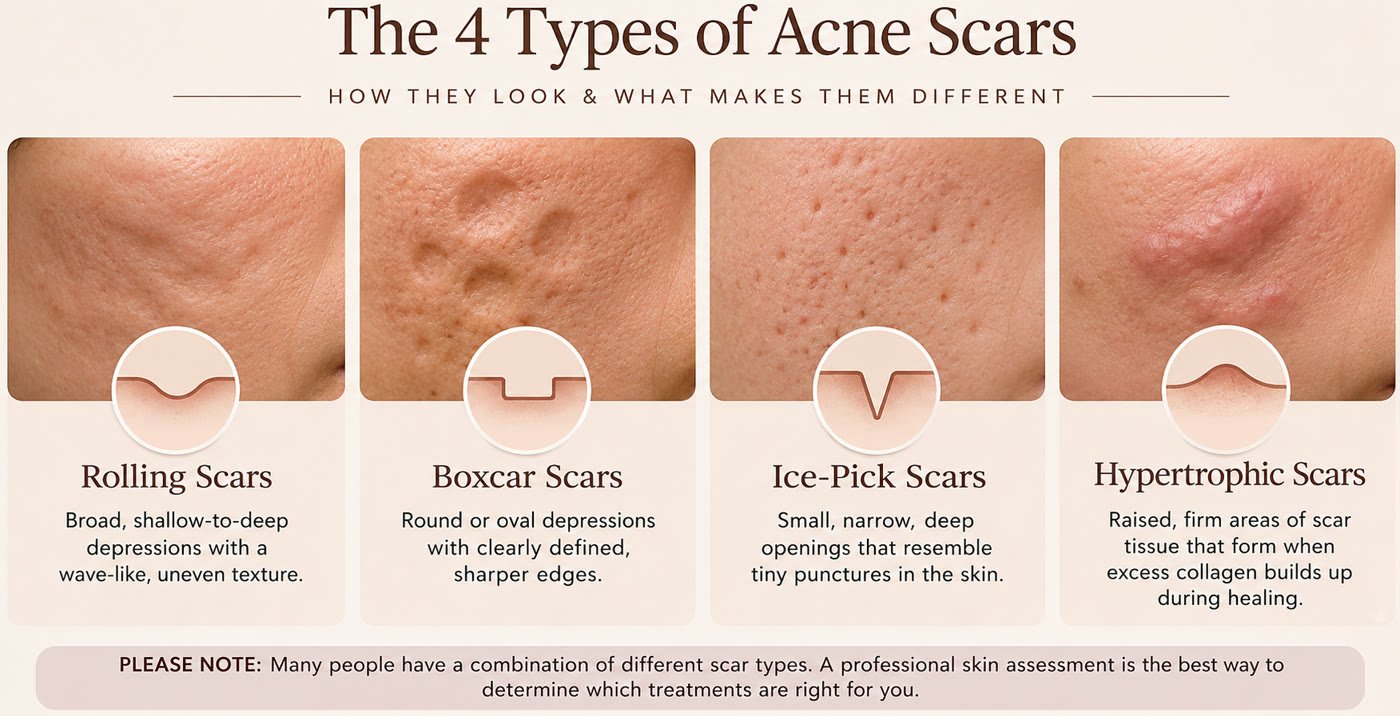
Most permanent acne scars develop when inflammation disrupts the skin’s normal healing process.
Some scars form because of tissue loss, creating depressions known as atrophic scars. Others result from excessive scar tissue formation, producing raised or hypertrophic scars.
Many patients have a combination of scar types, making individualized treatment planning particularly important.
1. Rolling Acne Scars
What they look like: Broad, shallow-to-deep depressions that create an uneven, wave-like appearance across the skin.
Rolling scars often develop when fibrous bands beneath the skin pull the surface downward, creating tethered areas.
How to recognize them: Rolling scars may become less noticeable when the surrounding skin is gently stretched. However, this observation alone cannot reliably determine scar type or treatment suitability.
Which treatments may help?
- Subcision to release tethering beneath selected scars
- Dermal fillers for appropriately selected depressions
- Fractional CO₂ or Erbium laser resurfacing
- Microneedling or radiofrequency microneedling for additional textural improvement
At Desert Bloom Skin Care, we assess whether selected rolling scars may benefit from filler-based correction, including Bellafill when appropriate.
Bellafill is an FDA-approved permanent filler for certain moderate-to-severe atrophic, distensible facial acne scars. Because it contains polymethylmethacrylate (PMMA) microspheres, treatment requires careful patient selection and consideration of long-term risks.
Deeply tethered rolling scars may require subcision before or in combination with other treatments.
2. Boxcar Acne Scars
What they look like: Round or oval depressions with clearly defined, relatively sharp edges.
Unlike rolling scars, boxcar scars typically have more distinct borders and may resemble small craters in the skin.
Some are shallow, while others extend deeper into the dermis.
Which treatments may help?
- Fractional CO₂ laser resurfacing
- Erbium laser resurfacing
- Radiofrequency microneedling
- Conventional microneedling for selected superficial scars
- Focal scar procedures for certain deeper lesions
Shallow boxcar scars may respond well to resurfacing treatments that improve surface texture and soften scar edges.
Deeper boxcar scars can be more resistant and may require focal procedures or combination treatment.
At Desert Bloom Skin Care, treatment selection depends on scar depth, skin type, and the potential for post-inflammatory pigmentation.
3. Ice-Pick Acne Scars
What they look like: Small, narrow, deep openings that resemble tiny punctures in the skin.
Ice-pick scars extend more deeply than their surface appearance may suggest.
They are among the most challenging acne scars to treat because conventional resurfacing often cannot adequately reach the deepest portion of the scar.
Can ice-pick scars be improved?
Yes, although they often require specialized techniques.
Treatments supported by clinical literature include:
- TCA CROSS, a technique involving carefully controlled focal application of trichloroacetic acid
- Punch excision for selected deep scars
- Combination approaches using focal scar treatment and subsequent resurfacing
Conventional microneedling or fractional laser resurfacing alone may produce limited improvement in deep ice-pick scars.
At Desert Bloom Skin Care, we assess these scars individually and explain when referral for a specialized focal procedure may be more appropriate than the treatments available in our clinic.
4. Hypertrophic Acne Scars
What they look like: Raised, firm areas of scar tissue that develop after inflammation or injury.
Hypertrophic scars form when excessive collagen accumulates during healing.
Unlike depressed acne scars, they extend above the surrounding skin surface. They may be pink, red, darker than the surrounding skin, itchy, tender, or occasionally painful.
Hypertrophic scars are different from active acne cysts, which are inflammatory lesions rather than mature scar tissue.
Which treatments may help?
- Intralesional corticosteroid injections
- Selected laser treatments
- Other scar-modifying procedures depending on scar characteristics
Because hypertrophic scars contain excess scar tissue, their treatment differs substantially from that of depressed scars.
Aggressive resurfacing is not necessarily the best first option and may worsen scarring in susceptible patients.
A clinical assessment is important before selecting treatment.
Acne Scars vs. Red or Brown Marks: Understanding the Difference
Not every mark left after acne is a permanent scar.
Many patients are concerned about discoloration that persists long after a breakout has healed.
These changes are often treatable, but they require a different approach from depressed or raised scars.
Post-Inflammatory Erythema (PIE): Red or Pink Acne Marks
PIE appears as persistent red, pink, or sometimes purplish discoloration following inflammation.
These marks are associated with vascular changes and are particularly noticeable in lighter skin tones, although they can occur across skin types.
Selected vascular lasers may help persistent redness. Treatment suitability depends on skin characteristics and the underlying cause.
At Desert Bloom Skin Care, we can assess whether a vascular-targeting laser approach is appropriate.
Post-Inflammatory Hyperpigmentation (PIH): Brown or Dark Acne Marks
PIH develops when inflammation triggers increased melanin production.
It may appear brown, gray-brown, or darker than the surrounding skin and is particularly common in patients with skin of color.
Treatment options may include:
- Azelaic acid
- Topical retinoids
- Carefully selected chemical exfoliants
- Pigment-directed skincare
- Professional chemical peels when appropriate
- Consistent broad-spectrum sun protection
Salicylic, mandelic, and other exfoliating acids may be useful in selected skincare protocols, but stronger or excessively frequent exfoliation can increase irritation and worsen pigmentation.
Treating PIH requires patience and attention to the skin barrier.
Acne Scar Treatments Available at Desert Bloom Skin Care
CO₂ Laser Resurfacing
Fractional CO₂ laser resurfacing creates controlled areas of thermal injury that stimulate skin remodeling.
It can improve selected atrophic acne scars, particularly certain boxcar and rolling scars.
Because CO₂ resurfacing is an ablative procedure, recovery time, redness, and pigmentary risks must be considered carefully.
The treatment is not appropriate for every skin type or scar pattern.
Erbium Laser Resurfacing
Erbium laser resurfacing is another option for improving selected acne scars and uneven skin texture.
Compared with some CO₂ laser protocols, Erbium treatment may involve less residual thermal injury, although the actual downtime and results depend on the treatment settings and depth.
At Desert Bloom Skin Care, we evaluate the appropriate laser modality according to skin characteristics, scar morphology, and treatment goals.
RF Microneedling
Radiofrequency microneedling combines needle penetration with controlled radiofrequency energy delivered into the skin.
It may help improve selected atrophic acne scars and uneven texture.
RF microneedling is not interchangeable with laser resurfacing, and results depend on the scar type, treatment parameters, and number of sessions.
Potential risks include burns, pigmentary changes, scarring, and unwanted changes to underlying tissue.
We carefully consider treatment depth and energy settings, particularly in areas where preservation of facial fat is important.
Traditional Microneedling
Microneedling uses fine needles to create controlled microinjuries that stimulate the skin’s remodeling response.
It may be useful for selected superficial acne scars and textural irregularities.
Patients with deep tethered scars or narrow ice-pick scars may require other approaches.
Bellafill and Selected Dermal Fillers
For certain depressed acne scars, filler treatment may help elevate the skin surface and reduce visible contour irregularities.
Bellafill is FDA-approved for specific atrophic facial acne scars.
Because Bellafill is a permanent PMMA-containing filler, its risks and long-term implications differ from those of temporary hyaluronic acid fillers.
Not all scars are suitable for filler correction, and results depend on scar anatomy and patient selection.
At Desert Bloom Skin Care, we discuss the potential benefits, limitations, and complications before recommending treatment.
Why Combination Treatments Often Work Better
Most patients do not have just one type of acne scar.
A patient may have rolling scars across the cheeks, sharply defined boxcar scars near the temples, a few deep ice-pick scars, and residual discoloration from previous breakouts.
One treatment may improve texture without addressing deeper tethering. Another may elevate selected depressions but have little effect on pigmentation.
For this reason, an individualized plan may involve more than one treatment modality, performed in an appropriate sequence.
At Desert Bloom Skin Care, we evaluate the entire skin presentation rather than recommending a single device for every concern.
Our goal is meaningful improvement in skin appearance while minimizing unnecessary procedures and complications.
What If You Still Have Active Acne?
Before beginning aggressive scar correction, active acne should be evaluated and appropriately managed.
Continuing inflammatory breakouts can produce new scars, even while existing scars are being treated.
Acne is a multifactorial inflammatory skin condition influenced by follicular changes, sebum production, microbial activity, hormones, and individual susceptibility.
Effective treatment may involve topical medications, prescription therapies, professional skincare, or systemic treatment depending on acne severity.
At Desert Bloom Skin Care, our approach includes evaluating relevant contributing factors when clinically indicated, while recognizing that evidence-based topical treatment is often an essential part of preventing new breakouts.
Start With an Acne-Focused Skin Assessment
For patients with congestion, blackheads, and selected non-inflammatory acne lesions, our professional Detox Facial may be an appropriate component of skincare.
It can include cleansing, carefully selected extractions, and skin-supportive treatments.
However, facials and extractions do not replace medical treatment for persistent inflammatory, nodulocystic, or scarring acne.
Patients with severe or progressive acne may require prescription treatment or referral for additional dermatologic management.
How Many Acne Scar Treatments Will I Need?
Acne scar correction is usually a gradual process.
The number of sessions depends on scar type, depth, distribution, skin type, chosen procedure, and individual healing response.
Some patients benefit from a series of resurfacing treatments, while others require targeted correction of individual scars.
Complete scar removal is generally not a realistic expectation.
Our goal is to improve the appearance of scarring, soften irregularities, and develop a treatment plan that respects your skin and priorities.
Questions
Frequently Asked Questions About Acne Scars
Can acne scars be completely removed?
Most permanent acne scars cannot be erased completely. However, selected treatments can improve their depth, texture, and visibility.
Which treatment is best for deep acne scars?
The answer depends on scar morphology. Tethered rolling scars may require subcision, deep boxcar scars may benefit from focal procedures or resurfacing, and ice-pick scars often require TCA CROSS or punch techniques.
Is CO₂ laser better than RF microneedling for acne scars?
Neither is universally superior. Fractional CO₂ lasers may produce greater improvement for certain scars but often involve more downtime and pigmentary risk. RF microneedling may be preferable in selected patients, depending on skin type, scar morphology, and treatment goals.
Does Bellafill work for acne scars?
Bellafill is FDA-approved for certain moderate-to-severe atrophic, distensible facial acne scars. It is not suitable for every scar type and requires careful evaluation because it is a permanent filler.
Are acne scars and acne dark spots the same thing?
No. Depressed and raised scars involve changes in tissue structure. Post-inflammatory hyperpigmentation involves discoloration, while post-inflammatory erythema involves persistent redness. These concerns may require different treatments.
Should I treat active acne before acne scars?
In most cases, controlling active inflammatory acne is an important priority before undertaking intensive scar correction. This helps reduce the risk of developing additional scars.
Can darker skin tones safely undergo acne scar treatments?
Yes, but treatment selection requires additional consideration of pigmentation risks. Device settings, technique, skin preparation, and aftercare should be individualized.
Begin With an Acne Scar Consultation at Desert Bloom Skin Care in Scottsdale
If you’re frustrated by acne scars, uneven skin texture, or lingering discoloration, the first step is understanding what you’re actually treating.
At Desert Bloom Skin Care in Scottsdale, Arizona, we offer personalized evaluations and a range of treatment options for selected acne scars and post-acne skin concerns.
Rather than promising a single miracle procedure, we help you understand your scar types, realistic treatment possibilities, and the procedures most appropriate for your skin.
Your acne scars may be permanent, but their appearance does not have to remain unchanged.
Ready to talk it through? Book a consultation and we will look at your goals, explain your options and give you a clear plan and price.