
Hair Thinning
Thinning hair can affect confidence at any age. We look at what is behind it and offer treatments that support healthier growth.
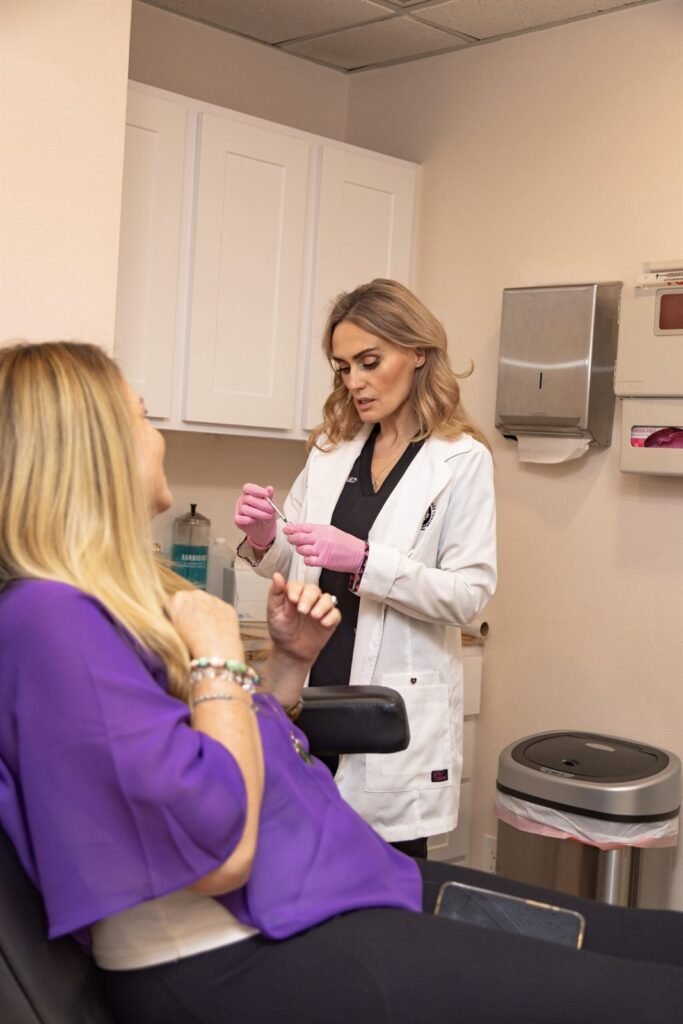
Regenerative, non-surgical hair restoration: PRP therapy with Dr. Natalya Borakowski, plus a compounded at-home topical for maintenance.
Find Your Pathway
When the Brush Holds More Hair Than It Should
Thinning on the crown, a part that keeps widening, postpartum shedding that never quite stopped. Most patients notice hair loss in photographs before they notice it in the mirror. At Desert Bloom in Scottsdale, non-surgical hair loss treatment is narrower than most websites suggest, and that is deliberate. Dr. Natalya Borakowski, NMD, offers one in-clinic injectable pathway, PRP hair restoration using the patient’s own platelets, and one compounded at-home topical (5% minoxidil, 1% finasteride, biotin) for daily maintenance between visits. No transplants, no laser caps in the treatment room, no “stem cell” marketing.
Before any protocol begins, Dr. Borakowski evaluates the underlying cause (genetic, hormonal, nutritional, or inflammatory), because treating a cause you have not identified is how patients end up cycling through treatments that were never going to work for them.
For the full PRP protocol, pricing, and what to expect session by session, see PRP hair restoration details.
At a Glance
Scope: One in-clinic treatment, PRP hair restoration (physician-performed, Dr. Borakowski), plus one at-home adjunct: compounded topical with 5% minoxidil, 1% finasteride, and biotin applied nightly. Protocol is 3 PRP sessions 4–6 weeks apart, then maintenance every 3–6 months. Results: reduced shedding at 4–6 weeks; density improvement by months 3–6. Pricing: $575/session or $1,500 for a 3-session package.
Provider & candidacy: All in-clinic treatment is performed by Dr. Borakowski. Best suited for early-to-moderate thinning with living follicles. Not appropriate for scarred or fully dormant follicles, because PRP cannot regrow hair in those zones. We do not offer hair transplant surgery, in-clinic low-level laser therapy, or stem cell injections.
Downtime & how to start: No downtime. Expect mild scalp tenderness for 24–48 hours and same-day return to work. Start with a consultation: Dr. Borakowski will identify the cause of your hair loss before recommending any protocol. No procedure is scheduled before a diagnosis is established.
Want to know which option suits you? Book a consultation with Dr. Natalya Borakowski, NMD
What Non-Surgical Hair Loss Treatment Covers at Desert Bloom
Non-surgical hair loss treatments aim to do three things: stimulate existing hair follicles, slow hormone-driven miniaturization (primarily DHT-driven androgenetic alopecia), and support scalp circulation. The wider range of non-surgical options includes PRP, low-level laser therapy, microneedling, topical minoxidil, oral finasteride and dutasteride, and scalp micropigmentation.
Desert Bloom’s program is intentionally narrow within that range: one regenerative injectable pathway, one compounded topical adjunct, and an honest assessment for patients whose hair loss is beyond what non-surgical options can address.
Most searches for non-surgical hair loss treatment are made by women and men with early-to-moderate thinning: a widening part, reduced density on the crown, postpartum shedding that lingered past six months, or diffuse telogen effluvium after a stressful period. If that describes you, the pathway that matches your situation is below.
Our Hair Rejuvenation Options
PRP Hair Restoration
Best for
Early-to-moderate androgenetic alopecia (male or female pattern), postpartum telogen effluvium, diffuse thinning across the crown or along the part line.
What makes it distinct
PRP uses your own blood. A single 30 mL tube is drawn, spun in a Tiger Aesthetics FDA-approved centrifuge kit, and the concentrated platelet layer, carrying PDGF, VEGF, IGF-1, TGF-β, and FGF-2, is injected into thinning zones. These growth factors stimulate dormant follicles, encourage new vessel formation, and extend the active (anagen) growth phase. Nothing external is introduced beyond your own biology.
Choose this if
You have living follicles that are underperforming (not scarred or fully dormant for years), you want the longest evidence base for injectable hair restoration, and you are prepared for a 3-session course spaced 4–6 weeks apart with quarterly maintenance afterward.
At-Home Topical (Compounded)
Best for
Daily maintenance between PRP sessions, or as a stand-alone starting point for patients who want to try a medical-grade topical before committing to injections.
What makes it distinct
Desert Bloom provides a compound pharmacy topical solution (5% minoxidil, 1% finasteride, biotin) applied nightly. For patients who want to layer, it can be combined with a derma roller and a patient-purchased LED helmet. This is an adjunct to a full protocol, used to hold progress between visits.
Choose this if
You are already doing PRP and want a daily habit that keeps the momentum, or your thinning is mild enough that Dr. Borakowski recommends starting conservatively before escalating.
How to Choose
- If your hair loss follows a genetic pattern (family history, gradual miniaturization on the crown or hairline): PRP hair restoration is the core pathway; topical finasteride/minoxidil supports it at home.
- If shedding started after pregnancy, weight loss, a stressful period, or a medication change: this is often telogen effluvium. PRP accelerates recovery; many patients also benefit from labs to check iron, thyroid, and vitamin D before starting.
- If your follicles are scarred, or you have been fully bald in a zone for several years: non-surgical options will not regrow hair there. Dr. Borakowski will tell you directly if that is the case.
- If you are pregnant or breastfeeding: defer all PRP; most topical agents are also deferred during pregnancy. Plan to start post-weaning.
- If you are on warfarin, heparin, or another anticoagulant, or have a platelet dysfunction disorder: PRP is not appropriate; the at-home topical can still be evaluated.
Not sure where you fall? A consultation with Dr. Borakowski clarifies it in one visit, and no procedure is scheduled before a diagnosis.
Candidacy: Who This Page Is For
Non-surgical hair loss treatment at Desert Bloom works best for patients with mild to moderate hair loss and living follicles. The treatments stimulate what is still there; they do not revive follicles that have been dormant for years in completely bald areas, and they do not reverse scarring alopecias (lichen planopilaris, frontal fibrosing alopecia, traction scarring) without medical co-management.

Good candidates
- Women experiencing postpartum or perimenopausal thinning
- Men with early androgenetic alopecia (Norwood II–IV)
- Women with diffuse thinning (Ludwig I–II) along the part line
- Patients who have tried topicals without the result they hoped for and want a clinical-grade pathway
- Patients supporting a prior hair transplant with regenerative maintenance
Not candidates at Desert Bloom
- Anyone looking for hair transplant surgery, which is not offered here
- Advanced baldness with scarred or permanently damaged follicles
- Active scalp infection or open wounds at the treatment site
- Platelet dysfunction disorders, current anticoagulant therapy, active hematologic malignancy
- Pregnancy and breastfeeding (deferred, not denied)
- Anyone expecting a single-session result, since this is a series and results build over months
Safety, Side Effects & What Cannot Be Promised
PRP uses your own blood, which makes allergic reaction extremely rare. The side effect profile is typical of any scalp injection: mild redness and tenderness for 24–48 hours, occasional pinpoint bruising, rare headache. There is no general anesthesia, no incision, and no downtime. Most patients return to work the same afternoon.
What non-surgical hair loss treatment cannot do
- It cannot regrow hair where follicles have been dormant for years or are scarred.
- It cannot stop DHT-driven miniaturization permanently. Maintenance is required or thinning resumes.
- It cannot replace surgical restoration for advanced Norwood V to VII patterns.
- It is not a single-session fix. Patients expecting visible change in two weeks are expecting something these treatments do not deliver.
Dr. Borakowski will give you realistic expectations at your consultation, not guarantees.
Pricing
| Treatment | Starting Price | Protocol |
|---|---|---|
| PRP Hair Restoration, single session | $575 | Performed by Dr. Borakowski; ~45 min |
| PRP Hair Restoration, 3-session package | $1,500 | 3 sessions, 4–6 weeks apart |
| Compounded topical (5% minoxidil / 1% finasteride / biotin) | Prescribed at consult | Nightly at-home; price varies by compound pharmacy |
Maintenance PRP is typically scheduled every 3–6 months after the initial 3-session course. Financing is available through CareCredit, Klarna, Affirm and Cherry.
Questions
Frequently asked questions
How long does non-surgical hair loss treatment take to work?
Most patients notice reduced shedding in 4–6 weeks. Visible density improvement typically shows at 3 months, with peak results around 6 months after completing the 3-session PRP course. Consistency matters. The patients who see the most meaningful gains are the ones who complete the full series and stay on maintenance.
How is this different from a hair transplant?
A transplant moves hair from one part of the scalp to another. PRP stimulates the follicles you already have instead of moving hair. PRP is appropriate earlier in the hair loss timeline, before advanced pattern loss; a transplant is the right call once follicles in a zone are fully dormant. Desert Bloom does not perform transplants.
Will I need to keep doing this forever?
If your hair loss is driven by androgenetic (DHT) miniaturization, as most pattern loss is, then yes, some level of maintenance is part of holding the result. Quarterly PRP plus daily topical is a common long-term pattern. If the driver was situational (postpartum, a stressful period) and has resolved, you may be able to stop after the initial course. Dr. Borakowski will tell you which pattern yours fits.
Can men and women both get PRP for hair?
Yes. PRP is effective for both male and female pattern thinning. The protocol and pricing are the same; injection density varies by pattern of loss.
Does insurance cover hair restoration?
No. PRP hair restoration and compounded topicals for hair loss are elective cosmetic procedures and are not covered by medical insurance. Financing is available through CareCredit, Klarna, Affirm and Cherry.
Why doesn’t Desert Bloom offer low-level laser therapy in the clinic?
Because LLLT works at home. Laser caps and helmets work best when patients use the device consistently (several sessions per week for months), which is a pattern of use that does not translate well to in-office delivery. If a patient wants to add LLLT, we recommend a reputable device for home use alongside PRP and topicals.
Not sure where to start? Book a consultation and we will look at your skin, explain your options and help you choose care that fits you.